
Crawling into bed on a freezing night, you reach for your heated vest instead of piling on another blanket. Who could blame you? It’s warm, it’s fast, and it feels like the obvious fix.
But before you drift off with that heating element against your chest, there’s something worth knowing. Sleeping in a heated vest isn’t as simple as it sounds.
The risks are real. They range from minor skin irritation to more serious problems like overheating and electrical faults. Whether it’s safe comes down to the specific vest you own and how you use it.
This guide covers the real dangers, the situations where nighttime use makes more sense, and the features to look for if staying warm through the night is non-negotiable.
Can You Sleep With A Heated Vest On?
The short answer: not recommended — at least not all night.
Most heated vests are built for active use. They’re not made for long contact with your skin while you’re asleep and can’t track what’s happening. That difference matters more than you might think.
Here’s the real issue: your body can’t pick up on warning signs while you sleep. A heating element running too hot against your ribs? You won’t notice. Fabric getting too warm? You won’t feel it. By the time any discomfort breaks through, skin irritation — or worse — may have already started.
Three main concerns to keep in mind:
- Overheating risk — steady heat during sleep raises your core body temperature in ways that daytime use does not
- Electrical safety — running the vest for hours increases the chance of battery strain or part failure
- Skin contact burns — direct, unbroken heat on the same skin spot for hours builds up damage over time
So, can you ever sleep in a heated vest? That depends on the product’s safety features — and how closely you stick to the rules around using it.
Is It Safe to Sleep With a Heated Vest On? (The Short Answer)
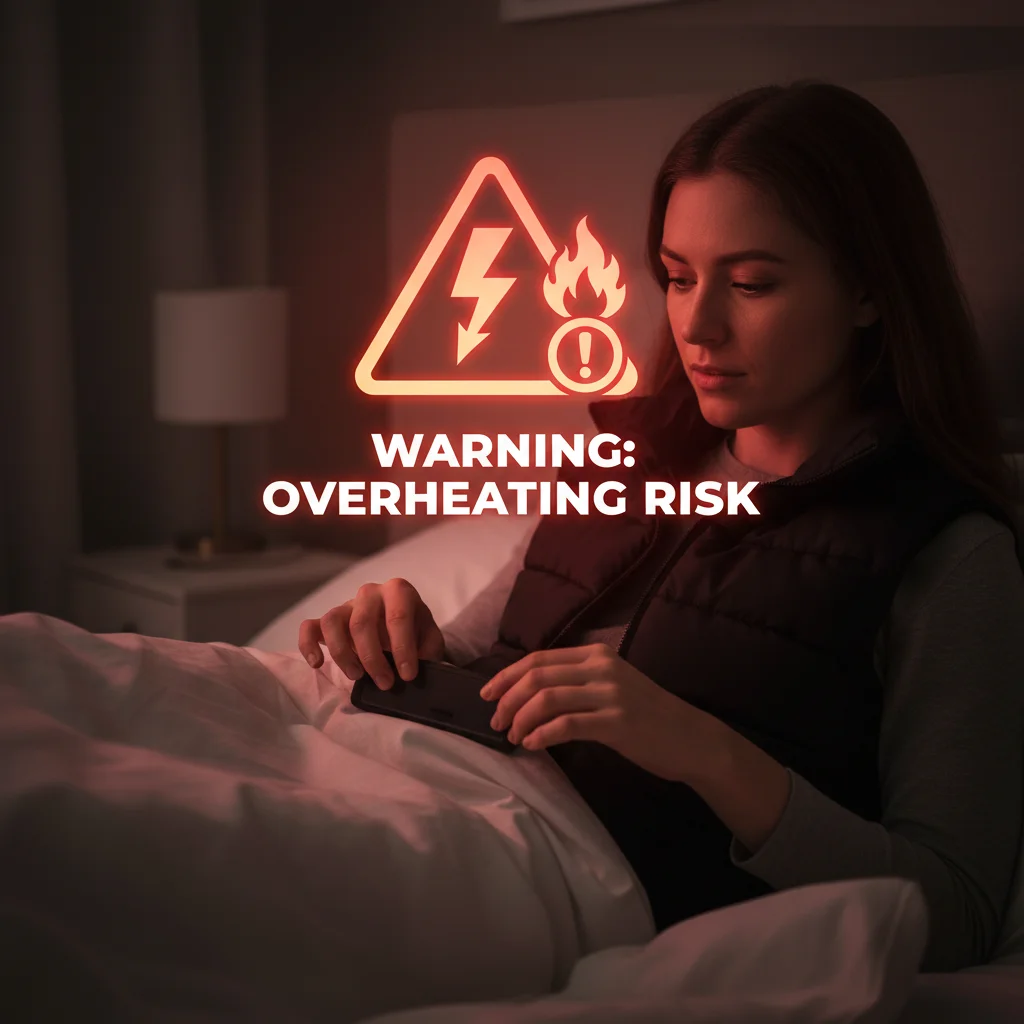
Most heated vest manufacturers — including major brands — warn against overnight use. This isn’t a disclaimer buried in fine print. It’s the actual answer.
Heated vests are built for daytime wear: awake, moving, aware. Sleep changes everything.
A few things go wrong once you’re lying down and unconscious that simply don’t happen when you’re upright and alert:
- Sleeping positions compress wires and heating zones — pressure builds up silently for hours
- Battery packs shift or disconnect — a 5V or 7.4V pack pinned under your body stops working the way it should
- Localized heat above 40°C (104°F) breaks down your skin’s ability to regulate temperature. Prolonged exposure reaches that point faster than most people expect
Brief, supervised use on the lowest setting? That’s possible. Eight hours unattended? That’s where real risk starts.
5 Real Risks of Sleeping With a Heated Vest (What Can Go Wrong)
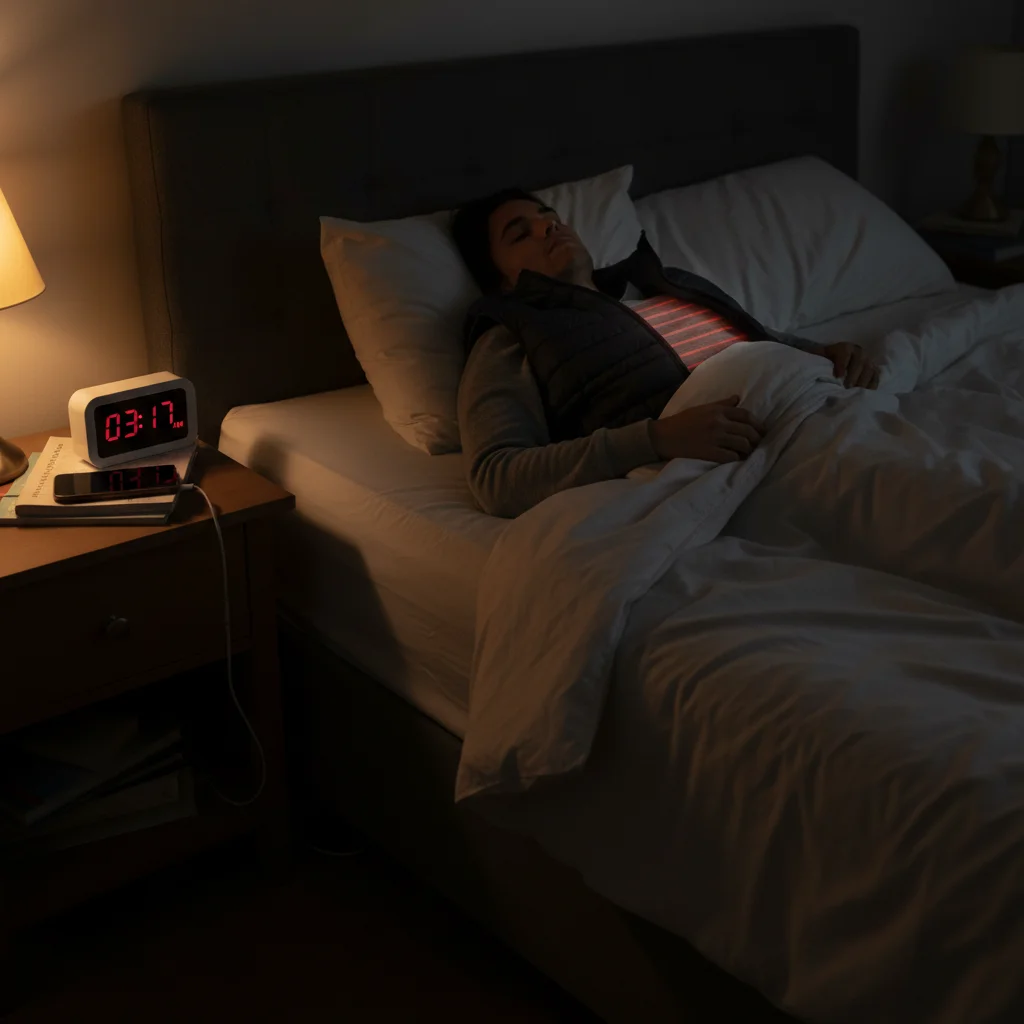
Let’s be specific about what goes wrong — because “it’s risky” isn’t useful on its own.
Risk 1: Low-Temperature Burns From Static Heat Contact
Burns don’t require a flame. They don’t even require heat that feels painful in the moment.
A heating zone pressed against the same patch of skin for hours causes real damage. Your body weight compresses it. You don’t move. Tissue damage builds up without any warning. This is called a low-temperature burn. It happens without waking you up. By morning, you’re looking at redness, blisters, and skin that took damage you never felt coming.
The burn risk is highest where the vest fits tightest: sides, lower back, chest panels.
Risk 2: Battery Strain and Electrical Faults
Japan’s consumer safety data recorded 35 heated apparel battery incidents in a single reporting year. More than half came from battery-related failures — not dramatic explosions, but small silent faults: leakage, overheating, short-circuit.
A 5V or 7.4V pack carries lower fire risk than higher-voltage designs. That’s a real advantage. But a battery pack pinned under your torso for eight hours faces physical stress it wasn’t built to handle. Pressure, heat, and hours of contact combined — that pushes components past their safe range.
Risk 3: Wire Compression and Hardware Damage
Every time you shift position, the internal wiring bends. Every hour you lie on a heating zone, the insulation weakens under that pressure. Sleeping on your back reduces the strain — but most people don’t hold one position all night. Frequent tossing and turning raises the chance of insulation breaking. That’s the failure that leads to electrical faults.
Risk 4: Disrupted Sleep From Thermal Overload
Your body needs to lower its core temperature to reach deep sleep. A heated vest works against that.
Research on heat stress recorded skin temperatures rising to 38.86°C (± 0.42°C), with heart rate climbing from 100 to 113 bpm — an 11% increase from thermal strain alone. The results: less deep sleep, higher resting heart rate, and reduced mental sharpness the next morning. The vest keeps you warm. It also chips away at your sleep quality in ways you won’t trace back to the heat right away.
Risk 5: Unsupervised Prolonged Exposure — Even With Auto Shut-Off
Here’s the detail most people miss: auto shut-off helps, but it doesn’t remove the risk. Heated vest manufacturers ban sleep use — not because the technology always fails, but because use beyond 8 hours without supervision removes every safeguard that depends on you being awake and aware.
A battery placed near the head or neck makes the hazard worse. Heat builds. You don’t respond. That gap between “device running” and “person monitoring” is where the real danger sits.
Who Should Never Sleep With a Heated Vest (High-Risk Groups)
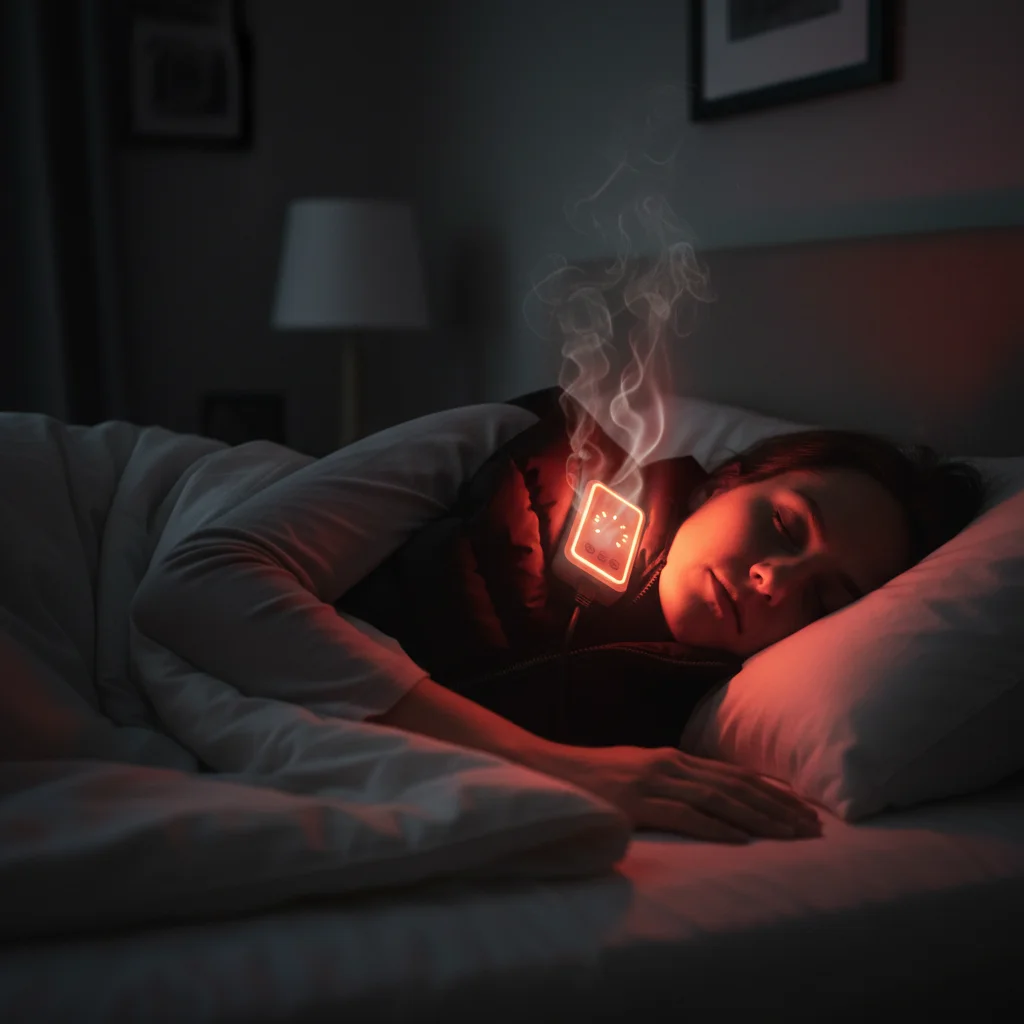
Some bodies have no room for error with overnight heated vest use. For certain people, the risks don’t just increase — they multiply.
Children and the Elderly
These two groups top the no-sleep list. The reason is simple: neither can manage body temperature or catch warning signs during sleep.
Children have thinner skin and weaker heat regulation. Heat that feels fine to an adult can damage a child’s tissue before any visible sign shows up. Older adults face the opposite problem. Their skin sensitivity drops, so pain signals arrive late — or not at all.
For both groups: no overnight use, period — no matter the setting, no matter the features.
People Who Toss and Turn
Active sleepers who shift position often create a real mechanical hazard. Every turn bends internal wiring. Every hour spent lying on a heating panel crushes insulation that wasn’t built for that kind of constant pressure. You wake up on the opposite side of the bed from where you started? That movement puts direct wire stress on the vest — the kind that causes electrical faults.
People With Circulation-Related Conditions
Here’s where things get tricky. The people most likely to want overnight heated vest use are often the ones who need to be most careful about it.
Raynaud’s disease is the clearest example. Poor circulation makes warmth feel like a must, especially at night. But the same circulatory problem that creates the need for heat also dulls the skin’s ability to sense when heat turns harmful. Low-voltage vests — 5V or 7.4V designs — cut the electrical risk. They don’t cut the skin contact risk. Auto shut-off helps. It still doesn’t make long, unsupervised use safe.
Better alternatives for Raynaud’s sufferers:
– Pre-warm your bed with the vest, then take it off before you fall asleep
– Switch to an electric blanket with automatic shut-off
– Layer thermal sleepwear or use an insulated sleeping bag instead
People With Chronic Pain or Sensitivity Conditions
You use a heated vest to manage chronic pain — back problems, muscle tension, joint stiffness — overnight use adds a layer of compounded risk. Pain conditions often change how skin feels. You may not notice localized heat building past a safe level. The vest does its job. Your skin pays the price.
Any medical condition that affects your circulation, skin sensitivity, or nervous system response means one thing: talk to a physician before using heated clothing in any sleep context.
If You Must Use It at Night: 6 Safety Conditions You Cannot Skip
Some nights, the cold wins. You’ve read the warnings, you understand the risks, and you’re still reaching for the heated vest. That’s a real situation — and it deserves a real answer.
These six conditions aren’t suggestions. They’re requirements. Skip any one of them and you’ve dropped a layer of protection that was doing real work.
Condition 1: Auto Shut-Off Is Required
A vest without an automatic timer has no business being near a sleeping body. Look for a model with a 2–8 hour auto shut-off. That one feature is what separates a device that stops on its own from one that keeps running until something fails.
Condition 2: Overheat Protection With Real Certification
Thermal sensors that cut power above 60°C aren’t optional — they’re the baseline. UL or CE certification means the vest went through 1,000+ test cycles under controlled conditions. A sticker on a product page means nothing. A certification mark means someone outside the company ran the tests.
Condition 3: Low-Voltage Battery Only
5V USB or 7.4V battery packs stay within a range that cuts burn and shock risk. Anything above 12V raises the danger level. Check the specs for a voltage number. No clear voltage listed? That’s your answer right there.
Condition 4: Run It on the Lowest Setting
Highest heat feels good. It’s also the setting most prone to pushing skin contact temperatures into harmful territory. The safe range for skin contact is 30–40°C. The lowest setting gets you there. The highest setting takes you past it.
Condition 5: Keep the Battery Pack Away From Your Head and Neck
Pack placement matters. Put it near your head or neck and you restrict blood flow. You also create a strong heat source right where your body is most exposed during sleep. Keep it at your lower back or hip — away from your airway, away from your face.
Condition 6: Never Charge and Wear at the Same Time
Charging while wearing adds electrical fault risk that no other safety feature can fix. Charge the battery first. Then put it on. One step at a time.
One More Rule Worth Keeping
Even with all six conditions met, cap your wear time at 2–3 hours. Not four. Not “just until I warm up.” Two to three hours keeps you on the safe side of the risk line. Past that point, the heat build-up, battery strain, and broken sleep all pile up together. The damage often doesn’t show up until it’s already done.
Safer Alternatives for Cold Sleepers (Heated Vest vs. Other Options)
The heated vest isn’t your only option — and for overnight warmth, it’s not even the best one.
Want to stay warm through the night? Tools built for sleep do that job more safely and more reliably. No trade-offs. No active electrical device strapped to your body while you’re unconscious.
Here’s how the main alternatives stack up:
Electric Blanket With Automatic Shut-Off
This is the most direct swap. Low-wattage electric blankets are built for sleep — not just adapted for it. They spread heat across a wide surface area instead of pressing it onto one patch of skin. The automatic shut-off is part of the core design, not an afterthought.
You get that same “instant warmth” feeling. No wiring against your body all night. For most cold sleepers, this is the practical upgrade worth making.
Thermal Sleepwear Layered With an Insulated Sleeping Bag
No batteries. No wires. No components that can fail at 3 a.m.
Merino wool base layers paired with a well-insulated sleeping bag hold body heat through the night. No electrical risk. No compressed hardware. No burn risk from skin contact. It’s a lower-tech answer — but for deep, uninterrupted sleep, lower tech often wins.
The Pre-Warm Method
Use your heated vest the way it was built to be used. Put it on 15–20 minutes before bed. Warm your sheets. Warm your core. Then take it off before you fall asleep.
You keep the heat benefit. You cut every overnight risk. Your bed stays warm. The vest stays off. Everyone wins.
| Option | Electrical Risk | Burn Risk | Sleep Quality Impact | Best For |
|---|---|---|---|---|
| Heated vest (overnight) | Moderate–High | Moderate | Negative | Not recommended |
| Electric blanket | Low | Very Low | Neutral | Most cold sleepers |
| Thermal layers + sleeping bag | None | None | Positive | No-tech preference |
| Pre-warm method | None (after removal) | None | Positive | Heated vest owners |
The pre-warm method deserves more credit than it gets. It costs nothing extra. No new purchase needed. It removes every risk tied to overnight use — and still gives you the core warmth that helps you fall asleep on a cold night.
What to Look for in a Heated Vest If You’re a Cold Sleeper (Buying Criteria)
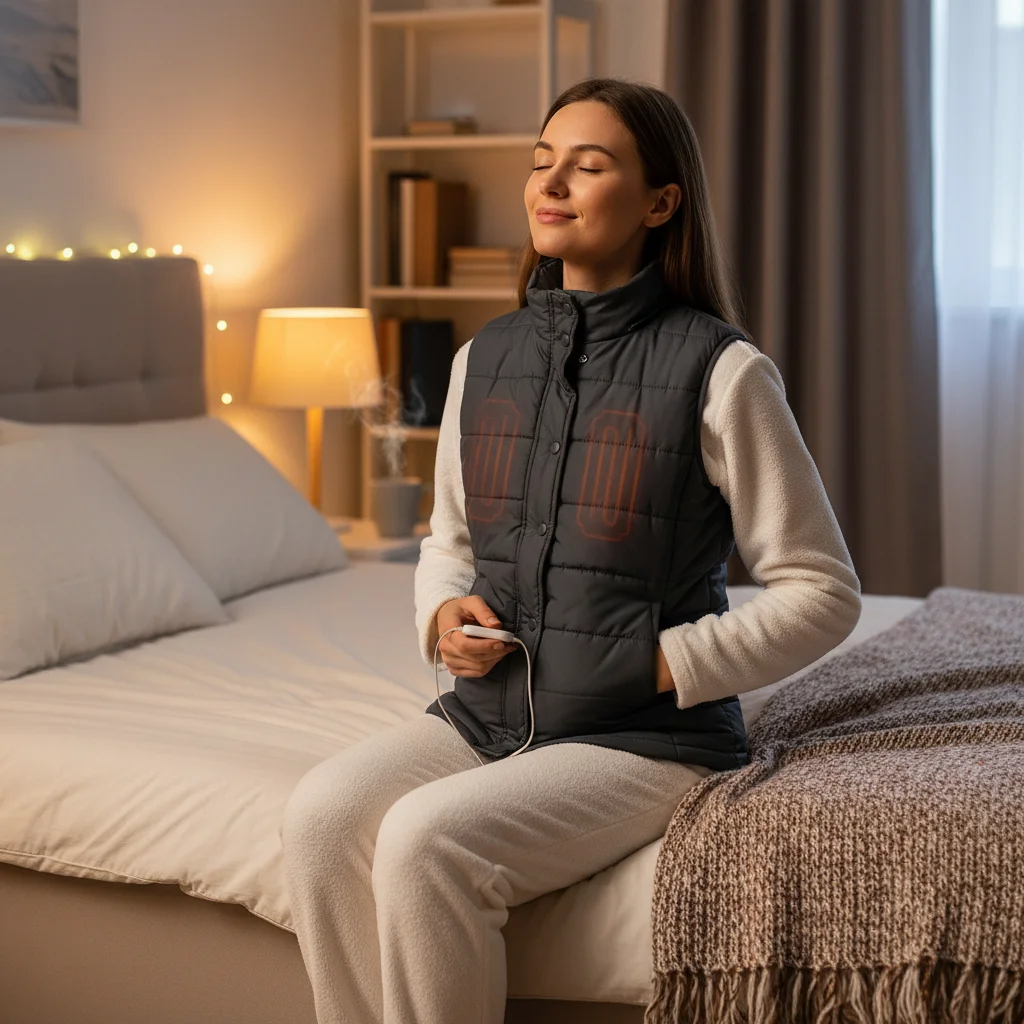
Not every heated vest works for sleep. A safe choice versus a risky one comes down to four specific features.
Adjustable Heat Settings
Low is the one setting that makes sense for sleep. Look for a vest with clear, defined levels — 38°C (100°F) on low, 45°C (113°F) on medium, and 55°C (130°F) on high. For nighttime use, stay at the bottom of that range. A single-button cycle between settings matters too. At 2 a.m., you’re not sitting up to scroll through a menu.
Fit That Doesn’t Fight You
A vest that fits too tight restricts circulation. It also traps heat in uneven patches. You want it to sit loosely over a base layer. It should move with your body without binding. Keep it lightweight too — heavy bedding plus a stiff vest turns sleep into a struggle.
Battery Life and Placement
Check the runtime on the lowest setting. That’s the number that counts for sleep. USB-C charging is worth having — it keeps things simple. Also, the battery pack needs to sit at your lower back or hip. A pack that digs into you mid-roll will wake you up fast.
Overheating Protection and Heating Zones
Thermal auto-shutoff is not a bonus — it’s a requirement. Some models use indicator lights to show active temperature (red, green, blue). Learn what those colors mean before you fall asleep.
Multiple heating zones — chest, collar, abdomen — spread warmth across your body. A vest with uneven coverage leaves cold patches. Cold patches push you to crank up the setting. Higher settings are where overnight risk goes up fast.
Recommended Heated Vests With Advanced Safety Features (2025)
Safety certifications and auto shut-off timers separate the vests worth buying from the ones worth skipping. Every model below cleared a basic threshold: thermal protection module, low-voltage design, and automatic shutoff built into the hardware — not just printed in the marketing copy.
1. Coolheatech Heated Vest — Top Pick for Safety-Conscious Sleepers
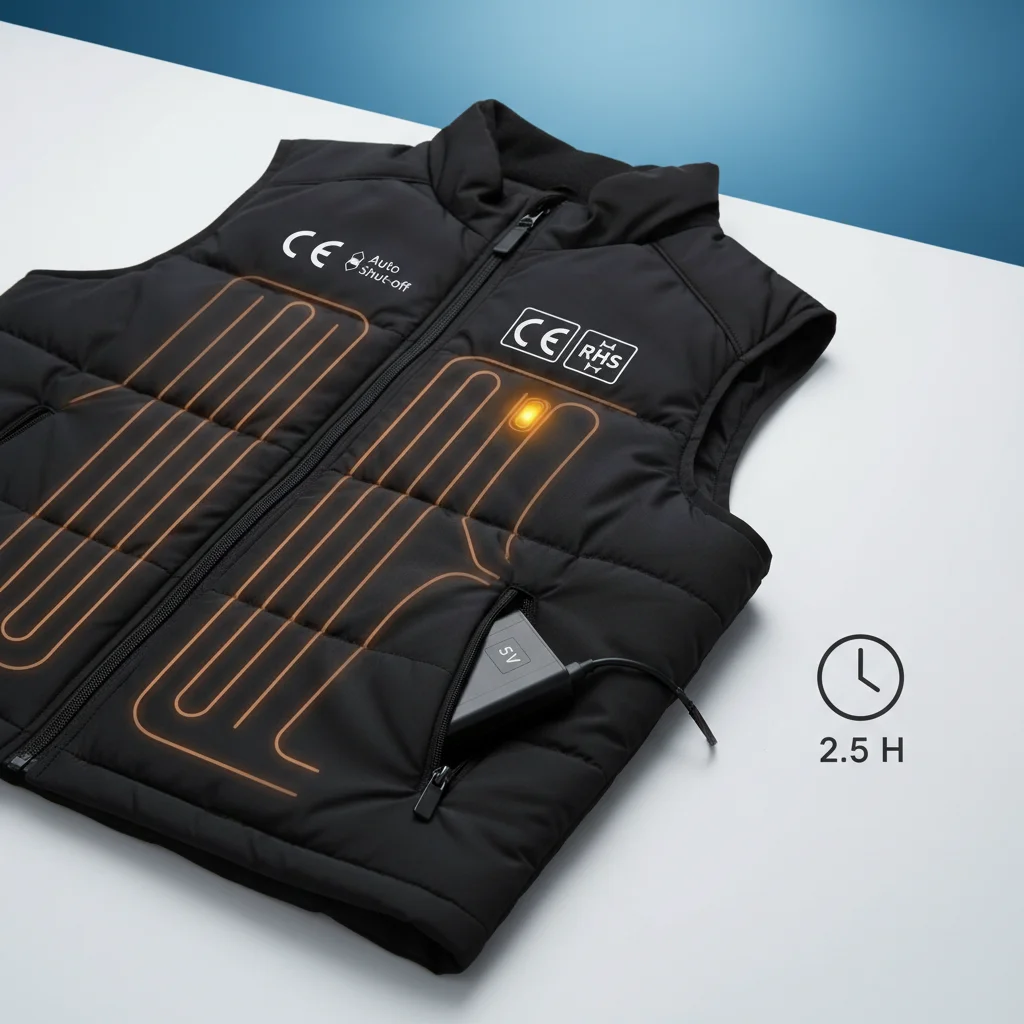
CE and RHS certified. Standard USB voltage — low enough that electrocution risk is off the table.
The auto shutoff kicks in at 2.5 hours. A built-in thermal protection module cuts power on its own if the vest overheats. So even if the timer misses it, the thermal sensor catches it. Six carbon fiber heating zones cover shoulders, waist, and abdomen. That’s broader coverage than most competitors at this price point.
User feedback points to one clear verdict: “One of the safest vests on the market.” For nighttime use, the 2.5-hour auto shutoff lines up with the 2–3 hour safe window outlined earlier in this guide. That’s not luck — it’s what a well-built safety feature looks like in real use.
2. Ororo Men’s Camo Heated Vest — Best Overall
UL-certified battery. You get a 10,000mAh lithium-polymer pack that holds 90% capacity after 500 charge cycles — real longevity, not spec-sheet padding.
Four carbon fiber zones: two chest panels, one full back, one collar. Heat activates in 30 seconds. Three settings run from 100°F (low) to 130°F (high). For sleep-adjacent use, stay at the bottom of that range.
Independent testing found users sitting in 10°F conditions 15% longer without fatigue. That’s heat retention you can measure — not just feel.
3. Doctor Prepare Heated Vest — Best for Custom Fit
No headline certification, but it has a working thermal protection module with overheat-detection auto shutoff. It runs on standard USB power banks, keeping voltage in the safe range.
The fit is the real standout. Adjustable construction means fewer pressure points. That matters a lot when you’re lying still for hours and can’t shift your weight around. Users sum it up simply: “Safety is a big win.” Hard to argue with that.
4. Tidewe Heated Vest — Best for Layering
10,000mAh battery with a collar zone that cuts heat loss from the neck — a detail most vests leave out. Heating zones cover chest, back, and collar. It’s thin enough to layer under a jacket without adding bulk.
One thing worth flagging: the manufacturer doesn’t specify auto shutoff details. So for any overnight-adjacent use, set an external timer as a backup. Don’t skip that step.
5. Venture Heat ProMax — Best for Versatility
Five heating zones cover the core and extended areas. The system warms up fast and runs efficiently on battery. No major certification on record, but no reported thermal failures in user testing either.
This one works best for daytime extended wear and fall-to-winter transitions. For sleep use, treat it as a pre-warm tool — not an all-night option.
Side-by-Side Safety Comparison
| Model | Auto Shutoff | Certifications | Heating Zones | Voltage |
|---|---|---|---|---|
| Coolheatech | 2.5 hrs | CE, RHS | 6 | USB (low) |
| Ororo Camo | Overheat cutoff | UL | 4 | USB / 10,000mAh |
| Doctor Prepare | Overheat cutoff | Thermal module | Adjustable | USB |
| Tidewe | Not specified | None listed | 3+ | 10,000mAh |
| Venture Heat ProMax | Efficient system | None listed | 5 | Not specified |
Cold sleepers who want the safest option should look at the Coolheatech vest first. It’s certified, runs on low voltage, and has a shutoff timer that matches the safe window this guide recommends. You don’t have to take it on faith. The hardware backs it up.
Conclusion
Your warmth shouldn’t come at the cost of your safety.
Sleeping with a heated vest on carries real risks — burns, overheating, and electrical hazards. No extra warmth is worth that. The good news? You don’t need to keep your vest running all night to stay comfortable. A solid pre-bed warm-up routine, paired with smart layering, keeps the cold out — no overnight risk needed.
But some people need that extra heat. You might be managing Raynaud’s, recovering from an injury, or just can’t shake the cold. A heated vest with automatic shut-off and low-voltage protection solves that problem. It gives you the warmth you need, with built-in safety features that work while you sleep.
That’s what CoolHeatech builds for. Check out their 2025 lineup of safety-certified heated vests — and sleep a little easier, in every sense of the word.