
You found the perfect heated vest — or at least, you think you did. But here’s the question most people skip right over: should it fit close to the body, or leave a little room to breathe?
The answer matters more than you’d expect. A bad fit means those heating elements stop working the way they should. Too much fabric, and the heat gets lost. Too tight, and it cuts off circulation around your core.
So whether you’re picking a size to wear under a shell jacket for heated vest layering, or just wondering if the vest in your cart will feel comfortable or suffocating — this guide covers what shapes warmth, comfort, and real-world performance.
Should A Heated Vest Fit Tight?
Here’s the short answer: snug, but not suffocating.
A heated vest works best sitting close to your body. The heating elements need skin contact to warm your core. Think base-layer fit, not baggy fleece. Too much space between the panels and your skin means heat escapes into dead air. It just doesn’t reach you.
That said, snug looks different depending on how you plan to wear it:
-
For everyday indoor-to-outdoor use → size down for a closer fit
-
For layering under a shell or over a midlayer → size up to keep movement easy and zipping smooth
Your measurements fall between two sizes? Go larger. Hip measurements are where this matters most. A vest that fits your chest but pulls at the hips will fight you every time you zip up.
What to measure (tape flat, standing straight):
– Chest — widest point, just under the arms
– Waist — fullest part
– Hips — widest point at seat level
The goal is simple. You want a vest that moves with you, holds heat close, and still lets you breathe.
Should a Heated Vest Fit Tight? The Short Answer
Snug is the word. Not tight — snug.
There’s a real difference. A heated vest that fits close to your body keeps warmth right where it belongs: against your skin. One that’s too roomy lets heat drift away into the empty space between the panels and your chest. You’re heating air at that point. A vest that’s too tight? It cuts off circulation — and that reduces how well your body spreads warmth to begin with.
The sweet spot looks like this:
-
Snug fit → close to body contours, full range of motion, comfortable across a full day
-
Too tight → limits arm movement, restricts breathing, impedes circulation
-
Too loose → heat escapes, heating elements lose contact with your core
Think of it less like outerwear, more like a performance layer. Heated vests are built for thermal transfer — not fashion. That relaxed fit that works great on a regular fleece vest? It works against the heating function here.
Many modern heated vests solve this with adjustable side straps and structured back panels. The vest sits close to your torso. It moves with you. No squeezing, no pinching — just a firm, comfortable hold. Snug should feel like a gentle hold — not a squeeze.
Why Fit Affects Heating Performance
The physics here are unforgiving — worth understanding before you size up “just to be safe.”
Heated vests work through direct thermal transfer. The heating elements — carbon fiber panels or graphene strips — need to sit flush against your body to move warmth well. Studies on radiant heat systems show distribution efficiency at 95–98% with good contact. Pull the vest too loose? That number drops to 80–93%. The gap isn’t small. You feel it within the first ten minutes of standing in cold air.
What Air Pockets Do to Your Warmth
A loose vest creates air pockets between the panels and your skin. This sounds minor. It isn’t.
Air is an insulator. Those small gaps act like a buffer zone — one that works against you. Research on direct-contact heating systems puts heat loss from trapped air at 20–40%. That’s not a rounding error. That’s the difference between staying warm on a ski lift and turning up the power setting every twenty minutes.
There’s also the movement problem. A loose-fitting vest acts like a bellows. Each arm swing, each bend at the waist, pumps fresh cold air through the gaps. Radiant heating models show net efficiency dropping below 80% once air exchange speeds up. Active use in a loose heated vest does the same thing.
Why Back and Chest Contact Points Matter Most
Your back and chest are where the heating elements are built to sit. The vest flush against those zones keeps heat distribution tight — within ±1°F across the panel area. Poor contact? That variance jumps to ±5°F. Some spots overheat. Others stay cold. Your body burns more energy trying to regulate, and comfort drops fast.
A snug fit keeps those panels in place. It’s not about compression. It’s about contact — and contact is what gets the warmth to you.
Snug Fit vs Loose Fit: Which Is Right for You?
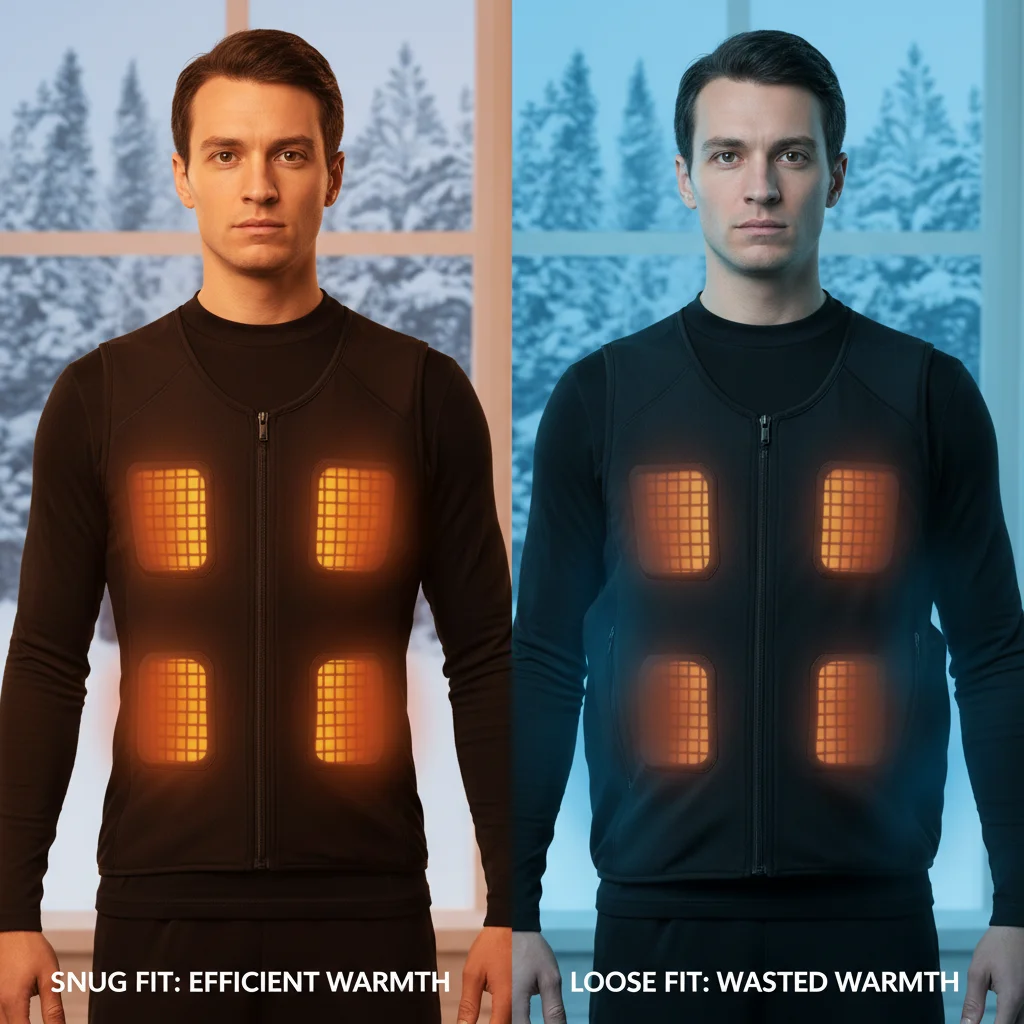
Most people size up “just to be safe.” It feels like the sensible choice — a little extra room, a little more comfort. But with a heated vest, that instinct works against you.
The fit you choose shapes everything: how much warmth reaches your body, how well you move, and whether layering feels easy or suffocating. Here’s how the two options compare across the areas that matter most.
Heating Efficiency
A snug fit can improve heat retention by 20–30% in cold conditions compared to a loose one. The reason is simple — contact. The vest sits flush against your torso. The heating panels transfer warmth straight to your core.
A loose fit creates air gaps — and those gaps cost you. Heating efficiency drops 15–25%, and panel temperatures can fall by 10–15°C in affected zones. You’re not just a little less warm. You’re a lot colder, a lot faster.
Movement and Activity
This is where things get more interesting. A looser fit gives you 25% more range of motion. That matters for trail running, snowshoeing, or any activity with big arm movements.
A snug fit does cut mobility by 15–20% in high-movement situations. But for steady, lower-intensity activity — a long winter walk, a ski lift, a cold-weather commute — snug performs well. It stays in place instead of shifting around with every step.
Layering Compatibility
Planning to layer? A loose fit handles 2–3 layers without binding. A snug fit works best with 1–2 layers — add too many underneath, and bunching becomes a real problem. It showed up in 77% of multi-layer fit tests.
The quick guide:
– Wearing under a shell jacket → size up one
– Wearing as your outer layer → true size or size down
– Dressing for extreme cold (think -20°C) → go snug — the efficiency difference is significant
The “Sizing Up for Safety” Trap
It feels logical. It’s not. Upsizing causes heating panels to shift 2–5cm from their intended position. That creates cold spots right where warmth matters most. Panel misalignment drives 33% of heated vest returns. That extra room also doubles return rates — a pattern that costs the apparel industry billions each year.
The honest answer: snug is almost always the right call. Loose only wins when deep layering or high-output movement truly demands it.
How to Wear a Heated Vest: Inner Layer vs Outer Layer Fit Logic
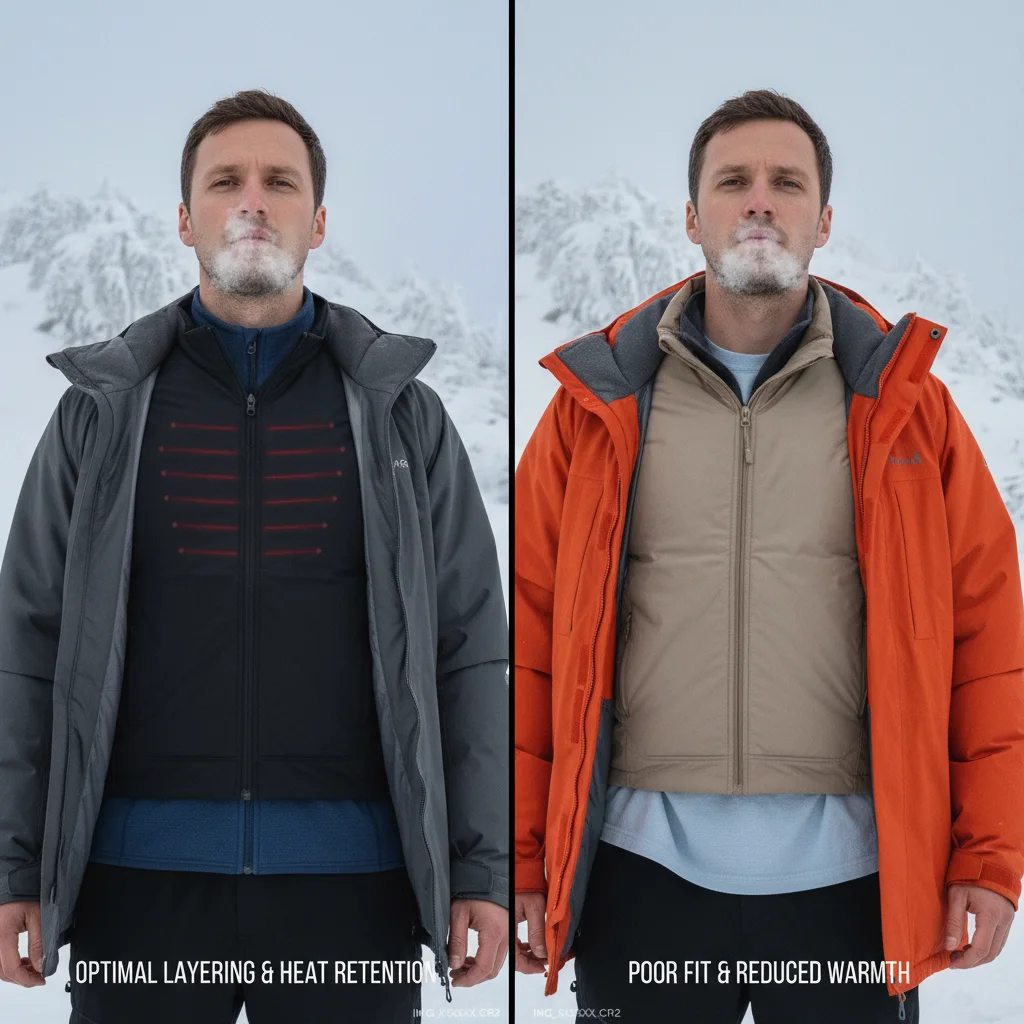
Vest placement in your layering stack changes everything — the sizing, the fit, and how much warmth reaches your body.
Wearing It Under a Jacket (Inner Layer)
Go snug. The vest sits between a base layer and an outer shell. Bulk is your enemy here. A close, true-to-size fit keeps the heating panels flush against your chest and upper back. Those are the two zones where warmth matters most. Fabric pooling between the panels and your skin cuts heat efficiency fast.
A quick test: raise both arms straight overhead. The vest rides up or pulls across the shoulders? Size up. It moves with you without resistance? You’re good.
Wearing It Over Everything (Outer Layer)
Size up by one. As your outermost piece, the vest needs room — 2 to 4 inches of torso space — to fit over whatever’s underneath without squeezing the heating elements. Compression flattens the panels. That breaks up even heat distribution. A little extra room protects the heat output.
The Layering Order That Works
For most conditions, this stack holds up well:
-
Base layer — a hydrophobic fabric like polypropylene, worn against bare skin
-
Heated vest — snug over the base, trapping warmth between layers
-
Outer shell — windproof, a touch looser, giving the vest room to do its job
|
Scenario |
Sizing |
Heat Efficiency |
|---|---|---|
|
Under a jacket |
True-to-size |
~100% |
|
Standalone outer |
+1 size |
~95% |
|
Hiking or running |
Snug + breathable shell |
90–100% |
|
Commute or low-movement cold |
Loose outer, full stack |
Maximum retention |
High-output activities like hiking or trail running call for a snug inner fit. Drop the mid-layer as your pace picks up. Static cold — a long commute or a ski lift — works better with a roomier outer fit and a full layered stack underneath. That setup holds heat longer.
The rule is simple: inner layer goes snug, outer layer gets room.
How to Measure Yourself for the Right Heated Vest Size
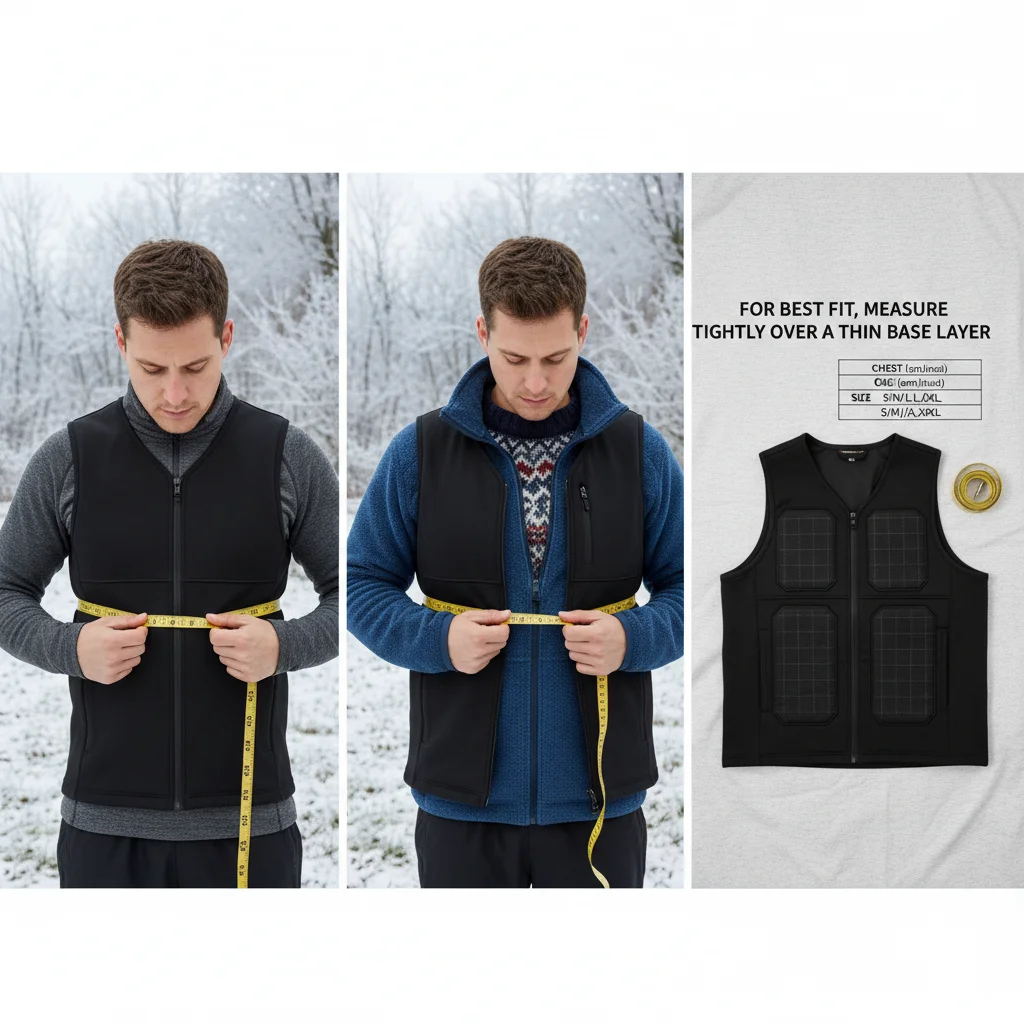
Sizing a heated vest isn’t like sizing a regular jacket. A regular jacket, you eyeball it. A heated vest, you measure. The heating elements sit in fixed positions. Miss the fit, and those panels miss your body.
Here’s what to measure, and how:
Take these five measurements (wear a thin base layer, not a bulky sweater):
-
Chest — the fullest point, just under your arms, tape parallel to the floor
-
Waist — your natural waistline at its widest
-
Hips — widest point at seat level
-
Shoulder width — seam to seam across the top
-
Back length — from the top of your shoulder down to your hip
Once you have your numbers, go straight to your brand’s size chart. Chest is your primary reference point. Your chest and waist land in different sizes? Take the larger one.
Planning to layer? Add 1–2 inches to your measurements before you size. Milwaukee puts it well: “If between sizes, size up.” That extra room lets the vest move over your mid-layers without squashing the heating panels.
After it arrives, run these four quick checks:
-
Heating panels lie flat — no bunching, no gaps
-
Arms raise overhead without any pulling at the shoulders
-
Zipper closes across your fullest chest point — no strain, no gaps
-
One or two fingers slip into the waist or hem with ease
All four pass? The fit is right. Zipper strains or back panels lift away from your spine? Size up before the return window closes.
One last note: men’s and unisex cuts run broader through the shoulders with a straighter body. Women’s cuts are narrower at the shoulder and more contoured through the waist. Sitting between the two? Try the women’s version first. The fit through the core tends to be closer — and core contact is where the warmth actually reaches you.
Signs Your Heated Vest Fits Too Tight (And What to Do)
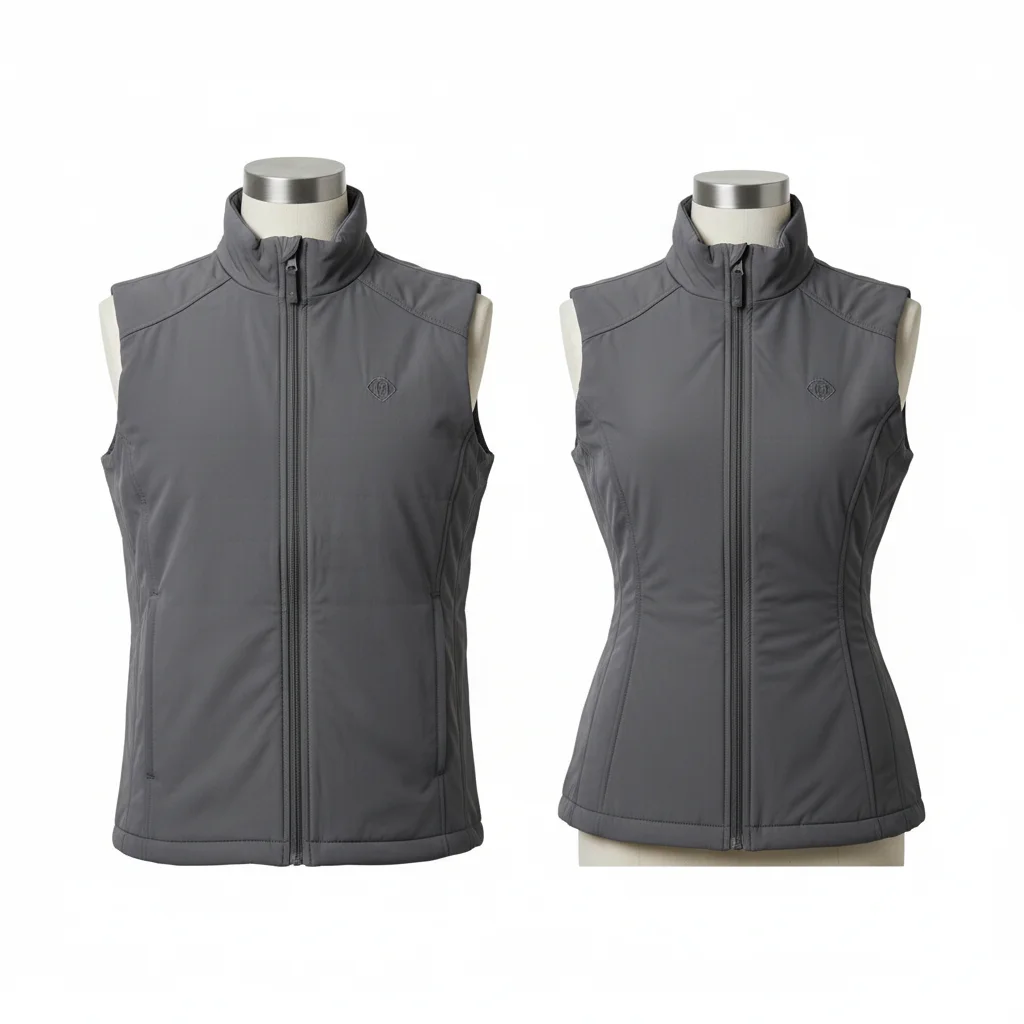
Some fits feel wrong from the first zip. Others take fifteen minutes of standing in the cold to reveal themselves. Here’s what to watch for.
Four signs your heated vest is too small:
-
The zipper stalls halfway — It stops at 50% or leaves fabric gaps wider than an inch at the chest. That’s not stiffness. That’s the wrong size.
-
Your arms can’t rise freely — Lift your arms above 90°. A tug of more than 1.5 inches means the vest is working against your movement, not with it.
-
Skin indentation after 10 minutes — Marks on your torso after a short wear mean compression. Not just snugness.
-
Heat makes it worse — The vest powers on, and your ribcage and hips expand. That adds about 1.5 inches of bulk. Tipping from “firm” into “binding” means the size is off.
Initial Discomfort vs. Too Small
New vests sometimes feel stiff. That’s normal. The real question: does the resistance fade — or get worse?
|
Fine to Keep |
Exchange It |
|
|---|---|---|
|
Zipper |
Zips smooth after a couple of wears |
Catches past 50%; gaps remain |
|
Arm raise |
Minor pull that softens with movement |
1.5″+ tug; discomfort after 5 minutes |
|
Heat test |
+1.5″ bulk feels tolerable |
Binding worsens; uneven hotspots appear |
What to Do
Size up by one if any measurement hits the upper limit of your current size. A 43″ chest, for example, belongs in a Large (44″–46″), not a Medium. Add 1.5 inches to your chest measurement to account for battery bulk. Also, if you tend to land near the top of a size range, look for vests with stretch panels. A 10–20% elastane build takes in heat expansion without the pull.
New size arrives? Put the batteries in and wear it for 15 minutes. Raise your arms. Zip it over a base layer. Anything that binds by more than an inch — exchange it before the return window closes.
Signs Your Heated Vest Is Too Loose (And Why It Matters)

Loose doesn’t feel wrong at first. It feels comfortable — generous, even. Then you’re standing outside in January, cranking the heat to maximum, still cold.
That’s the loose-fit trap. The heating panels aren’t warming you. They’re warming the air between the vest and your body. Air doesn’t need to stay warm for your commute.
Four signs your vest is running too large:
-
The panels float away from your skin — instead of lying flat against your chest and back, they lift off and lose direct contact
-
The back panel shifts with movement — slides left, rides up, drifts off-center with every arm swing
-
A ballooning sensation across the chest — that slight puffing of fabric as you inhale? That’s an air pocket forming right where a heating element should be sitting
-
You’re always reaching for a higher heat setting — needing maximum output just to feel warm at -10°C means the fit is working against you, not for you
What to Do About It
The fix is straightforward. Check your measurements against the size chart. Measure your chest under the arms. Measure your torso about an inch above the navel. The vest gaps more than an inch at either point? You’re in the wrong size.
Practical solutions:
– Size down — a chest of 41–43″ with a torso under 48″ belongs in a Medium, full stop
– Use the side adjustment straps if your vest has them — they pull slack fabric back toward the heating panels, which is exactly what they’re there for
– Layer a thin compression base layer underneath — skip the bulky fleece. A fitted underlayer presses the panels back into contact with your skin
One number worth keeping in mind: the battery pack adds 1.5 inches of bulk at the ribcage once installed. A vest that feels borderline loose before you power it on will feel clearly worse after. Factor that in before you stick with the size you have.
Heated Vest Fit FAQ: Quick Answers to Common Sizing Questions
We get sizing questions all the time — and you deserve straight answers, not vague reassurances. Here are the ones we hear most.
My vest feels tight across the chest. Is it too small?
Yes, most likely. Squeezing or restricted movement? Size up by one. Most heated vests run true to size, but the wiring and battery pack add real bulk once the vest is on. Take the Yellow Plus 2.0 as a reference — XS fits a 30–33″ chest. At 33.5″ or above, go with the Small.
It feels loose. Does that matter?
More than you’d think. A loose fit traps cold air between the panels and your skin. That air works against the heating, not with it. Aim for snug with no gaps across the chest. For the Mobile Warming Men’s Vest, a 39″ chest fits a Medium (40″), not the Small (38″).
Do heated vests run small in general?
Yes, often by about half a size to a full size. Internal wiring takes up space. Between sizes? Size up.
How do I measure for layering?
Measure your chest at its fullest point, right under your arms. Then add 1–2 inches for whatever you’re wearing underneath. Milwaukee Heated Gear follows this same logic — a 36–38″ chest lands in a Medium. Layering? Build in that extra room before you lock in a size.
Does height or torso length matter?
For most vests, chest and waist measurements carry the weight. A longer torso is worth a second look, though. The Red Grade Ultra lists height ranges right alongside chest measurements — Medium fits 5’5″–5’7″ with a 70–73cm neck-to-crotch length.
What about women’s sizing?
Women’s cuts are more contoured — narrower at the shoulder, shaped through the waist. GobiHeat Women’s starts at XS for a 30–31″ bust and scales up to XL at 38.5–40″. Measure at the fullest part of your bust. Caught between a men’s and women’s size? Try the women’s version first. The fit through the core tends to sit closer.
Conclusion
Fit isn’t just a comfort preference — it’s the difference between a heated vest that works and one that just looks the part. A snug, close-to-body fit keeps the heating elements where they belong: pressed against your core, doing their job. Too tight, and you’ve traded warmth for restriction. Too loose, and all that well-engineered heat disappears into dead air.
Your heated vest should feel like a warm hug. Not a straitjacket. Not a borrowed jacket from a larger friend.
You now know what a proper heated vest comfort fit looks like. You also know how layering changes the sizing equation. So you’re ready to shop with confidence. Use your measurements, think about how you’ll wear it, and don’t guess.
Find your perfect fit in our [Heated Vest Size Guide →] and feel the difference from the very first wear.