
Summer heat kills dogs. They can’t sweat like humans. This makes them prone to heat stroke in temps that feel just warm to us.
Panting helps, but sometimes it’s not enough. Thousands of pet owners buy cooling vests. But does wet fabric stop overheating? Or is it just costly peace of mind?
Evaporative cooling technology for dogs uses real science. It applies thermodynamics principles. Your dog’s body temperature can drop by 10-15°F.
You might need a custom dog cooling vest for your thick-coated Husky. Or you’re comparing cooling methods—evaporative, gel-based, or reflective. Understanding how these vests control your dog’s body temperature matters. This choice could save your dog’s life.
We’ll explain the technology. You’ll see how different types perform in real conditions. Proper usage separates a cool, safe pup from false security.
How Dog Cooling Vests Work: Evaporative Cooling Technology Explained
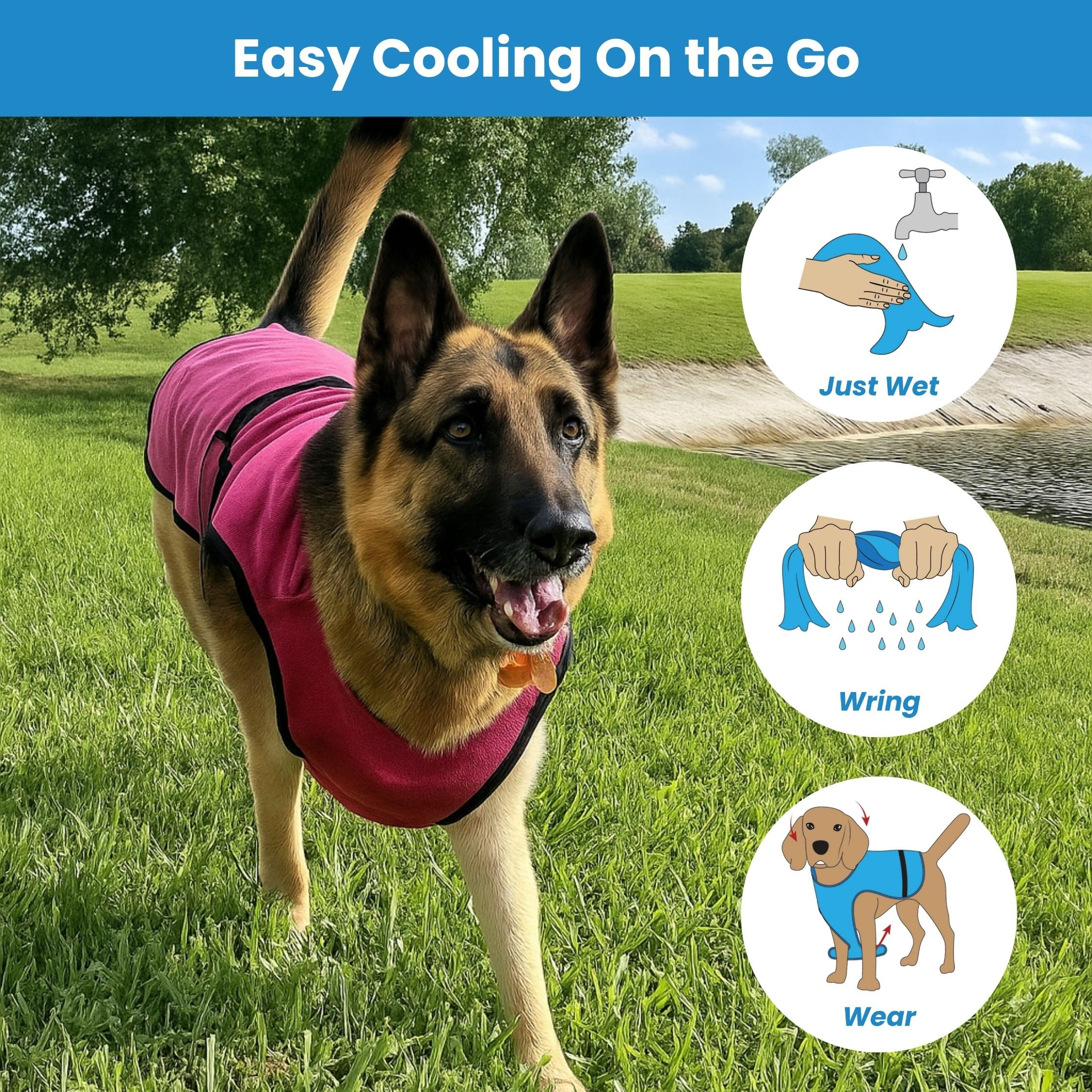
The physics behind evaporative cooling vests mirrors how sweating cools humans. Water changes from liquid to gas. This pulls heat away from your dog’s skin. The process creates a measurable temperature drop on contact surfaces.
Water-activated dog vests use a three-layer design. High-quality models like the Ruffwear Swamp Cooler show this structure well:
Layer 1 (Outer): Breathable mesh fabric handles two jobs. It wicks moisture outward for maximum air exposure. The material includes UPF 50+ protection, blocking about 98% of harmful UV rays. Light-colored exteriors reflect solar radiation before it reaches your dog’s body.
Layer 2 (Middle): This reservoir layer absorbs and stores water. Think of it as a sponge that releases moisture over time. How long this layer stays wet determines how long evaporation lasts.
Layer 3 (Inner): The comfort layer sits against your dog’s fur and skin. It stays fairly dry while transferring body heat outward. This design prevents the soggy feel of wearing wet fabric against the skin.
Activation and Real-World Performance
To use evaporative cooling technology for dogs, follow these steps:
-
Submerge the entire vest in water for complete saturation
-
Wring out excess water—you want damp, not dripping
-
Secure the vest covering your dog’s back, chest, and belly areas
-
Evaporation starts as soon as air flows across the surface
-
Re-soak when the vest feels dry to touch
Critical warning: A dry vest changes from cooling device to insulating blanket. It traps body heat and increases overheating risk.
Performance changes based on environmental conditions:
|
Climate Condition |
Measured Temperature Drop |
Effectiveness Rating |
|---|---|---|
|
Dry desert air (low humidity) with wind/sun |
80°F+ surface temperature drop within minutes |
Maximum—may overcool |
|
85°F ambient, moderate 70% humidity |
~6°F air temperature reduction (down to 79°F) |
Moderate—noticeable relief |
|
High humidity environments (>70% RH) |
0°F or negative (heat retention) |
Ineffective—avoid use |
Humidity: The Make-or-Break Factor for Canine Body Temperature Regulation
Evaporative cooling fails in humid climates. Air already holds maximum moisture, so water cannot evaporate from the vest. The wet fabric then acts as insulation. It traps your dog’s body heat underneath.
Best performance happens below 50% relative humidity. Efficiency drops fast between 50-70% RH. Above 70% humidity, switch to other dog heat stroke prevention methods.
Airflow matters just as much. Breeze or movement speeds up evaporation rates. A dog lying still in stagnant air gets minimal cooling benefit. Active dogs running in dry wind can experience big temperature drops—sometimes requiring monitoring to prevent overcooling.
How Evaporative Vests Compare to Other Technologies
Different cooling systems suit different conditions:
|
Cooling Technology |
Dry Climate Performance |
Humid Climate Performance |
Re-activation Needed |
|---|---|---|---|
|
Evaporative (water-activated) |
Excellent (80+°F drop) |
Poor to none |
Every 1-3 hours |
|
Phase Change Material (gel packs) |
Moderate cooling |
Consistent performance |
After gel warms (4-6 hours) |
|
Reflective coating |
Moderate (blocks sun) |
Moderate (blocks sun) |
None—passive design |
Gel cooling packs for dogs maintain steady temperatures regardless of humidity. They work through phase change rather than evaporation. But they provide less cooling in ideal dry conditions compared to evaporative vests.
Reflective cooling vest dogs use passive technology. Metallic or light-colored coatings bounce solar radiation. These work anywhere but offer the weakest active cooling.
For custom dog cooling vest applications, manufacturers often combine technologies. A vest might feature evaporative fabric with reflective outer coating and gel pack pockets. This hybrid approach works in multiple climate scenarios. It also provides backup if you forget to activate it properly.
Smart usage means carrying a water bottle on hikes for quick re-soaking. Monitor your dog for dog overheating symptoms: excessive panting, drooling, weakness, or bright red gums. Even the best thermoregulation in dogs technology needs attentive human supervision.
How to Use a Dog Cooling Vest: Step-by-Step Activation Guide

Set up your cooling vest the right way. This decides if your dog gets relief or stays hot in wet fabric that fails. Different cooling systems need different prep. Wrong steps waste time and risk your dog’s safety.
Water-Activated Evaporative Vest Activation
Most water-activated dog vests follow this tested setup:
-
Soak the entire vest in cold water for 1 hour before first use. Later uses need just a few minutes. Full soaking helps the middle layer absorb the most water.
-
Wring out excess water with a firm squeeze. The vest should be damp all over, not dripping. Water running off means lost cooling power. Pat the outside with a towel to remove surface wetness.
-
Secure the vest on your dog using the adjustable straps. Cover the back, chest, and belly where major blood vessels run close to the skin. Make it snug enough to stay in contact. Leave room to slide two fingers under the vest. This keeps airflow moving without squeezing too tight.
-
Check the vest every 30-60 minutes by touching the outside. Feels dry? Time to re-soak. Extreme heat or low humidity makes this happen faster.
-
Re-soak several times during activity. Carry a collapsible water bowl or find streams for quick dunks. Keep the fabric wet for best results.
Phase Change Material (PCM) Cooling Vest Activation
Gel cooling packs for dogs use a different setup method:
-
Remove gel packs from the vest pockets. Check the maker’s guide for freezer or fridge storage. Some brands want freezer storage. Others say use the fridge to avoid packs getting too cold.
-
Chill packs for the recommended time. Freezer time runs 2-4 hours. Fridge chilling takes 6-8 hours but gives gentler, longer cooling.
-
Insert chilled packs into vest pockets right before use. Most designs place pockets along the spine and across the chest for best cooling.
-
Secure the vest on your dog once all packs are loaded. Gel packs add weight, so you may need to adjust straps more than usual.
Gel packs hold cooling for 4-6 hours based on outside temperature. They work steady no matter the humidity level.
DRY® Technology Activation (Newer Vest Models)
Some advanced breathable mesh dog vests use DRY® systems:
-
Open the valve cap on the vest’s outside.
-
Pour the right water amount into the valve opening. Check your product guide for exact volume. Too much water cuts effectiveness.
-
Spread water through the vest by sliding and pushing your hands across all sections. This moves moisture through internal channels.
This system works faster than old-style soaking. Plus, it makes less mess.
Fit Verification for Maximum Cooling Efficiency
Good fit affects cooling power. A loose vest creates air gaps that block heat transfer. Too tight stops airflow and causes discomfort.
Size matters for different breeds: Brachycephalic breeds (Bulldogs, Pugs) need chest coverage first. Long-coated breeds (Huskies, Malamutes) do better with more surface coverage. Puppies and seniors may need gentler cooling with shorter wearing times. Giant breeds need custom dog cooling vest options for full coverage.
Test the vest at home before outdoor trips. Watch for rubbing, movement issues, or signs your dog wants it off. A good-fitting vest should feel like part of your dog’s summer dog safety gear—there but not annoying.
Custom Dog Cooling Vest: Tailored Solutions for Different Breeds
A Greyhound and a Golden Retriever standing side-by-side need different cooling strategies. Research shows that the same vest produces opposite results across breeds. Some dogs cool down well. Others get minimal benefit or even overcool to dangerous levels.
Breed-specific body types drive these differences. Double-coated breeds, flat-faced dogs, giant breeds, and working dogs each face unique heat challenges. Off-the-shelf vests often miss these key variations. Custom dog cooling vest solutions address coat density, body mass, chest depth, and breed-specific heat risks.
Why Standard Vests Fail Certain Breeds
Thermal imaging studies on double-coated dogs at 55% humidity show dramatic temperature differences across body regions. The head and uncovered side areas measure 38-40°C without protection. Vest-covered middle sections drop 2-4°C lower. Inside the vest after removal, readings confirm 35-37°C temperatures. This proves cooling penetrates thick fur layers.
But this same vest creates problems for thin-coated breeds. Greyhounds in controlled studies got too cold wearing evaporative vests during moderate exercise. Their minimal body fat and thin coat let heat escape fast. The vest pushes this natural cooling beyond safe levels.
Golden Retrievers present another puzzle. Despite their thick double coat, some studies show minimal cooling effect from standard vests. The dense undercoat creates a barrier that blocks moisture from touching skin. Water sits in outer guard hairs. It never reaches the body surface where evaporative cooling happens.
Coat Type Determines Vest Design Requirements
Double-coated breeds (Huskies, Malamutes, German Shepherds, Golden Retrievers) need maximum surface coverage with extended contact time. Their coats hold heat like thermal blankets. Custom dog cooling vest designs for these breeds should feature:
-
Increased water reservoir capacity: Standard vests hold about 0.5L (2 cups) of water. This works for 30 minutes of activity. Double-coated breeds benefit from 50-75% more capacity. This helps penetrate dense fur layers and maintain longer cooling periods.
-
Compression design elements: Light pressure helps moisture reach through guard hairs to the skin surface. Without compression, water evaporates from the outer coat. The dog’s body stays hot underneath.
-
Extended back and chest panels: Cover maximum body surface area where thick fur traps the most heat. Standard vests often leave lower chest and stomach areas exposed. These are key cooling zones for heavily-coated dogs.
Testing confirms these modifications work. A double-coated dog walking 30 minutes at 28°C (82°F) wearing a proper evaporative vest maintains coat temperatures below air temperature. The same test at 34°C (93°F) for 15 minutes produces similar cooling results.
Thin-coated breeds (Greyhounds, Whippets, Vizslas, Boxers) require gentler cooling technology:
-
Reduced coverage area: Vest panels covering just the back and upper chest prevent overcooling. Leave lower body and leg areas exposed for natural heat release.
-
Phase change material preference: Gel cooling packs for dogs provide controlled, steady cooling without the sharp temperature drop of evaporative systems. PCM vests reduce core temperature by 0.492°C at 15 minutes post-exercise. This is effective but less intense than evaporative cooling’s 0.769°C drop.
-
Shorter wear duration: Limit vest use to high-intensity activity periods. Remove during rest breaks to prevent excessive cooling.
Brachycephalic breeds (Bulldogs, Pugs, French Bulldogs, Boston Terriers) face unique challenges. Their compromised breathing makes canine body temperature regulation very difficult. These breeds need:
-
Priority chest coverage: Focus cooling on the chest area where the heart and major blood vessels are. Chest cooling provides faster core temperature reduction than back coverage alone.
-
Breathable mesh dog vest construction: Avoid heavy, restrictive fabrics that further limit breathing. Ultra-lightweight materials with maximum airflow keep breathing effort minimal.
-
Hybrid technology: Combine evaporative cooling with reflective cooling vest dogs coating. The reflective outer layer blocks solar heat before it reaches the body. The inner evaporative layer provides active cooling. This dual approach offers maximum protection for heat-vulnerable breeds.
Custom Sizing for Giant and Barrel-Chested Breeds
Standard vest sizing stops around 36 inches in girth. Great Danes, Mastiffs, Saint Bernards, and heavily-muscled breeds like American Bullies need custom measurements:
-
Neck-to-tail length: Ensures full back coverage without restricting movement
-
Chest circumference at widest point: Accounts for barrel-chested builds and deep chests
-
Stomach band extensions: Secures the vest on deep-bodied breeds where standard straps don’t reach
-
Weight distribution: Heavier fabric and gel packs require reinforced strap attachment points on large dogs
For working dogs—search and rescue K9s, police dogs, military dogs—cooling vests serve operational needs beyond comfort. Field studies show vests slow core temperature rise during extended work periods. This extends safe working time in hot conditions.
These dogs often work in full sun wearing tactical harnesses and carrying equipment. Custom dog cooling vest solutions for working breeds work with existing gear:
-
Modular attachment systems: Compatible with duty harnesses, avoiding strap overlap
-
Quick-release mechanisms: Handlers need to remove vests fast if the dog enters water or tight spaces
-
Durability standards: Reinforced stitching, tough materials, and heavy-duty closures survive rough conditions
Summer exercise data reveals the stakes. Dogs post-exercise show rectal temperatures 2.5°C higher than core body temperature. Without cooling help, recovery exceeds 60 minutes. Evaporative cooling vests cut this recovery time a lot. The measured reduction in core temperature is 0.427°C overall compared to no vest (p=0.012). Maximum temperature without vest protection reaches dangerous 41.22°C post-exercise.
Selecting the Right Custom Configuration
Match vest technology to your dog’s specific profile:
For double-coated breeds in dry climates: Evaporative vests deliver 2-4°C sustained cooling across 4-hour periods. The 30-minute surface temperature drop stays consistent throughout activity. Choose models like the Cool Dog Wrap or K9 Cool Coat with Oasis material for better breathability.
For thin-coated breeds or humid environments: PCM vests avoid overcooling risks and maintain function regardless of humidity levels. Though less strong than evaporative cooling (0.492°C vs. 0.769°C reduction at 15 minutes), they provide safer, steadier temperature control.
For combination conditions: Hybrid designs balance multiple technologies. Reflective outer coating blocks solar heat in all climates. Evaporative layers activate in low humidity. Gel pack pockets offer backup cooling when moisture fails.
Breed-specific customization transforms cooling vests from general accessories into precise dog heat stroke prevention tools. Understanding your dog’s unique heat profile—coat type, body mass, breathing capacity, activity level—guides the right custom configuration. This targeted approach boosts cooling power while removing the dangers of one-size-fits-all solutions.
Conclusion
How cooling vests work for dogs – this knowledge helps you protect your furry friend during hot summer months. Evaporative cooling mimics natural sweat. Reflective designs use gel packs. The right vest makes the difference between a safe outdoor trip and heat stroke.
The key points? First, activation matters. Water-activated vests need enough soaking time to work well. Second, breed type counts. What fits a compact Beagle won’t work for a thick-coated Husky. Third, cooling vests prevent problems. They don’t fix emergencies. Watch your dog’s behavior. Use the vest with shade, water, and smart exercise times.
Ready to find your custom dog cooling vest? Check your dog’s size first. Look at coat type. Consider activity level. Got a working dog or service animal? Unique breed needs? Custom options match your specific requirements. Your dog can’t tell you they’re too hot. But you can stay ahead with the right cooling tech. Don’t wait for warning signs. Prepare before the next heatwave. A dog cooling vest is more than an accessory—it’s a lifeline in summer. By understanding how does a cooling vest work for dogsand choosing the right style (large/small/thick-fur), you can protect your pup from overheating. Pair it with a dog cooling mat for home, a bandana for extra flair, and always follow our sizing and care tips.
At ICE Bear, we’re passionate about keeping pets cool. Explore our collection of custom dog cooling vests today, and give your furry friend the gift of summer comfort. After all, a cool dog is a happy dog!