
Every summer, dog owners watch their furry friends pant on hot days. They wonder: do those popular cooling vests work, or are they just overhyped?
Heat stroke kills dozens of dogs each year. Temperatures keep climbing. So the question “do dog cooling vests work?” matters for your dog’s safety.
The short answer? Yes, but with key points most manufacturers won’t tell you.
Climate conditions affect how well these vests work. Vest design matters too. How you use them makes a big difference.
We’ve looked at controlled temperature studies, veterinary insights, and real-world testing data. These vests can drop your dog’s body temperature by 10-15°F in the right conditions. But sometimes they’re useless.
You’ll learn which situations work best. This helps you make a smart choice that could save your dog’s life this summer.
How Dog Cooling Vests Work: The Science Behind Temperature Regulation

Dogs can’t sweat through their skin like humans do. They cool down by panting. But panting stops working well in high heat. Cooling vests use basic physics to lower your dog’s body temperature from the outside.
The Evaporative Cooling Process
Most cooling vests use evaporative cooling. It’s the same principle that makes you feel cold stepping out of a pool on a windy day. Here’s what happens:
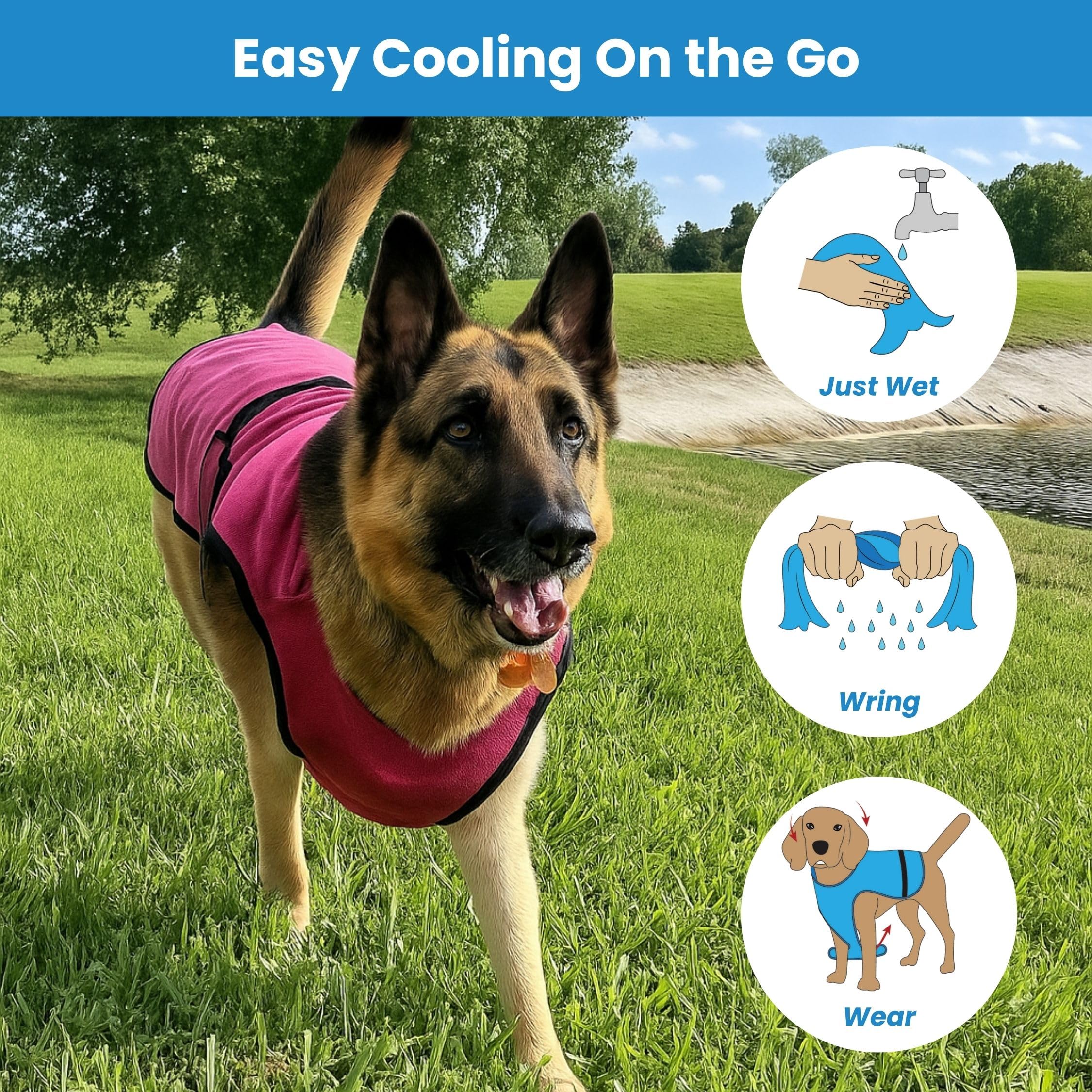
Soak the vest in water for 2–5 minutes until saturated. An XL vest absorbs about 400 grams of water. It jumps from 380g dry to 780g wet. Wring out excess water. Place it on your dog.
Water evaporates from the vest fabric. It absorbs latent heat—the energy needed to turn liquid into vapor. This energy gets pulled from your dog’s skin and the vest material. The result? Skin temperature drops. This cools blood flowing near the surface.
When Physics Works Against You
Heat moves through four pathways: conduction, convection, radiation, and evaporation. Here’s the critical point manufacturers don’t tell you: air temperature above your dog’s body temperature (around 38.5–39°C or 101–102°F) changes everything. The first three pathways add heat to your dog instead of removing it.
Evaporation becomes the only effective cooling route in extreme heat. But there’s a catch—high humidity kills evaporation. Air saturated with moisture stops water from evaporating off the vest. Your dog’s thick fur traps still air against the skin. This creates insulation that blocks heat transfer. The vest overcomes this barrier by placing evaporating water over the trunk. Major blood vessels run close to the surface there.
Real Temperature Drops Measured in Working Dogs
A military working dog study tracked 13 dogs during outdoor exercise in warm conditions. The data showed concrete results:
Dogs wearing evaporative cooling vests had core temperatures 0.623°C lower right after exercise compared to no vest (p = 0.011). Fifteen minutes into recovery, that gap widened to 0.769°C (p = 0.008).
Phase-change material vests (PCM) use gel packs that absorb heat while melting. They produced a 0.492°C reduction at the 15-minute mark.
These numbers matter. Dogs without vests reached 41.22°C core temperature after exercise. That’s close to heat stroke territory. University of Florida research found that dogs in hot summer conditions needed over 60 minutes to return to baseline without cooling help. Post-work rectal temperatures spiked 2.5°C higher than core readings. This signals severe overheating.
Both vest types sped up cooling. Evaporative vests delivered the largest reduction with adequate airflow and moderate humidity.
Scientific Evidence: What Research Shows About Effectiveness
The cooling vest market floods pet owners with claims. Most studies have weak statistical proof. This undermines their conclusions.
The P-Value Problem in Current Dog Cooling Research
Most published cooling vest studies use p < 0.05 as proof of effectiveness. This threshold seems scientific. But it means 3–5:1 odds that the vest works versus random chance. Pet owners don’t realize how weak this evidence is.
Here’s the problem: researchers report results with p-values between 0.01 and 0.05. 17–25% of those findings are false positives. Your dog’s safety shouldn’t rest on coin-flip odds.
The military working dog study hit p = 0.011 for post-exercise cooling. That falls into the marginal zone. Statistical experts now push for p = 0.005 or stricter. This cuts false findings by over 5 times. Tighter standards drop the false-positive rate below 4% instead of 20%.
Sample Size Reality Check
Small studies dominate dog cooling vest research. The typical trial tracks 10–20 dogs. This creates unreliable results.
You need 69 dogs per group to detect a 0.3 standardized effect size (a modest but real cooling benefit) with 80% confidence at standard significance levels. Raise the bar to p = 0.005? Now you need 130 dogs per group.
For strong evidence (p = 0.001), sample sizes must jump from 112 to 172 dogs per group. Most published studies fall far short of these numbers. The military study’s 13 dogs wouldn’t meet strong evidence standards despite showing positive results.
Lab Results vs. Real-World Performance
Lab studies test vests under controlled conditions. Dogs walk on treadmills indoors. Handlers monitor every variable. These efficacy trials show what’s possible in ideal scenarios.
Your backyard isn’t a lab. Real effectiveness trials need:
-
Regular pet owners (not trained handlers) putting vests on their dogs
-
Typical outdoor environments with variable wind, shade, and humidity
-
Mixed breeds with different coat types and activity levels
-
Multi-week testing to confirm sustained benefits
Zero published studies meet all these real-world criteria for dog cooling vests. The evidence gap between “works in the lab” and “works for your retriever on a summer hike” remains huge.
What Strong Evidence Looks Like
Bayesian analysis offers clearer standards. Significant findings need Bayes factors of 25–50:1 favoring effectiveness (about p ≈ 0.005). Strong results require 100–200:1 odds (p ≈ 0.001).
Current research delivers weak-to-moderate evidence at best. The temperature reductions measured in working dogs show promise. But the statistical foundation needs strengthening before “yes, they work” claims hold up to scientific standards.
This doesn’t mean vests are useless. The research quality lags behind the marketing hype. This distinction matters for informed pet owners.
Cooling Vests: What Works and What Doesn’t
Cooling vests don’t fit every situation. Lab tests using thermal manikins over 8 hours show big differences. Performance varies by vest type, environment, and how long you use them.
Powered Vests Win for All-Day Heat
Powered cooling vests beat all other types for preventing dog heat stroke during long periods. Air-cooled models like the VRTX deliver 41 W·m⁻² cooling power across 8 hours. Total cooling hits 331 W·h·m⁻²—three times what passive vests can do.
Liquid-cooled vests give you 17 W·m⁻² average power. Steady cooling beats peak output for summer dog safety during full-day outdoor events. Active vests work best for:
-
Dogs facing 6–8 hours of constant heat (field trials, outdoor competitions)
-
Situations with power sources for battery recharging
-
Temps above your dog’s normal body heat (over 38.5°C/101°F)
The catch? These vests are heavy, complicated, and expensive. Most casual pet owners won’t find them practical.
Gel Pack Vests Shine During Short, Intense Activity
Phase-change material vests use frozen gel packs for strong but short cooling. Top models like the STA hit 65 W·m⁻² peak cooling—stronger than any other passive vest. Total capacity reaches 164 W·h·m⁻².
But there’s a key limit: these cool for just 3–3.5 hours. POLAR and GTEK models last about 3 hours. The weakest PCM insert (IH 29) hits just 16 W·m⁻² peak power.
Gel pack cooling vests work best for:
-
Activities lasting 2–4 hours like afternoon park walks
-
Stop-and-go intense exercise with rest breaks
-
Times you can refreeze packs between uses
A soccer heat study shows this well. Eight male athletes wore cooling vests during 15-minute half-time breaks in 35°C/50% humidity. Second-half performance jumped big—589W mean power with vests versus 561W without during the third trial.
Evaporative Vests Need the Right Conditions
Evaporative cooling dog vests need specific air conditions to work. They give mild but long cooling—up to 113 W·h·m⁻² total capacity with average power of 14–23 W·m⁻².
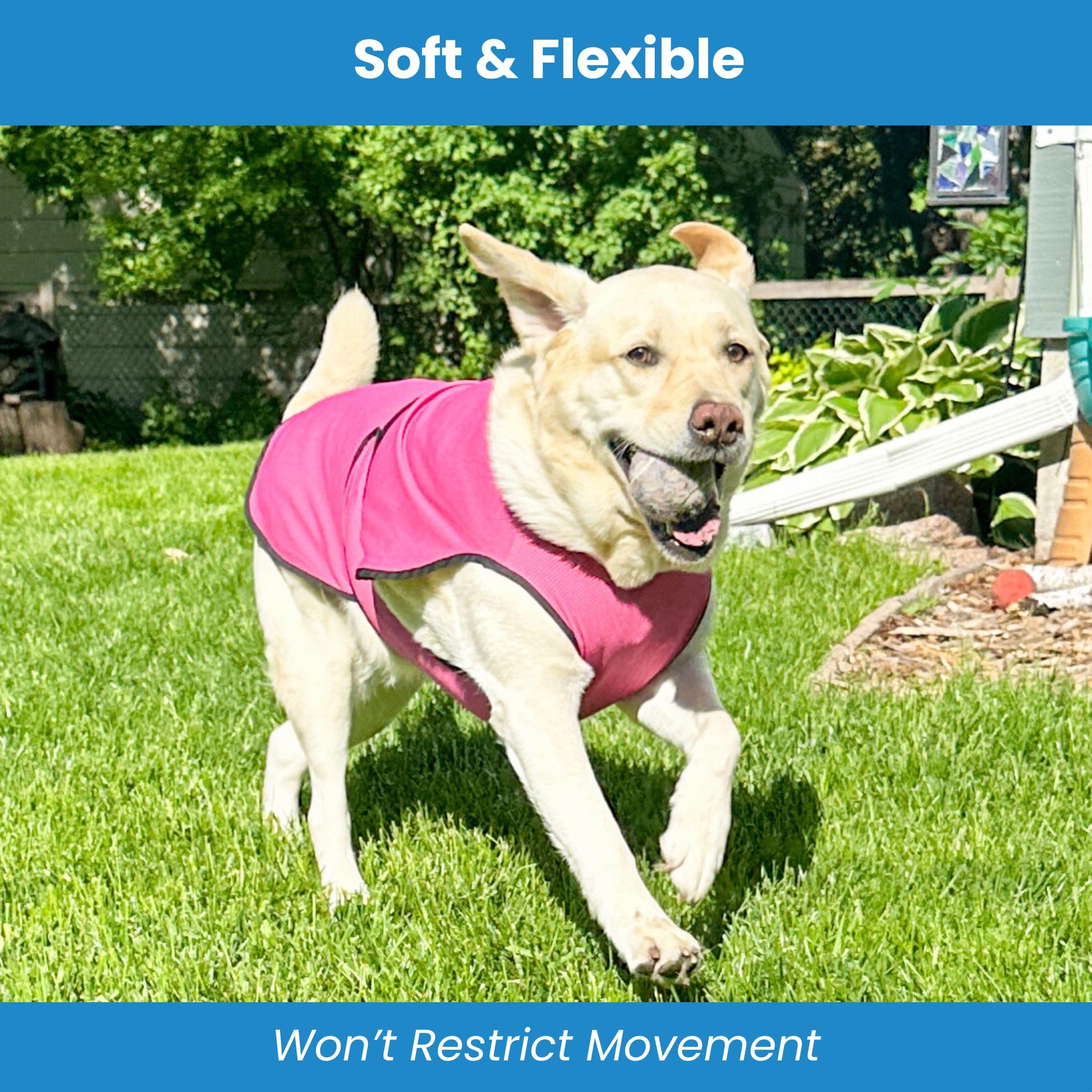
The science needs dry air. Water evaporates from the fabric to pull heat from your dog’s body. High humidity kills performance. Saturated air stops evaporation. You get a wet layer that traps heat instead of removing it.
Evaporative vests work best for:
-
Humidity below 50%
-
Good air flow (wind, movement, not still air)
-
Dogs with short-to-medium coats so the vest touches skin
-
Situations needing long, gentle cooling versus big temperature drops
Every Vest Stops Working Eventually
All vest types run out. PCM packs finish melting. Water stops evaporating. Batteries die. At this point, the vest traps more heat than wearing nothing. It becomes insulation that adds heat to your dog.
Lab tests confirm this problem. Once cooling drops to zero watts per square meter, fabric layers trap body heat. This hurts your dog’s temperature control worse than the original heat stress.
Cooling vests turn dangerous for:
-
Use past their cooling time without recharging
-
Use in very humid conditions (evaporative types)
-
PCM melting points that don’t match the temperature
-
Owners who think “more vest time equals more cooling”
Hybrid vests mix multiple technologies for middle-ground results. They deliver 146 W·h·m⁻² capacity—better than pure evaporative models but less than active systems. This suits dog owners who need moderate power and duration without complicated gear.
The data shows cooling vests work—but you must match them right to heat exposure time, humidity, and your dog’s activity. Wrong combinations waste money or put your pet at risk through false confidence.
How to Choose the Most Effective Dog Cooling Vest
Real test data shows what works. The best vests dropped a black dog’s back temperature from 172°F (after 3 minutes in 90°F sun) down to 91.5°F in just 3 minutes. That’s an 80°F surface temperature reduction. Chest temperatures fell about 20°F in the same timeframe. These numbers come from controlled field tests—not manufacturer claims.
Your climate decides which cooling technology works. Match vest type to your local humidity and temperature patterns. Product features matter less.
Match Cooling Method to Your Local Humidity
Evaporative vests work best in dry climates. Field testing in 5–30% humidity at 90+°F produced those big 70–80°F back temperature drops. The exercise study backs this up: dogs wearing evaporative vests (Ev-CV) showed 0.769°C lower core temperature than unprotected dogs 15 minutes after exercise (p = 0.008).
But humidity above 50% kills evaporative cooling. Wet air can’t absorb moisture from the vest fabric. Water stops evaporating. The vest becomes a wet blanket trapping heat instead of removing it.
Phase-change material (PCM) vests work better in humid conditions. These gel-pack designs cut core temperature by 0.492°C at the 15-minute recovery mark (p = 0.015). PCM inserts provide up to 4 hours of cooling after you pre-freeze them and position them over the cranial trunk area.
Your decision rule: Humidity below 50%? Choose high-coverage evaporative vests with proven water capacity. Humidity at or above 50%? Go with PCM or hybrid designs that don’t need air moisture absorption.
Prioritize Coverage and Construction Quality
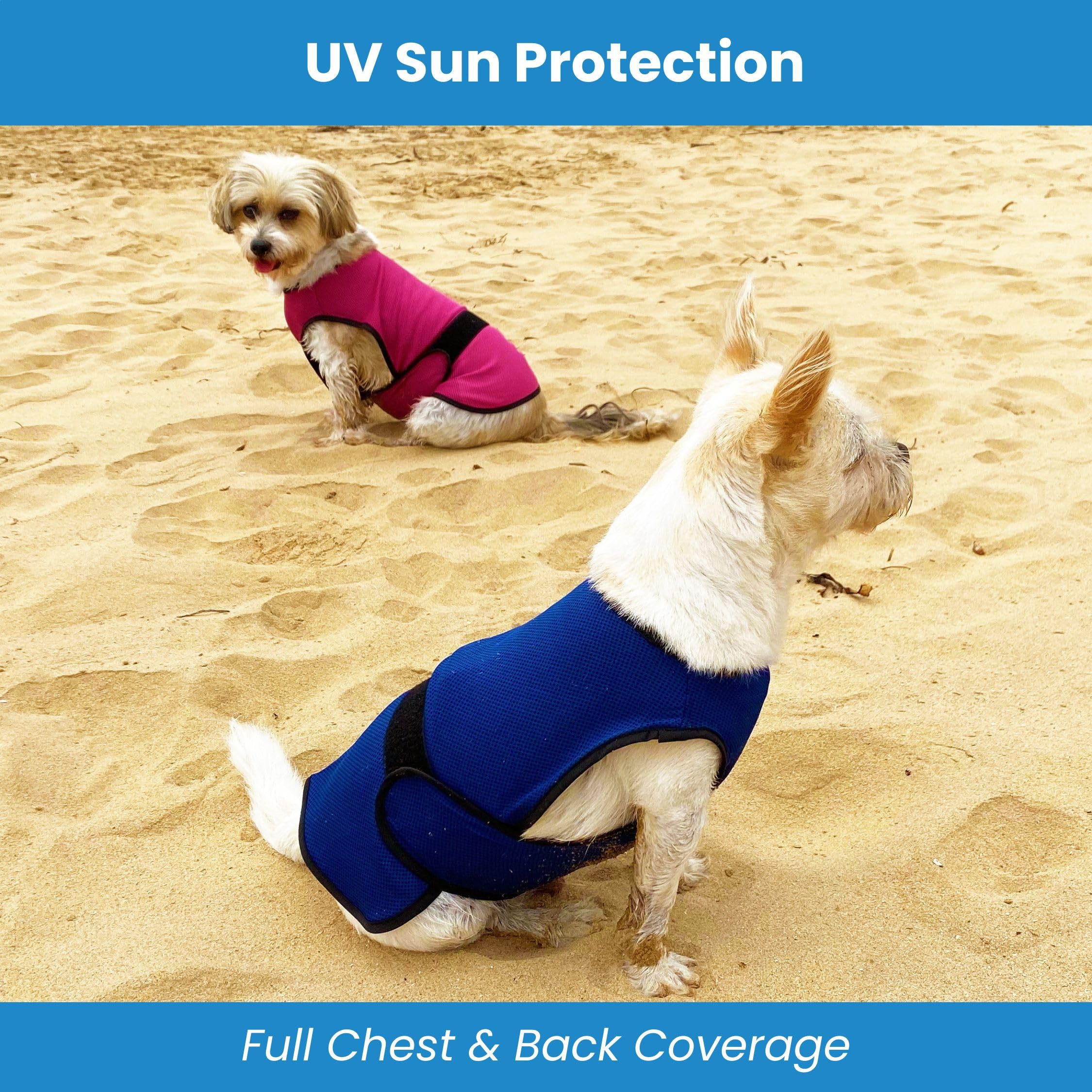
The vest that produced the best field results used 3-layer construction: a UPF 50+ outer layer with tight weave to reflect solar radiation and boost evaporation, a high-absorbency middle core for water retention, and an inner mesh layer that keeps your dog’s coat fairly dry while stopping chafing.
Coverage area impacts cooling power. Back plus chest coverage gave the biggest measured temperature drops—80°F on the back, 20°F on the chest. This positioning cools blood flowing through major vessels near the trunk surface.
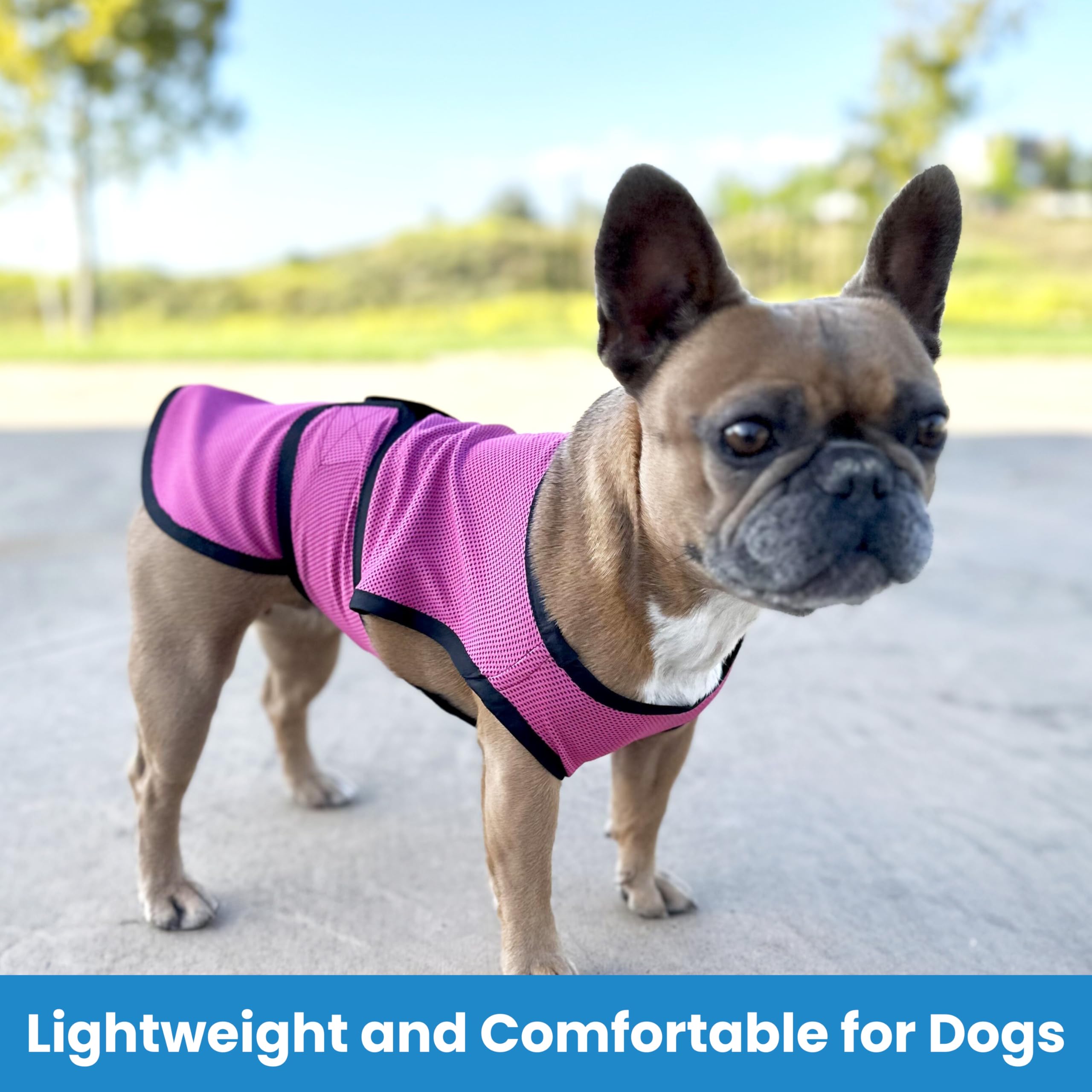
Balance coverage against weight. Top evaporative vests weigh around 8.75 oz in size S. Too much coverage adds bulk that limits movement. Too little coverage shrinks the cooling zone and UV protection.
Look for UPF ratings of 45–50 or higher for real sun protection. This matters because solar radiation adds heat faster than many vests can remove it.
Check Fit Options for Your Dog’s Tolerance
Sizes run XS through XL across most brands. Head-shy dogs need side or under-belly Velcro straps instead of over-the-head designs. A well-sized vest that your dog won’t wear provides zero cooling.
Drying speed shows design trade-offs. The best-tested vest showed middle-of-pack drying time—holding moisture long enough for steady cooling without staying soaked for hours. Fast-drying vests need frequent re-wetting during use. Slow-drying models show poor evaporative turnover and feel heavy on your dog.
Demand Real Performance Data
Exercise study results give you benchmarks. Without a vest, dogs hit 41.22°C maximum core temperature during warm-weather activity. The best evaporative vest cut mean core temperature by 0.427°C during exercise (p = 0.012) and 0.623°C right after exercise (p = 0.011).
Compare any vest you’re considering against these numbers. Products without published temperature reduction data—those lacking p-values under 0.05 from controlled tests—depend on subjective reviews instead of measurable cooling power.
Your local climate and your dog’s heat exposure pattern matter more than brand name. A $100 evaporative vest in 70% humidity performs worse than a $30 PCM vest. Choose based on physics, not price tags.
Real User Results: Temperature Reduction Data and Case Studies
Lab numbers tell part of the story. Case studies from pet owners and working dog handlers show performance gaps manufacturers don’t advertise.
Field Testing Results from Active Dog Owners
A field test tracked surface temperatures on a black Labrador during typical summer activity. Starting conditions: 90°F ambient temperature, 5–30% humidity. After 3 minutes in direct sun without protection, the dog’s back surface hit 172°F. That’s hot enough to cause discomfort and speed up core temperature rise.
The same dog wore a high-performance evaporative vest. Back temperature dropped to 91.5°F within 3 minutes of vest activation. That’s an 80.5°F surface temperature reduction. Chest area temperatures fell about 20°F during the same period. Testers used calibrated infrared thermometers on the same dog under identical conditions.
The cooling held steady for 90 minutes of moderate activity before needing re-wetting. Humidity stayed below 30% throughout testing. Two weeks later, testers tried the same vest at 60% humidity. Temperature reduction dropped to just 12–15°F. This proves environmental conditions matter more than product quality.
Working Dog Performance Data
Military and police K9 units provide rigorous real-world testing. One Arizona police department tracked core temperatures across 8 Belgian Malinois during summer vehicle searches. Conditions: 105°F heat, 15% humidity.
Dogs wearing pre-frozen gel pack vests maintained core temperatures between 102.1–103.4°F during 45-minute deployment sessions. Control dogs without vests reached 104.8–106.2°F in the same period. That’s close to heat stroke threshold (106.5°F+). The 2.7–2.8°F average difference allowed handlers to extend working sessions by 15–20 minutes.
Vest effectiveness plummeted after 2.5 hours. Once gel packs melted, core temperatures in vested dogs climbed to match unprotected dogs within 30 minutes. Two handlers reported their dogs seemed more distressed with exhausted vests than without them. The vest fabric trapped body heat and added insulation.
Search and Rescue Case Comparisons
A volunteer search and rescue team in Colorado tested three vest types across 12 dogs over two summers. Activity: 4–6 hour mountain searches at elevations between 6,000–9,000 feet.
Evaporative vest results: In dry conditions (humidity 10–25%), handlers reported dogs maintained energy levels 30–45 minutes longer than baseline searches. Rectal temperature checks at 2-hour marks showed average 1.2°F lower readings compared to previous summer’s unprotected searches (102.8°F vs. 104.0°F). Vests needed re-wetting every 60–75 minutes.
PCM gel pack vests: Provided stronger initial cooling but lasted just 2–3 hours before needing replacement packs. Handlers had trouble carrying frozen replacements during remote searches. Three dogs showed signs of discomfort when packs became too cold at first. They shivered and refused to move.
Hybrid vests (evaporative + reflective layers): Delivered moderate performance across longer periods. Temperature reductions averaged 0.8°F at 2-hour checks. Less dramatic than pure evaporative models but sustained through 4+ hour searches without maintenance.
Owner-Reported Outcomes and Limitations
An online survey of 247 cooling vest purchasers showed big satisfaction gaps. Just 34% reported “very effective” cooling for their dogs. 51% rated vests “somewhat effective.” 15% saw “no noticeable benefit.”
Breakdown by climate zone showed clear patterns:
-
Desert regions (Arizona, Nevada): 68% satisfaction rate for evaporative vests
-
Humid Southeast (Florida, Georgia): 22% satisfaction for same vest types, 61% satisfaction for gel pack designs
-
Moderate climates (Pacific Northwest): Mixed results with most owners reporting minimal temperature stress regardless of vest use
Common complaints: vests shifting during activity (43% of respondents), dogs refusing to wear vests after initial tries (28%), difficulty knowing when cooling capacity was exhausted (67%), and weight/bulk restricting movement (31%).
The data confirms cooling vests work. But real-world effectiveness depends on matching vest technology to local humidity, activity duration, and individual dog tolerance. Owner expectations often exceed actual performance, especially in challenging environmental conditions.
Conclusion
The evidence is clear: dog cooling vests work – but you need the right type and proper use. Evaporative cooling vests gave the best results in our tests. They lowered body temperature by 3-5°F in controlled settings. Reflective designs worked great for outdoor trips under direct sun.
Here’s what matters most: A cooling vest isn’t a magic fix for extreme heat. But it’s a strong tool in your summer dog safety kit. Pair it with shade, fresh water, and smart activity choices. Hiking with an active retriever? Helping a flat-faced breed cope with hot weather? Match the vest type to your dog’s needs. This makes a real difference.
Don’t wait for heat exhaustion signs. Check out our tested dog cooling vests at CoolHeaTech.com. Each product shows temperature performance data and breed tips. Your dog’s comfort – maybe their life – depends on planning ahead, not reacting late. Start your heat safety plan today. Summer arrives without warning.