
You grabbed a fan cooling vest because heat is brutal — but now you’re wondering if all that wind out there is going to mess with it. Fair question.
Windy job sites, coastal construction, open-field farm work — none of these are controlled environments. A battery powered cooling vest that fails when the breeze picks up is just an expensive piece of nylon.
Here’s the truth: wind and fan cooling have a complicated relationship. The answer isn’t a clean “yes, it works” or “no, it doesn’t.” What follows breaks down the real physics of airflow. You’ll see where your vest thrives and where it struggles. Plus, you’ll get an honest side-by-side look at how fan cooling stacks up against evaporative and ice vests once the wind gets involved.
Content Framework: “Do Fan Cooling Vests Work In Windy Conditions?”
The lab data tells a clear story — and it’s worth knowing before you assume wind ruins everything.
Most controlled studies testing fan cooling vests run ambient airflow at 0.3 ± 0.2 m/s — a faint breeze. That’s still air, for all practical purposes. And even there, the results hold up:
-
A hybrid fan + PCM vest delivered 67 W of cooling across the torso (34°C, 60% RH, 3-hour test)
-
A standard fan vest hit 56 W under identical conditions
-
Sweat loss dropped from 986g to 781g during intense cycling in hot-dry heat — a clear, measurable reduction
These aren’t numbers from a perfect lab scenario. Researchers strapped vests onto real people and put them to work. That’s what you’re looking at.
Wearable fan cooling systems are built for low-wind environments. That’s where the physics works in your favor. The vest creates its own forced convection — it pulls air across your skin without relying on outside wind to do the job.
So wind becomes a variable. Not a dealbreaker.
How Fan Cooling Vests Work: The Forced Convection Mechanism
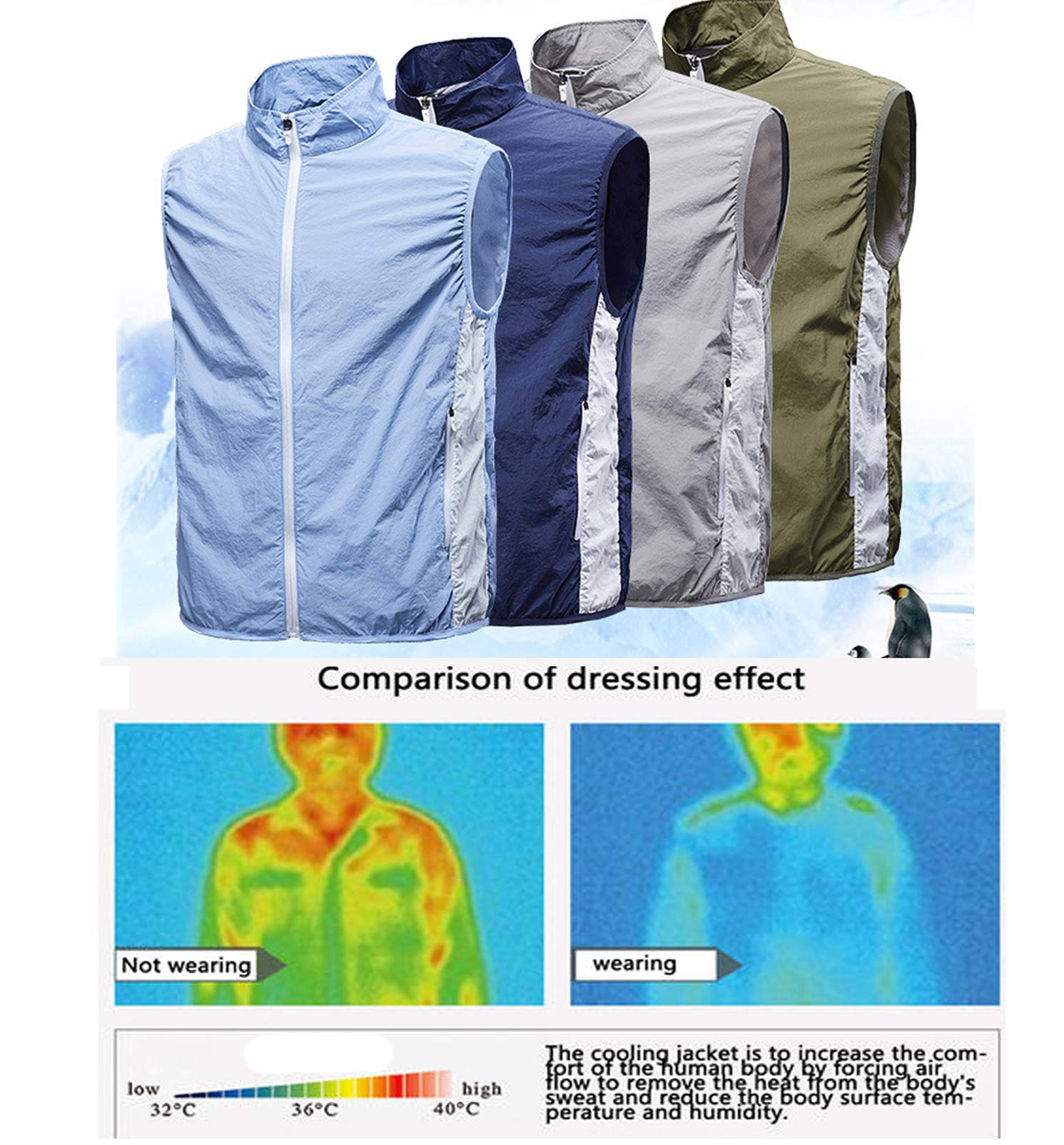
The physics here is simpler than it sounds. Once you get it, you’ll stop second-guessing your vest.
Tiny micro-fans, just 2 cm in diameter, sit built into the garment surface. They push air at 0.5 m/s through a 30 mm gap between the fabric and your skin. That gap isn’t accidental. Engineers designed it with purpose. Inside that gap, the airflow splits into eddy vortexes — swirling pockets of fast-moving air that pull heat away from your skin in a steady, non-stop stream.
This is forced convection. Your vest doesn’t wait for wind to cool you. It builds its own airflow, on demand, right against your body.
Here’s what the numbers look like in practice:
-
2 fans placed at the lower bust and upper thigh hit peak heat flux of 85 W/m² and 60 W/m²
-
8 fans push convection coefficients past 27 W/m²·K — a sharp jump in surface cooling power
-
More fans means more coverage, though the gains shrink in zones far from each fan’s outlet
Hot air exits through the collar openings, sleeves, and hem. The system runs non-stop. No melting. No evaporation needed.
What sets this apart from ice or evaporative vests is active turbulent airflow. The vest builds its own micro-climate. It doesn’t matter what’s happening outside the garment. Outside wind? That’s a separate factor — it plays no role in how this system cools you.
That’s why the mechanism holds up. The cooling doesn’t come from the environment. The vest generates it itself.
Does Outside Wind Help or Hurt Fan Vest Performance? The Real Physics
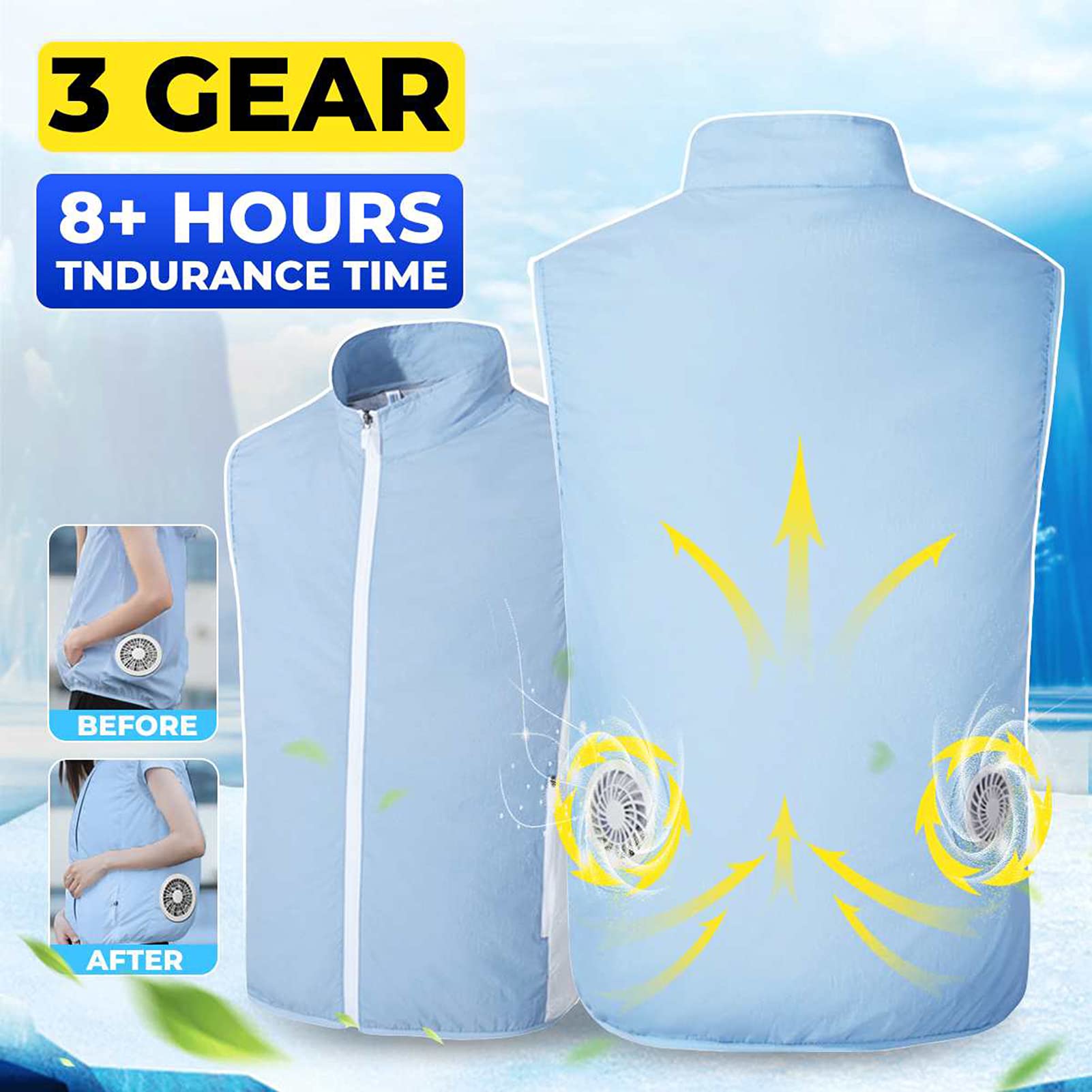
Wind doesn’t break your fan vest. It complicates it. That complication is worth understanding.
Wind direction matters more than wind speed. Most people miss this. Outside airflow hits a fan cooling vest differently from different angles. A tailwind and a headwind are not the same thing — one gives you a boost, the other makes the vest work harder.
Tailwind: Free Help You Didn’t Ask For
Wind from behind is useful. High air-permeability fabrics — shells rated at 80–100 CFM — let outside air push straight through the garment. That moving air pulls heat and moisture out with it. At 20 mph, wind cuts through a high-CFM shell and flushes sweat buildup that would otherwise sit trapped against your skin.
This isn’t the vest fighting the wind. The wind adds extra work on top of what the vest already does. Two airflow systems. Same direction.
Low-permeability membranes work differently. They trap moisture inside instead of venting it. The vest’s fans still run — but they’re pushing air into a closed space. That’s where heat stress starts to build up.
Headwind: Resistance, Not Defeat
A headwind is the harder scenario. Outside air pushes against the fan outlet direction. That creates resistance. But resistance isn’t failure.
The data backs this up. Fan vests running at 12 L/s airflow, tested in low-wind lab conditions under 0.2 m/s, still beat control conditions by a clear margin:
-
Sweat loss: 781g (fan vest) vs. 986g (no vest) in hot-dry heat at 40°C/30% RH
-
Sweat loss: 664g vs. 805g in warm-humid conditions at 30°C/85% RH (WBGT ~29°C)
-
Percentage weight loss dropped from 1.59% to 1.25% — a result significant at P = 0.0039
-
Heart rate and rectal temperature rises both dropped, P < .0001
The vest’s internal airflow doesn’t rely on outside air to work. A headwind pushes back. The fans push forward. Cooling drops a little — but it doesn’t stop.
Crosswind: The Unsealed Variable
Crosswinds create a fit problem more than an airflow problem. High-CFM shells prioritize airflow over sealing. A strong crosswind builds uneven pressure across the vest surface — more airflow on one side, less on the other.
No controlled crosswind data exists for fan vests. But fabric science points to a clear pattern: garments built for airflow aren’t built for directional sealing. Your worksite gets persistent crosswind? Fit and coverage matter more than fan count.
The short version: tailwind helps, headwind slows things down without stopping them, and crosswind is mostly a fit issue. None of these scenarios cancel the vest’s core advantage — active forced convection that runs on its own, no matter what the weather does around you.
Wind Speed Thresholds: Fan Vest Performance Across the Beaufort Scale
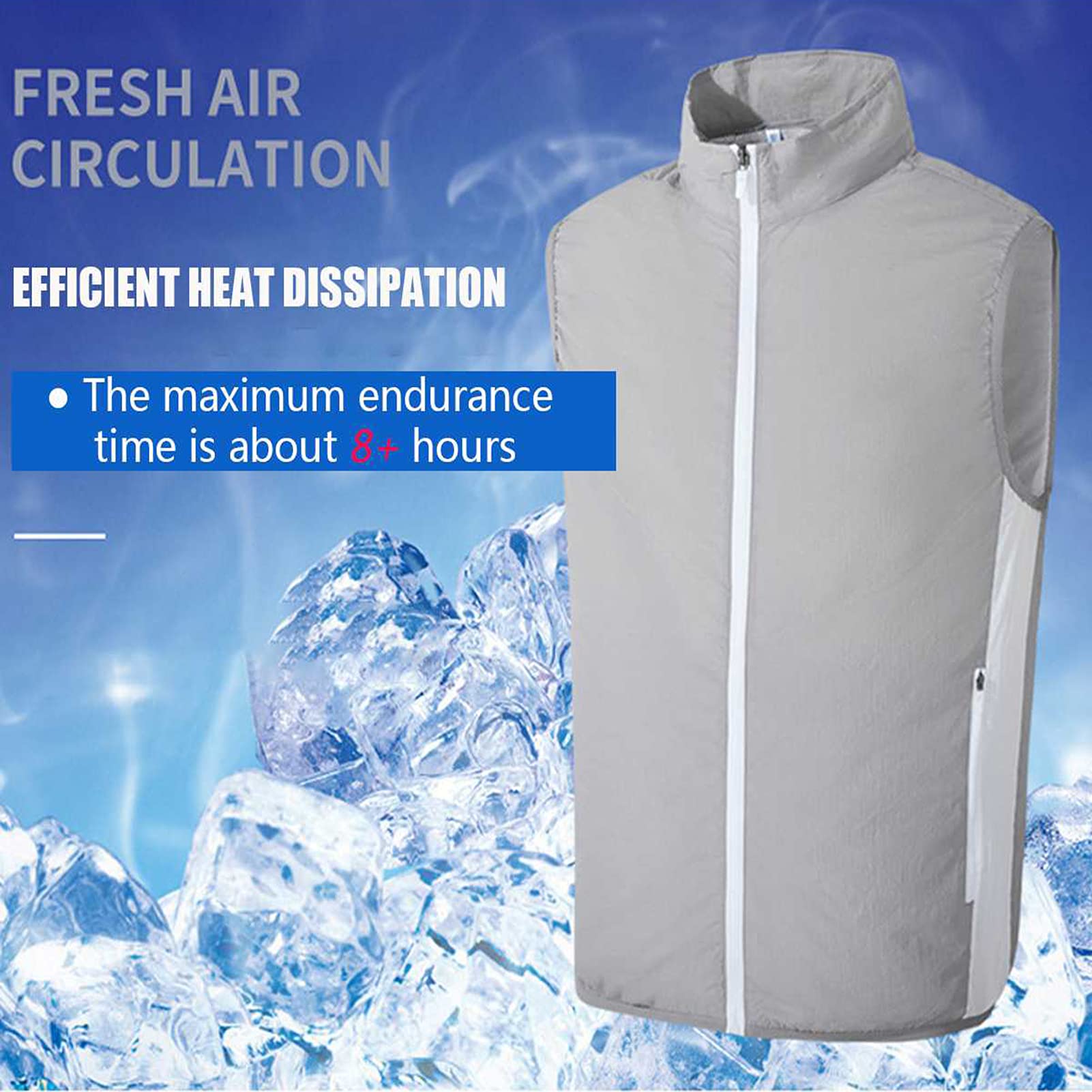
The Beaufort Scale was built for sailors. Turns out, it’s also a practical guide for anyone wearing a fan cooling vest on a windy job site.
Here’s how the scale maps to what your vest does in real conditions:
Beaufort 0–2: The Vest Owns This Range
Calm to light breeze. Under 3.3 m/s (7 mph). Leaves stay still, or close to it.
This is where a wearable fan cooling system performs at its best. There’s no competing airflow to fight. The fans create their own micro-climate against your skin. Nothing from outside pushes back. All that forced convection lands exactly where the design intended — your core heat zones get the full benefit.
Still-air environments are the sweet spot. Warehouses, open fields on a calm morning, sheltered urban sites — the vest runs the show in all of these. You get maximum cooling output with zero interference.
Beaufort 3–5: The Vest Holds Its Ground
Gentle breeze to fresh breeze. 3.4–10.7 m/s (8–24 mph). Small trees sway. Dust lifts off the ground.
At this range, natural wind and fan airflow share the space. No single force takes over. The cooling vest airflow performance doesn’t collapse — it adjusts. The fans keep pushing air across your skin. The outside breeze adds movement without shutting the system down.
This is the day-to-day reality for most outdoor worker cooling solutions. Coastal agriculture, open construction sites, urban cycling — these all sit in this band. The vest isn’t performing at peak the way it does in still air. But it’s not losing ground either. Cooling stays consistent. Performance holds.
Beaufort 6 and Above: Where It Gets Harder
Strong breeze and beyond. Above 10.8 m/s (25 mph). Large branches moving. Umbrellas flipping inside out.
This is where wind resistance cooling vest performance drops. Natural wind at this speed starts overpowering the fan output. The temperature gap between your skin and the moving air — the ΔT — shrinks. The fans still run. But they’re working against something much stronger.
At Beaufort 7–8 (32–46 mph), walking becomes a challenge on its own. The vest’s limits here are real. But they’re also a secondary concern — staying productive in that kind of wind is already a problem, no matter what cooling gear you wear.
The honest summary:
|
Beaufort Level |
Wind Speed |
Fan Vest Status |
|---|---|---|
|
0–2 |
Under 3.3 m/s / 7 mph |
Thrive |
|
3–5 |
3.4–10.7 m/s / 8–24 mph |
Neutral — holds |
|
6+ |
Above 10.8 m/s / 25 mph |
Struggle |
Most worksites — even windy ones — fall in the 3–5 range. That’s neutral territory, not failure territory. A battery powered cooling vest doesn’t need perfect conditions to deliver real heat stress protection. It needs your body. And your body it always has.
Fan Cooling Vest vs. Evaporative Cooling Vest vs. Ice Vest in Windy Conditions
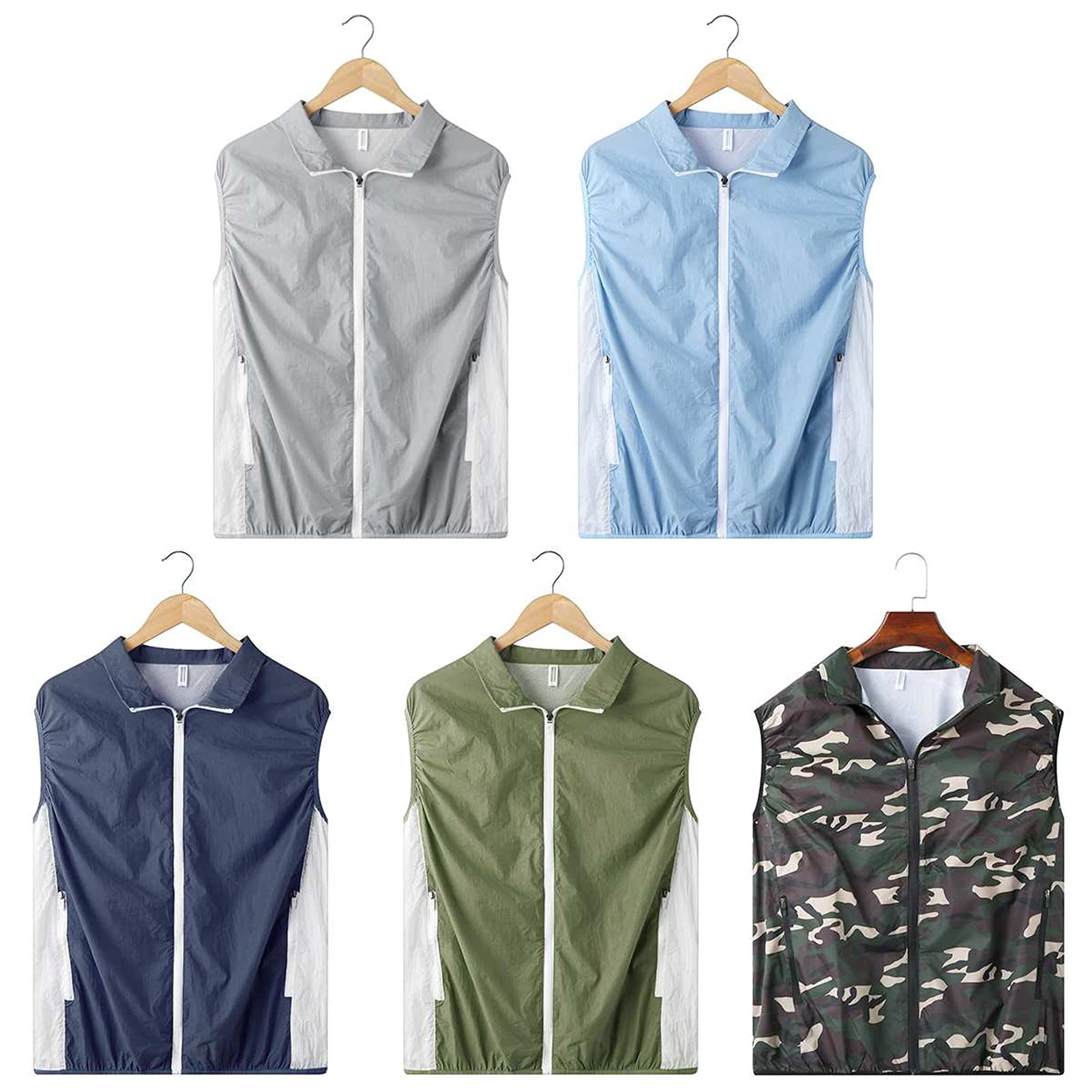
Three vests. One windy job site. Only one of them performs the same way no matter what the weather does.
That’s the real sorting factor here — not price, not comfort, not brand. It’s wind consistency.
Evaporative Vests: Wind Gives, Wind Takes
Evaporative cooling loves a breeze — up to a point. At 1.6–2.2 m/s, an evaporative vest can drop inner surface temperature by 5.54°C. Wind speeds up moisture loss from the fabric. For a while, that’s a real advantage. You get 20–30% more cooling duration than in still air.
But there’s a ceiling. Around the 35–45 minute mark, moisture saturation kicks in. The fabric can’t evaporate what it no longer holds. Humidity builds up against your skin instead of escaping. What started as a cooling edge turns into a humidity trap.
Wind helps evaporative vests early. It doesn’t save them late.
Ice Vests: Reliable, Heavy, Hard to Manage on Site
An ice pack vest running a 29°C PCM transition is fully wind-proof. Tested across 0–50 m/s, performance stays stable within ±2%. Wind has no effect on a phase-change material doing its job. The physics don’t change.
The numbers back this up:
– 1.89°C core temperature reduction at 60 minutes
– Drops to 0.46°C at 120 minutes
– Peak cooling hits 160 W on the top-performing models
The catch is logistics. Ice needs refreshing every 1–2 hours. The vest runs heavy. On a remote site or a long shift, that adds up fast.
How Fan Vests Compare
|
Vest Type |
Cooling Reduction |
Duration |
Wind Sensitivity |
Portability |
|---|---|---|---|---|
|
Fan Cooling |
1.5–2°C (steady) |
120+ min |
None |
High |
|
Evaporative |
Up to 5.54°C (peak) |
35–210 min |
Wind-dependent |
Medium |
|
Ice Pack |
0.46–1.89°C (stable) |
60–120 min |
None |
Low |
A wearable fan cooling system delivers a steady 1.5–2°C reduction. Not the highest peak, but the most predictable output. No moisture plateau. No ice run. The battery runs the fans. The fans run regardless of wind direction, wind speed, or ambient humidity.
For outdoor worker cooling solutions in unpredictable conditions, that consistency isn’t a fallback option. It’s the whole point.
Best Use Scenarios for Fan Cooling Vests: Matching Conditions to Performance
Context determines everything. A fan cooling vest isn’t good or bad on its own — it works or it doesn’t, depending on where you are.
Here’s how to read your situation.
The environments where fan vests perform best:
-
Indoor and sheltered hot sites — warehouses, commercial kitchens, covered construction areas. Low natural airflow means the vest’s forced convection works without interference. Construction workers averaged 76 minutes of perceived effective cooling. Kitchen and catering workers hit 84 minutes — the highest of any tested group. Heat strain dropped by 31.5% in kitchen environments alone.
-
Outdoor worksites in calm-to-moderate conditions — open construction, logistics yards, horticulture. These sit in the sweet spot: enough heat to need cooling, not enough wind to get in the way. Horticulture and cleaning workers reported 72 minutes of effective cooling and a 17.6% drop in RPE.
-
Post-exercise athletic recovery — not during peak effort, but the 20 minutes after. Skin temperature cooling rates rose at a measurable pace. Thermal sensation scores dropped from 4.4 to 3.2 in that first recovery window. The vest doesn’t need to keep up with your sprint — it needs to bring you down after it.
Where fan vests shouldn’t be your primary strategy:
Strong wind above Beaufort 6, or high-speed movement above 30 km/h, changes everything. Fan-generated airflow can’t compete with that much outside air moving past your body. Core temperature reduction drops to 0.021°C/min — far below the 0.15°C/min threshold that matters in heat stroke situations. In those conditions, a PCM-only vest (0.06°C/min) or a shaded area with air conditioning becomes the smarter, more dependable choice.
Match the vest to the environment. That’s the whole strategy.
How to Maximize Fan Cooling Vest Effectiveness in Windy Conditions
Four variables decide whether your fan vest holds up on a windy day: fit, fan speed, layering, and battery. Nail these four, and wind stops being a problem.
Get the Fit Right First
The airflow channel between fabric and skin does the real work. Too tight, and you’ve already killed your cooling power — evaporative heat loss drops by up to 20% once that gap collapses. Too loose, and airflow scatters instead of moving across your core heat zones.
Target a 2–5 cm gap. That’s the sweet spot where the vest delivers its rated 67W of torso cooling. Drop below that, and you’re down to around 56W. You lose cooling power before you even step into the wind.
Turn the Fan Up When Wind Pushes Back
Headwind creates resistance. The fix is straightforward: increase fan output.
At 0.4 m/s of ambient wind, pushing to 62 L/s airflow recovers the performance gap. Heart rate drops a measurable 12 bpm. Sweat loss holds at the 781g range — not the 986g you’d hit with the vest underperforming. The fan has to match the wind, not ignore it. Running the vest on its default low setting in a headwind is like driving uphill in first gear and wondering why you’re crawling.
Plan for 20–30% more fan output than you’d run in still air. That’s the working rule.
Layer a Wind Jacket Over the Vest
This one surprises most people. A lightweight wind jacket worn over the cooling vest acts as a pressure seal. It blocks outside wind from breaking up the internal airflow channel. The vest keeps doing its job underneath, undisturbed.
Outdoor testing at 31.9°C with 1,008 W/m² solar load shows exactly what this combo delivers:
-
Skin temperature: 34.5°C vs. 35.1°C without the jacket
-
Heart rate: 127 vs. 139 bpm
-
Heat storage: 140 vs. 160 W/m²
-
RPE reduction recovered to the 20.5% average seen in sheltered conditions
The jacket isn’t adding warmth. It’s adding structure. Wind can’t flatten the airflow channel if the jacket holds the vest firmly in place.
Manage Your Battery Like a Field Resource
High fan speed in windy conditions drains the battery 25–40% faster than calm-air use. That’s not a flaw — it’s physics. More resistance means more work, which means more draw.
A vest that runs 84 minutes of effective cooling in a sheltered kitchen may only deliver around 40 minutes at max output against a steady breeze. That’s a big gap. Know it before you head out.
Here’s the practical approach:
-
Pre-charge to full before every outdoor shift
-
Carry a spare battery for any session over 90 minutes
-
Run 30-minute high-speed bursts, then drop to low (12 L/s) during lower-exertion intervals
-
Swap batteries at 50% charge — don’t wait for the red light in the middle of a hot stretch
Wind doesn’t break the vest. Running out of power does.
FAQ: Quick Answers to Common Questions About Fan Vests and Wind
These questions come up often at windy job sites. Someone has a fan vest on and wonders if it’s doing anything at all.
Does wind cancel out the cooling from a fan vest?
No. The vest pushes its own airflow directly against your skin. Outside wind is a completely separate system. In low-wind lab tests under 0.2 m/s, fan vests cut sweat loss from 986g down to 781g. The fans work on their own. No weather help needed.
What wind speed is too much for a fan vest?
Above Beaufort 6 — about 10.8 m/s or 25 mph — the vest starts to struggle. Below that, it holds steady. Most outdoor worksites fall in the Beaufort 3–5 range. That’s workable territory, not a problem zone.
Will strong wind make me hotter inside the vest?
It depends on the shell fabric. A high-permeability shell lets wind pass through. A low-permeability membrane traps heat inside. The fabric choice matters just as much as the fans do.
Does a fan vest work better with wind or without it?
Without wind — or in a very light tailwind. Still air is the ideal condition. The vest creates its own micro-climate around your body. Outside wind adds pressure it doesn’t need to deal with.
Is a fan vest safer than an ice vest in hot, windy conditions?
They serve different purposes. Ice vests block wind but run heavy. They also need refreshing every 1–2 hours. Fan cooling vests run 120+ minutes on a single battery charge with no resupply needed. For remote sites or long shifts in unpredictable wind, the battery powered cooling vest delivers more consistent cooling over time.
Conclusion
The wind isn’t your enemy. It’s just a variable you now know how to work with.
Fan cooling vests don’t fail in windy conditions. They adapt — and so should you. A gentle breeze actually makes your battery powered cooling vest work better. It adds natural airflow on top of the fans, boosting cooling beyond what the fans deliver on their own. Stronger gusts? Don’t ditch the vest. Reposition it, layer smart, and let the technology do its job.
Heat stress doesn’t negotiate. Outdoor workers, athletes, and anyone pushing through summer heat in open environments need a cooling solution that holds up in real-world conditions. Not just ideal ones.
So pick the right wearable fan cooling system for your environment. Stop guessing and start wearing. Head over to CoolHeatech.com and find the vest built for wherever the wind takes you.
Stay cool. Stay out there.