
Choosing a cooling vest sounds simple — until your skin disagrees with the fabric. For anyone dealing with allergies, eczema, or chemical sensitivities, that familiar itch, rash, or irritation can turn a comfort product into a source of misery.
Not all cooling vests are made with sensitive skin in mind. The fabric sitting against your skin matters far more than most buyers ever consider. So before you buy, it’s worth knowing what fabrics are used in hypoallergenic cooling vests — and why some materials soothe while others trigger reactions.
This guide cuts through the marketing noise. You’ll get a clear look at real materials — from organic cotton to merino wool — and what makes each one worth your attention or worth skipping.
What Fabrics Are Used In Hypoallergenic Cooling Vests?

No single fabric defines hypoallergenic cooling vests. It’s a group of materials — each picked for what it doesn’t do to your skin, as much as what it does.
The Core Fabrics Worth Knowing
Organic cotton is the baseline standard. It skips synthetic pesticides and chemical finishes — a real difference for eczema-prone skin.
Bamboo and Lyocell (Tencel) have grown into solid alternatives. Both are hypoallergenic by nature, moisture-wicking, and low-friction against skin. Tencel comes from wood pulp and has a silky feel that cuts irritation at contact points.
Hemp and linen offer breathability and natural antimicrobial properties — no chemical treatments needed. A 70/30 linen-polyester blend tested in PPE cooling vest trials recorded a median skin moisture effect size of 0.810 — classified as a very large improvement.
What to Watch For
Polyester and nylon aren’t the problem by themselves. Their chemical finishes are. Azo dyes, antimicrobial coatings, and wrinkle-resistant treatments are the real triggers. EU regulations flag azo dyes for breaking down into carcinogenic aromatic amines — a direct health risk.
Look for OEKO-TEX Standard 100 or GOTS certification on any vest claiming hypoallergenic status. Both check residual chemicals across the full production chain — not just the outer fabric layer.
Pro tip: Check the cooling inserts too. Quality hypoallergenic vests use PCM inserts with inorganic salts — non-toxic, effective between 55–65°F, lasting 2–4 hours, with no chemical barriers touching your skin.
Why Fabric Choice Matters for Sensitive Skin in Cooling Vests
Skin doesn’t lie. A fabric reaction hits fast — redness, hives, that creeping itch that gets worse with every hour of wear.
The problem isn’t always the fiber itself. It’s what happens to the fiber before it reaches you.
Polyester dominates the cooling vest market for one practical reason: it pulls moisture away from your skin fast. But polyester almost never arrives untreated. Manufacturers bond antimicrobial coatings, dye fixatives, and wrinkle-resistant finishes directly into the fabric during production. For sensitive skin, those leftover chemicals are the real trigger — not the polyester strand itself. The result? Contact dermatitis, persistent redness, or hives that build up across a long workday.
Evaporative vests carry a separate risk. They hold moisture against your skin. That worsens eczema and sets up a steady environment for irritation to grow.
Then there are the cooling inserts. Direct ice contact can push skin temperature below 9.2°C — that’s well outside the safe therapeutic range. For reactive skin, that’s a real tissue irritation risk.
Hypoallergenic fabric choice works on three levels:
-
Material selection — organic cotton, TENCEL™, hemp
-
Processing standards — no synthetic pesticides, no azo dyes, closed-loop solvent systems
-
Verified certification — OEKO-TEX Standard 100 as the minimum threshold
A vest labeled “hypoallergenic” means nothing without proof across all three levels. The fabric touching your skin needs to be formulated, processed, and tested to lower immune response — not just promoted around one natural ingredient.
Organic Cotton — The Gold Standard for Hypoallergenic Cooling
Dermatologists don’t recommend organic cotton by accident. There’s a number behind that recommendation worth knowing: 70–90% reduction in skin irritation among sensitive users. That figure comes from clinical testing — not marketing copy.
The difference from conventional cotton starts at the field, not the factory. Conventional cotton accounts for 16% of global insecticide use. That chemical load doesn’t disappear during processing. It leaves behind pesticide residues of 0.1–1 ppm in finished fabric. Organic cotton, grown and processed under GOTS certification, brings that number down to 0.0001–0.001 ppm. For eczema-prone skin, that gap is the difference between a vest you wear all day and one you pull off by noon.
What the Numbers Say
The hypoallergenic case for organic cotton isn’t vague. It’s specific:
-
95% fewer allergic reactions in eczema patients — no formaldehyde, no heavy metals, no azo dyes
-
Infant skin testing recorded 0% irritation with GOTS-certified organic cotton, versus 15% with treated alternatives
-
84% of eczema patients report the highest comfort scores with organic cotton worn against skin
-
Chemotherapy patients in organic cotton reported a 20–30% reduction in night sweats — a direct result of better breathability with no chemical interference
How It Cools
Organic cotton isn’t just gentle. It works. Moisture absorption reaches 25 times its own weight — compare that to just 0.4x for polyester. Thermal conductivity lands between 60–71 mW/(m·K), beating most synthetics, which top out below 50.
Coconut oil-treated organic cotton hits a Q-max of 0.106 W/cm² — the lowest in comparative testing. That means the coolest contact feel against your skin. Fabrics built with WICKING WINDOWS™ technology on organic cotton run 5°F cooler than untreated versions. You get the same performance as synthetic PCM fabrics — without the chemical trade-off.
The Real Limitation
Organic cotton holds moisture 2–3x longer than synthetics after heavy sweating. Push it hard and breathability drops 15–25% once saturated. Thermal resistance falls 10–15% in sweat-heavy conditions. Leave it damp past 24 hours and mold becomes a real risk.
For moderate activity and everyday wear — particularly for sensitive, eczema-prone, or immunocompromised users — organic cotton is the strongest choice in hypoallergenic cooling vests. Just don’t expect it to keep up with a polyester vest during a marathon.
Bamboo & Bamboo Rayon — Antibacterial Claims Meet Silky Comfort
Bamboo has a quiet reputation problem. Half the products labeled “bamboo fiber” aren’t what you think — and for sensitive skin, that gap between label and reality matters more than any marketing copy lets on.
The antibacterial story starts with Bamboo Kun, an antimicrobial compound found inside the bamboo plant itself. In raw fiber form, the numbers are striking: bacterial reduction rates up to 99.8%. Against K. pneumoniae, natural bamboo fiber (NBF) cuts bacterial counts by 8–95%. Against S. aureus, reduction runs 3–50%. Japan’s textile verification testing confirmed 70% bacterial destruction — and that activity holds after 50 washes.
Those aren’t the numbers most bamboo vests are working with.
What Processing Does to the Antibacterial Claim
Converting bamboo into viscose or rayon — the most common commercial form — takes a chemical-heavy process using carbon disulfide. That strips a large portion of Bamboo Kun out of the finished fiber. The result: only 1 out of 12 tested bamboo viscose products showed meaningful antibacterial activity against S. aureus and K. pneumoniae. The top-performing viscose sample reached just 37.45% bacterial growth inhibition — a grade 1–2 zone, far below the grade 4–5 zones enzymatic NBF processing achieves.
Enzymatic and lyocell-method bamboo performs better. Enzymatic NBF processing reaches 95.06% inhibition with minimal chemical residue. That’s much closer to the plant’s original performance.
What Bamboo Does Well — Regardless of Processing
Even processed bamboo rayon keeps one consistent edge: moisture management.
-
60% higher absorption capacity than cotton
-
20% better air permeability than cotton
For hypoallergenic cooling vests, that combination is useful. Sweat moves away from skin faster. The fabric breathes better. Those two things together reduce the damp, friction-heavy conditions that trigger eczema and contact dermatitis.
The silky texture is real — not a marketing invention. Bamboo fiber’s smooth surface produces less mechanical friction against skin at pressure points — shoulders, chest edges, underarms. That’s exactly where vest-related irritation tends to develop first.
How to Read a Bamboo Label Without Getting Misled
The FTC requires manufacturers to disclose when “bamboo fiber” is bamboo viscose or rayon. Most don’t make that clear. Watch for these:
-
Red flag: “100% bamboo fiber” with no processing method disclosed
-
Red flag: Antibacterial claims with zero lab verification — unprocessed natural bamboo can promote bacterial growth under certain conditions
-
What to look for: Oeko-Tex Standard 100 certification (confirms no harmful chemical residue after processing), plus documented inhibition rates above 70% that hold after repeated washing
Bamboo rayon isn’t a fraud. It’s a soft, skin-friendly fabric with solid moisture advantages. It just isn’t the antibacterial powerhouse the label often implies — unless the manufacturer backs that claim with actual data.
Lyocell (Tencel™) — The Semi-Synthetic That Sensitive Skin Tolerates
Here’s what most cooling vest buyers never find out about Lyocell: it isn’t cotton, it isn’t synthetic, and it doesn’t follow either set of rules.
Wood pulp gets dissolved in a non-toxic NMMO solvent. The solvent is then recovered at a 99% closed-loop rate. So your skin contacts Lyocell with almost no chemical residue left behind. That’s not a marketing claim — it’s a process difference. Viscose and rayon use sodium hydroxide in open systems. Those open systems leave irritating chemical traces on the fiber. Lyocell doesn’t.
The fiber itself has an unusual structure. Round, hollow-core, and smooth all the way around — it glides against skin instead of catching on it. That low-friction shape matters most at pressure points. Think shoulder straps, chest edges, and underarms. Those are the spots where eczema-prone skin takes the hardest beating during wear.
What the Data Shows
A 2009 atopic dermatitis study tested 100% lyocell against 100% cotton head-to-head. Lyocell came out ahead on every comfort measure:
-
Softness
-
Temperature control
-
Moisture management
-
Wrinkle resistance
It also recorded lower average itching scores and showed a trend toward decreased transepidermal water loss (TEWL). Lower TEWL means the skin barrier holds moisture better. For reactive skin, that’s a real signal — even where the study didn’t hit full statistical significance.
Moisture absorption runs 50% higher than cotton. Plus, under sweaty conditions, lyocell inhibits Staphylococcus aureus — the bacteria tied to eczema flare-ups.
The National Eczema Society recommends it alongside cotton. Three separate certifications support the safety case:
-
OEKO-TEX® Standard 100
-
Blue Label by Asthma Allergy Denmark
-
FKT “medically tested” status for sensitive skin
In hypoallergenic cooling vests, Lyocell sits as the inner skin-contact layer. That’s the position where its friction reduction and moisture-wicking properties do the most work.
Linen & Hemp — Underrated Hypoallergenic Options for Hot Climates
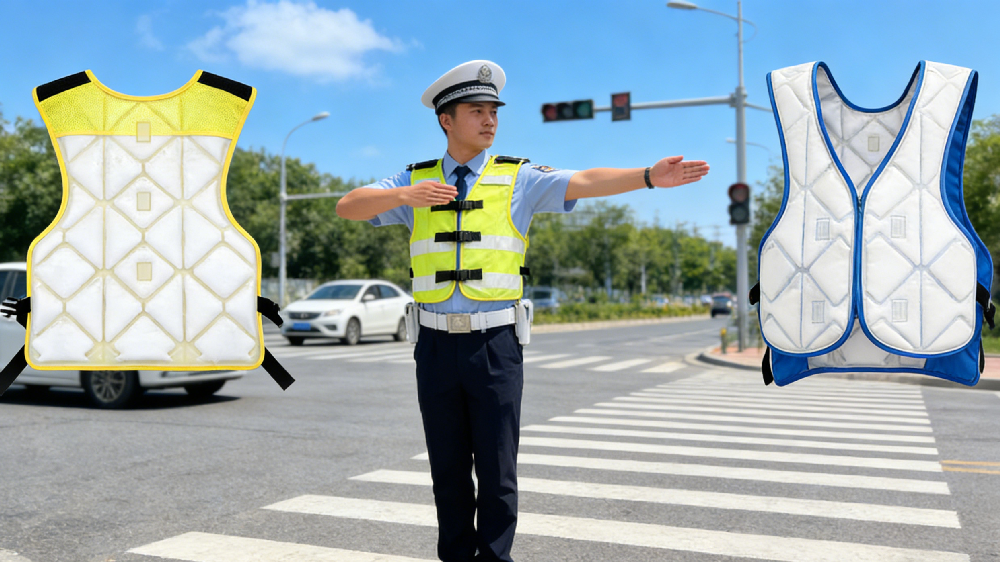
Two fabrics sit at the edge of the cooling vest conversation — almost never marketed, almost never featured, and consistently underestimated. Linen and hemp don’t need chemical treatments to perform. They’re built for heat.
Hemp’s secret is structural. Its hollow fiber creates micro air chambers that slow heat moving from the inside out. No coatings, no additives — just physical design. That’s why hemp fabrics keep body temperatures 2–3°C more stable than polyester in hot conditions (Textile Research Journal, 2023). For sensitive skin through long outdoor shifts, that stability isn’t a comfort bonus. It’s a functional requirement.
The moisture numbers are just as compelling:
-
Hemp absorbs 30% of its own weight in moisture — beating cotton’s 25%
-
It dries 30–40% faster than cotton (Journal of Natural Fibers, 2023)
-
Wet hemp holds up to 70% of its insulating properties — cotton drops 90% under the same conditions
Linen takes a different path but reaches the same result. It pulls perspiration away from skin fast, using natural fiber geometry instead of synthetic wicking technology. No treatments needed. The fiber shape does the work.
Where Blends Outperform Pure Fibers
Pure linen and hemp have one real limitation: stiffness. Lignin makes both fibers rigid. That adds processing difficulty and cost. Against bare skin across a full workday, the rigidity creates friction — especially at vest edges and contact points.
Blends fix this. You keep the breathability and temperature control, and lose the stiffness:
-
30% hemp blends deliver 25% better breathability than pure cotton
-
Hemp-CBD modified fabrics push moisture absorption to 7.7–12.8% while keeping thermal resistance low
-
Panama weave hemp reaches 182.62 Ws¹/²/m²K thermal absorptivity — fast heat dispersion that makes it ideal for summer wear
For hypoallergenic cooling vests built for outdoor use, a hemp or linen blend gives you something most synthetic fabrics can’t match: real breathability and temperature control, with zero chemical triggers.
Synthetic Fabrics (Polyester & Nylon) — What They Do Well and Where They Fall Short
Polyester and nylon built the modern cooling vest industry. That’s not a small statement — and it’s not a straight compliment either.
Both fabrics earn their place on performance alone. Polyester dries faster than any natural fiber on this list. Its moisture absorption sits at just 0.4% — that low number is the point. Sweat moves away from the surface instead of pooling against your skin. UV stability is exceptional. Color retention holds after 500 wash cycles. At $3–$8 per yard, it keeps vest pricing accessible.
Nylon leads on durability. Tensile strength runs 4.2–5.8 g/d — the highest of any fabric in this category. Elastic recovery reaches 98%. Abrasion resistance hits 8,000 cycles, compared to polyester’s 5,000. That’s why you find nylon in backpacks, heavy outdoor gear, and performance sportswear built to take real punishment.
Where Sensitive Skin Runs Into Trouble
Neither fiber is the villain. The manufacturing process is.
Antimicrobial coatings, azo dyes, wrinkle-resistant finishes — manufacturers bond these into polyester and nylon during production. Those residues sit against your skin all day. For anyone with contact sensitivities, that’s the real trigger — not the fiber itself.
Polyester’s poor breathability adds to the problem. Up against skin in a cooling vest, it traps heat and moisture at contact points. Nylon absorbs 4.5% moisture and dries much slower. That’s a problem for long wear in humid conditions.
The bottom line: In hypoallergenic cooling vests, polyester and nylon belong as outer structural layers — not as the skin-contact surface. Pair them with OEKO-TEX certified inner liners, and their durability advantages stay fully intact. Skip the certification and put them unwashed against reactive skin, and you’ve built an irritation machine with great color retention.
Merino Wool — The Surprising Hypoallergenic Base Layer Option

Most people rule out wool the moment they hear the word. That instinct makes sense. Scratchy wool sweaters have left red marks on enough wrists to earn that reputation. But merino wool isn’t standard wool. The difference comes down to one measurement: fiber diameter.
Ordinary wool runs 25–30 microns thick. That’s coarse enough to irritate skin on contact. Merino sits below 18.5 microns — fine enough to bend on contact rather than poke. You get a fiber that feels soft, not scratchy, even against eczema-prone skin worn all day long.
Why It Works as a Cooling Layer
A four-year study by NC State and Woolmark found something synthetics can’t replicate. Merino maintains thermal equilibrium across both exertion and rest. Synthetics drop temperature fast the moment you stop moving. Merino doesn’t. It’s also 2x cooler to touch than synthetics in warm environments. It conducts heat away from your skin rather than trapping it.
The moisture behavior is just as unusual:
-
Absorbs up to one-third of its own weight in moisture vapor
-
The outer fiber surface repels water. The inner core pulls it in. Sweat moves through without the fabric ever feeling wet
-
Natural antimicrobial properties stop bacterial growth. This delivers multi-day odor-free wear that synthetics can’t match
Where Merino Performs — and Where It Doesn’t
|
Scenario |
Fit |
Why |
|---|---|---|
|
Cool/cold outdoor activity |
Ideal |
Insulates without bulk; wicks moisture; odor-free across multi-day wear |
|
Stop-go sports (cycling, climbing) |
Strong |
Holds comfort through activity-rest cycles without synthetic chill |
|
High-heat industrial environments (>30°C) |
Limited |
Performs best below 20°C; struggles in sustained extreme heat |
For hypoallergenic cooling vests, merino earns its place as the inner skin-contact base layer. That’s the position where fiber diameter and moisture behavior matter most. It won’t outperform synthetics in a high-heat warehouse. But for sensitive skin in variable-temperature outdoor work or stop-go activity, no other fabric on this list combines itch-free wear, moisture management, and temperature stability the same way.
Fabric Certifications That Guarantee Hypoallergenic Safety
A label saying “hypoallergenic” costs nothing to print. A certification costs something to earn. That difference is where sensitive skin stays protected — or gets burned.
Two certifications lead this space. Knowing what each one tests (and what it skips) helps you stop buying vests based on marketing language.
OEKO-TEX Standard 100 — The One That Tests What Touches You
OEKO-TEX Standard 100 screens finished products against 1,000+ harmful substances — every component, not just the outer fabric. Threads, buttons, zippers, prints, trims — all tested. That scope matters because irritants hide in hardware just as often as in fabric.
The formaldehyde limits tell the real story:
-
Class I (infant products): ≤16 ppm — strict enough to be mouth-safe
-
Class II (direct skin contact — underwear, t-shirts, vests): ≤75 ppm
-
Class III (no direct skin contact — outer jackets): ≤300 ppm
For cooling vests worn against bare skin, Class II is the minimum you should accept. Anything less is an outer-layer standard slapped onto a skin-contact product.
Class II testing goes beyond formaldehyde. It also covers pH values (optimal 4.0–7.5 for skin safety), heavy metals in dyes, phthalates, allergenic dyes, azo dyes, and pesticide residues. Certifications renew each year with spot checks. So a valid label means current compliance — not a one-time pass from years ago.
To verify: Scan the QR code or enter the certificate number into the OEKO-TEX Label Check database. Match the test number on the label to the supplier’s certificate. A supplier who can’t produce a certificate listing the specific product and components? That label means nothing.
GOTS — Organic from Field to Factory
GOTS (Global Organic Textile Standard) takes a different approach. It certifies the fiber origin and the full production chain — not the finished product’s chemical content. To carry GOTS certification, a fabric must contain ≥95% certified organic fiber. Every processing step must use approved substances only.
Here’s the practical distinction:
|
What You Need to Know |
OEKO-TEX Standard 100 |
GOTS |
|---|---|---|
|
Tests finished product |
✅ Yes (1,000+ substances) |
❌ No |
|
Requires organic fiber |
❌ No |
✅ Yes (≥95%) |
|
Covers processing chain |
Partially |
✅ Fully |
|
Best for hypoallergenic skin safety |
Primary choice |
Strong secondary |
For hypoallergenic cooling vests, OEKO-TEX is the more direct guarantee. It confirms what’s in the fabric that touches your skin. GOTS confirms the fiber was grown and processed cleanly. But it doesn’t always audit end-product chemical residue at the same level of detail.
The best option? Look for both.
One More Step Most Buyers Skip
Ask the supplier for a Material Safety Data Sheet (MSDS) for the vest and its components. Then cross-check it against the OEKO-TEX certificate. Your MSDS checklist should confirm:
-
Zero formaldehyde, heavy metals, phthalates, and azo dyes
-
pH between 4.0–7.5
-
No latex, nickel, or synthetic fragrances
PCM cooling inserts need the same level of scrutiny. You can verify quality inorganic PCM salts through component-specific OEKO-TEX testing for heavy metals and finishing treatments. No separate “latex-free” certification exists. The OEKO-TEX substance list is your practical stand-in.
A certification is only as good as your ability to check it. Three things separate a genuine hypoallergenic vest from one that just looks the part: annual renewal, a matching label number, and a supplier who will hand over documentation without hesitation.
How to Choose the Right Fabric Based on Your Specific Sensitivity
Sensitivity isn’t one thing. It shows up in different ways on different skin — the fabric that soothes one person’s eczema can trigger someone else’s hives within the hour.
Start by naming your specific reaction. “Sensitive skin” isn’t enough.
Chemical sensitivity (dye or fragrance reactions): Drop synthetics first. Nylon-heavy blends sit in a 30–150 gsm range and often come with dye fixatives already bonded into the fiber. Go with 100% organic cotton instead. Choose knitted constructions over woven ones — lower shear stiffness means less mechanical resistance against reactive skin.
Friction sensitivity (itching from texture or roughness): Knitted fabrics outperform woven ones here. Across 125 fabric samples, knitted constructions produce smoother contact — roughness-bumpiness correlations stay above Rs 0.5. Woven fabrics tell a different story. Across 300 observations, they score higher on hardness, with experts rating a median of 4 on a 5-point scale.
Heat urticaria (skin reactions from warmth): Mesh and laminated constructions lower isotropy-roughness scores in testing. Low hairiness and high uniformity are the two things that matter most. Your fabric can’t trap heat at contact points — full stop.
Match Fabric to What You’re Doing
|
Use Case |
Best Fabric |
Why It Works |
|---|---|---|
|
Medical rehab |
Woven cotton plain |
Lowest shearing resistance |
|
Outdoor work |
Nylon windproof (82 gsm, 0.21 mm) |
Drape built for airflow |
|
Sports |
Mesh constructions |
Strong surface smoothness control |
|
Daily wear |
Double-layered cotton |
Lowest stickiness in sensory testing |
For PCM vests with 2–4 hour cooling durations, pair the insert with fabrics under 100 gsm and 0.41 mm thick. Lighter weight improves drape. Better drape pushes more airflow between the vest and your skin.
Budget reality check: Basic organic cotton woven runs $5–10/m². Mid-range knitted or mesh sits at $10–20/m². Premium nylon blends go up to $20–40/m². Spending more gets you better durability and structure — not better hypoallergenic performance. For sensitive skin, certification matters more than price.
Conclusion
Your skin doesn’t negotiate — and neither should your cooling vest.
The fabrics covered here — organic cotton, bamboo, Lyocell, linen, and Merino wool — each have a different story. But they all share one truth: what sits against sensitive skin matters a great deal. Heat and moisture already push your body hard. The fabric you choose either helps or makes it worse.
Picking the right fabric for a hypoallergenic cooling vest takes more than reading a label. “Breathable” and “soft” are starting points — not answers. Dig deeper. Look for certifications like OEKO-TEX® or GOTS. Check whether the finishing process is as clean as the fiber itself. And match the fabric to your specific sensitivity — not someone else’s comfort chart.
The right cooling vest does more than keep you cool. It disappears against your skin. No itching. No irritation. Just quiet, invisible comfort you stop noticing — because there’s nothing to notice.
Start with the fabric. Everything else follows.