
A miner collapsing from heat exhaustion on a Western Australian iron ore site carries serious consequences. You’re looking at operational shutdowns, WorkSafe investigations, and reputational damage that sticks with a company for years. Yet heat stress stays one of the most preventable risks across Australian mining operations.
HSE managers are moving toward purpose-built custom cooling vests made for Australian mining site workers. These aren’t generic cooling products. You get the right technology, the right fit, full compliance with local WHS standards, and branding that suits your workforce.
This guide covers every key decision:
-
Cooling technologies and how they compare
-
Customisation options for your team
-
What to look for in a manufacturer
-
Compliance checklists for Australian WHS requirements
Use it to make a smart procurement decision — one you won’t need to revisit next summer.
Custom Cooling Vest Manufacturers For Australian Mining Site Workers
Heat-related injuries and illness cost Australian mining operations $94 million every year. That’s not a vague number — it shows up as lost productivity, compensation claims, and staff turnover in your annual budget.
The data is clear. Core body temperatures across mining roles breach safe thresholds on a regular basis:
|
Role |
Peak Core Temp (°C) |
WBGT (°C) |
|---|---|---|
|
Open cut processing |
38.5 |
35.1 |
|
Surface blast crew |
37.8 |
35.5 |
|
Deep mine (QLD, 1200–1600m) |
39.5 |
— |
Australian WHS regulators — including WA WorkSafe — list personal cooling equipment as a critical control measure. Cooling vests sit alongside ice packs and liquid-circulating systems. Heat-affected workers need these interventions before they can return to task.
Generic workwear doesn’t cut it on mine sites. Custom cooling vests built for these conditions deliver sustained core temperature reduction. You wear them under full PPE, across 6–12 hour shifts, in WBGT conditions that exceed 35°C. That’s exactly what standard vests can’t do.
Why Australian Mining Sites Need Custom Cooling Vests
The numbers don’t lie: 77.5% of Australian mining workers experience at least one heat illness symptom during summer. Sweating, fatigue, headaches, muscle cramps — the average worker reports two or more symptoms per shift. That’s not an edge case. That’s your workforce, every season.
Underground environments often reach 38°C. Hotspots near active machinery can push past 50°C. The link between rising temperature and rising injury rates is strong — a correlation of r² = 0.89. Put simply: as heat goes up, so does illness.
The Shift Length Problem
Standard hydration and cool showers don’t fix the core problem. Mining shifts run 10–12 hours a day. The risk data shows this clearly:
-
Workers on 5–8 hour shifts face up to 5.71× higher risk of multiple heat illness symptoms
-
Workers on 3–5 hour shifts still face 2.88× higher risk
No hydration schedule can offset that level of heat buildup over a full shift.
New Starters Face Greater Risk
Miners in their first few years on the job face higher heat illness rates during the acclimatisation period:
-
First 3–6 months: 1.72× higher rate of multiple symptoms
-
6–12 months: 1.71× higher rate
-
1–3 years: 1.40× higher rate
This isn’t a small gap. It’s a well-documented pattern. New starters need stronger personal cooling protection from their very first day on site.
An Environment That Fights Back Against Passive Solutions
Underground mining conditions work against standard environmental cooling in multiple ways:
-
Variable wind speeds cut evaporative cooling effectiveness
-
Heavy machinery nearby adds radiant heat load
-
Confined spaces block air movement
-
In open-cut mines, sun angle and intensity shift throughout the shift
Australia also has no broad heat-exposure legislation covering extended mining shifts. That means site operators carry full responsibility for thermal protection. This regulatory gap turns the decision to buy personal cooling equipment for mining into a risk management move — not just a comfort upgrade.
Expert projections point to most working days in mine-heavy regions of Northern Australia reaching extreme temperatures by 2100. The equipment choices made today will shape whether those sites can keep operating safely.
Custom cooling vests exist because generic workwear, hydration breaks, and showers can’t keep workers cool across a 10–12 hour shift in a 50°C underground environment. That’s the gap this equipment closes.
4 Cooling Technologies Used in Mining-Grade Vests — Which One Fits Your Site?
Four cooling technologies dominate the mining-grade vest market. Each one solves the heat problem in a different way. Pick the wrong one for your site, and workers still overheat — just in more expensive gear.
Here’s how they break down.
Liquid Circulating (Chilled Water)
This is the heaviest option available. In the right setting, nothing beats it.
Chilled water runs through medical-grade tubing connected to an external compressor via a 3-metre hose. Quick-release brass fittings let workers move without disconnecting the full system. This is the one technology proven to work in environments hitting 50°C — the kind of heat you find near deep-mine machinery and underground hotspots.
Human trial data backs this up. A controlled 40°C, 40% RH, 120-minute simulation showed liquid cooling vests cut mean skin temperature by 1.9°C compared to no cooling. The maximum drop reached 5.7°C at the back waist using a horizontal-vertical tube layout.
Best for: Confined high-heat spaces, static or semi-static roles, deep underground operations.
Phase Change Material (PCM)
PCM vests lead the industrial and mining market right now — and the reasons are solid.
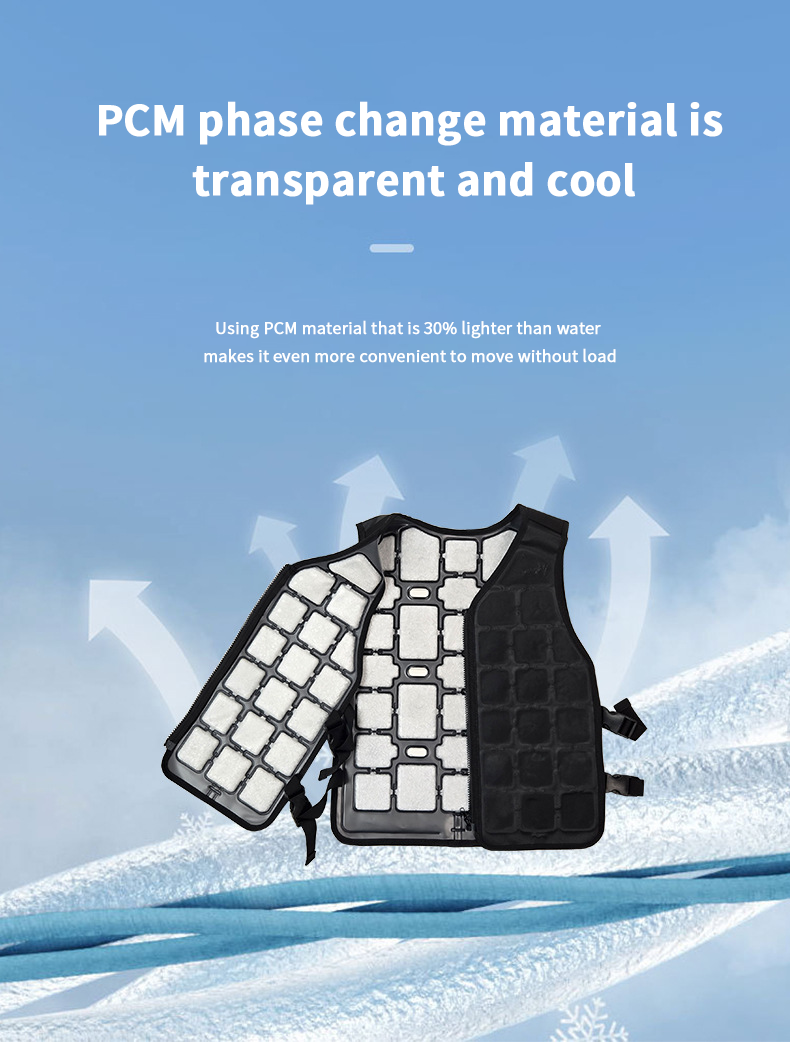
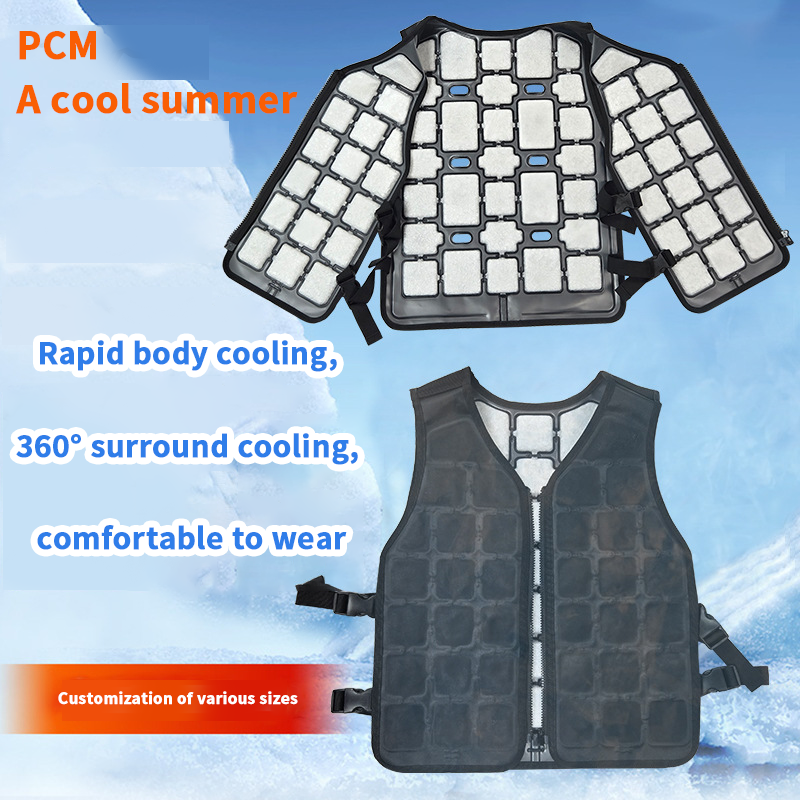
The material soaks up heat as it shifts from solid to liquid. This keeps a steady cooling temperature for 8–12 hours. It handles high humidity. It’s recyclable. It also holds up through heavy physical labour, where body heat adds to the external temperature load.
The global industrial cooling vest market sits at USD 420 million (2023). It’s on track to hit USD 710 million by 2032. PCM technology takes the biggest slice of that growth, pushed along by mining and heavy industry demand. R&D spending on PCM efficiency has climbed 24% since 2020.
Best for: Full-shift protection in extreme heat, humid underground environments, high-exertion roles.
Ice Pack-Based
Ice pack vests hit hard at the start — but they have real limits across a 10–12 hour mining shift.
2023 lab testing produced this performance data:
|
Vest Model |
Avg Cooling Power (J/s) |
Total Energy (J) |
Wet Weight (oz) |
|---|---|---|---|
|
FlexiFreeze (96 ice cubes) |
59.59 |
427,521 |
76.20 |
|
Ylnewways (6× 400ml packs) |
55.63 |
562,291 |
— |
|
Qore ICEVEST HiVis Class 2 |
50.04 |
944,689 |
162.00 |
|
Qore ICEPLATE EXO-SLK |
48.27 |
946,880 |
21.90 (dry) |
|
NJDGF HiVis |
25.13 |
562,291 |
— |
Two things jump out from this data.
First, vest fit matters a lot. The NJDGF HiVis scored just 25.13 J/s because poor fit broke skin contact and cut cooling output.
Second, wet weight adds up fast. The ICEVEST HiVis Class 2 reaches 162 oz fully loaded — that’s over 4.5kg of extra weight a miner carries through an entire shift. Over a long day, that load becomes a real problem.
Best for: Shorter rotations, surface roles, sites without compressor infrastructure.
Evaporative Cooling
Evaporative vests pull heat away from the body through water evaporation. They’re light, low-cost, and simple to add into existing PPE setups.
The trade-off is clear: humidity kills performance. Underground mines in Queensland’s deeper operations often run high moisture levels in the air. More humidity means slower evaporation and less cooling. For surface work in dry heat or open-cut environments, evaporative vests are a practical, budget-friendly choice.
Best for: Dry-climate surface operations, lightweight PPE layers, lower-heat exposure roles.
Quick Reference: Which Technology Matches Your Site?
|
Site Condition |
Recommended Technology |
|---|---|
|
Underground, >45°C, confined |
Liquid circulating |
|
Full 10–12 hour shifts, high humidity |
Phase change (PCM) |
|
Surface roles, shorter rotations |
Ice pack-based |
|
Dry open-cut, lightweight priority |
Evaporative |
There’s no single right answer for mine site heat management. The best choice depends on your site’s specific conditions. Humidity, shift length, worker mobility, and existing infrastructure all play a role. Most large Australian mining operations use more than one technology across different site zones.
Key Customisation Options for Mine-Site Branded Cooling Vests
Some manufacturers treat mining sites like any other industrial worksite. That’s where procurement decisions go wrong. The right customisation options separate a vest that survives a Pilbara summer from one that fails by week three.
Here’s what to lock in before you place a bulk order.
Branding and Visual Compliance
Mine-site vests carry more than your logo. Reflective strips meet low-light visibility requirements. Hi-vis panel colours match site-specific PPE colour codes. Logo placement covers the chest and back panels — either through embroidery or heat-transfer printing. Both methods hold up through repeated washing and hard daily wear.
These aren’t cosmetic choices. Branded vests that meet hi-vis standards also serve as OHS compliance records during site audits.
Cooling Technology Configuration
Not every vest ships the same way. Good manufacturers let you choose the cooling system based on your site’s actual conditions:
|
Configuration |
Shift Coverage |
Best Application |
|---|---|---|
|
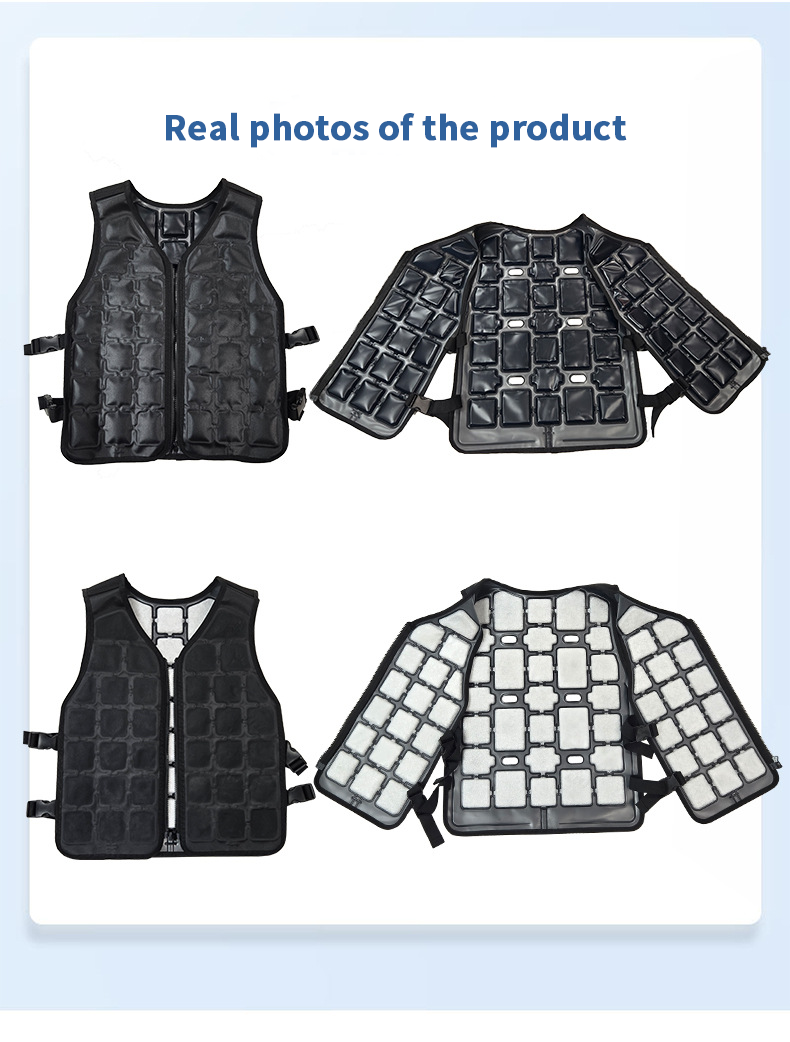
PCM (4-pack: 2 front, 2 back) |
8–12 hours |
Underground ops, high humidity |
|
Evaporative fabric zones |
Up to 8 hours |
Open-cut, dry surface work |
|
Thermoelectric (Peltier-based) |
Variable, precise |
Enclosed high-heat machinery areas |
PCM packs recharge in a standard freezer. That’s 5 minutes for a partial top-up or 12 hours for a full freeze cycle. Evaporative vests soak in water for 5–10 minutes. Both options fit into existing site break schedules. No extra infrastructure needed.
Ergonomic and Sizing Specifications
The standard range runs S through 5XL, with chest measurements from 90cm to 140cm. A loaded vest weighs between 0.5kg and 1.5kg. That’s light enough to wear under full PPE across a 10–12 hour shift without adding real fatigue.
Adjustable shoulder and side straps let each worker set their own fit. This is especially useful in tight underground spaces. Bulk reduces mobility there and creates friction against PPE layers.
Flame-Retardant and Durability Upgrades
Australian mining regulations in certain zones require flame-retardant outer fabrics. Specify this upfront — don’t leave it as an afterthought. Reinforced stitching at stress points — armholes, side panels, strap anchors — extends vest life in high-abrasion underground environments.
A vest that lasts two seasons instead of one cuts your per-worker cost on large headcounts. That saving adds up fast across a full site crew.
Top Custom Cooling Vest Manufacturers Supplying Australian Mining Sites
The global industrial cooling vest market is smaller than you’d think. A handful of manufacturers truly understand high-heat work environments. The rest are filling shelf space.
Market data backs this up. The top five manufacturers control 45% of global cooling vest revenue as of 2024. That concentration tells you something useful — it shows where the real engineering investment, compliance track record, and production capacity sit.
Here’s who carries real weight in the market supplying Australian mining sites.
The Manufacturers Worth Evaluating
Arctic Heat Pty Ltd is the strongest Australian-based option. They operate as a local Pty Ltd entity, which means local manufacturing infrastructure, faster lead times into WA and QLD, and no cross-border compliance headaches. Their main focus is phase change material (PCM) vests for industrial and medical use — the same PCM technology that works best in full-shift underground mining.
Global players with confirmed presence in industrial and mining sectors:
-
Glacier Tek — A top name in thermal solutions worldwide. Their patented evaporative cooling technology leads in industrial and medical markets. They rank among the top five by revenue year after year.
-
Techniche International — Builds advanced PCM vests for extreme heat. Their steady-temperature cooling profile suits deep-mine conditions, where heat stays brutal for an entire shift.
-
Polar Products — Covers a broad occupational range. They sit second in market share behind Glacier Tek, with solid credentials across industrial and medical crossover applications.
-
Steele Industries — Built for mining-relevant durability. Their industrial vest line holds up in high-abrasion conditions without breaking down.
-
Ergodyne — Offers a wide industrial range with proven comfort and durability in mining-adjacent settings.
For drier surface environments, HyperKewl is a strong pick for lightweight evaporative cooling. They carry solid recognition in high-temperature occupational work.
What the Market Size Signals for Procurement
The numbers here are worth paying attention to. The industrial cooling vest segment sits at USD 420 million (2023) and is heading toward USD 710 million by 2032. Mining is a primary growth driver — not a side note.
Australia’s mining equipment market is projected to reach US$18,076 million by 2033, growing at a 7.3% CAGR. PPE categories, including cooling vests, move alongside that equipment spend. That growth is pulling more manufacturers into the Australian supply chain. You get more options — but also more noise to sort through.
The smarter path is direct engagement with manufacturers who have real industrial mining supply experience, confirmed customisation capability, and existing Australian logistics infrastructure. Going through distributors adds margin without adding technical knowledge. Cut out the middleman where you can.
How to Evaluate a Cooling Vest Manufacturer for Your Mining Operation
Picking the wrong cooling vest manufacturer is a costly mistake — and it shows up fast. Failed vests, overheated workers, and a procurement cycle you have to run again mid-summer. That’s a problem you don’t want.
Six specs separate manufacturers who understand mining from those who don’t.
The Six Specs That Matter
1. Melt Point Temperature
Standard industrial PCM runs between 14–18°C. Deep-mine environments often need packs closer to 25°C. Get the melt point wrong and the phase transition fires too soon — or not at all. Ask for this number upfront. Don’t accept a range. Get the exact figure.
2. Duration Capacity
Standard PCM packs last 1.5–4 hours. Newer materials push that to 8–12 hours. A 10-hour mining shift on a 4-hour pack leaves your workers unprotected for half their day. Ask for extended-duration packs or a documented rotation system with spare stock on hand.
3. Vest Mass
Target 1.12 kg for full torso coverage. Every kilogram above that adds physical fatigue. Fatigue builds heat stress risk across a long shift. Weight matters more than most buyers realise.
4. Physiological Strain Index (PSI) Reduction
This is where manufacturers show their real engineering capability. PCM2-class systems deliver −2.2 PSI reduction versus no vest, and −0.8 versus lower-spec alternatives. Ask for documented PSI data — not a marketing summary. Numbers on a data sheet beat claims in a brochure.
5. Ergonomic Compatibility
Controlled trials flagged ergonomic failures in 8 of 12 participants wearing badly designed vests. Unbalanced pack distribution cuts trunk movement — a serious issue in tight underground spaces. Check for adjustable sizing and full PPE compatibility before you commit to an order.
6. Recharge Logistics
A vest with a 30–45 minute freezer recharge cycle needs your site to support it. Battery-operated systems require charging infrastructure. Circulating liquid systems need electrical input. Passive gel-pack systems need more freezer space but have fewer moving parts — that’s why they tend to be more reliable in the field. Match the recharge system to your site’s break schedule and what your infrastructure can handle.
Questions to Ask Every Manufacturer
Get clear answers to these before you request a quote:
-
What is the documented PSI reduction for their specific vest model under mining-relevant conditions?
-
Can they provide real cooling duration data at your site’s WBGT levels — not lab averages?
-
What recharge infrastructure do they recommend, and do they support on-site freezer logistics?
-
Is the vest rated for your specific ambient temperature range and shift duration?
Manufacturers who can’t answer these with hard data aren’t building vests for serious mining operations. They’re building vests for warehouses.
Match Environment to Spec Before You Order
Measure WBGT — not just air temperature. Humidity and radiant heat push the real thermal load well beyond what a dry thermometer shows. From there, match melt point to your ambient conditions. Plan recharge logistics around your shift structure. Check any applicable WHS compliance requirements before you lock in your specifications.
Cooling performance benchmarks from military and industrial testing put the range at 85–160 watts across passive and active systems. Your site’s right spec sits somewhere in that range. The wrong manufacturer won’t help you find it — and that’s a problem you’ll feel by week two of summer.
Custom Cooling Vest Compliance Checklist for Australian Mining WHS Standards
Australian mining WHS compliance is mandatory. The regulatory framework around cooling vests is far more specific than most procurement teams expect.
Your cooling vest must sit inside your site’s Safety Health Management System (SHMS) as a formal heat exposure control measure. That means documentation, trigger thresholds, and a clear chain of responsibility — not just handing out vests at the start of summer.
Regulatory Thresholds You Need to Know
Queensland’s Coal Mining Safety and Health Regulation 2017 sets hard numbers:
-
Underground: Wet bulb temperature above 27°C requires mandatory health provisions [s369(1)]
-
No work permitted if Effective Temperature (ET) exceeds 29.4°C — unless the site holds specific exemptions [s369(3)]
-
Surface operations: A documented procedure to protect workers from heat illness is required [s143]
The heat stress index also depends on where your workers are:
|
Environment |
Required Index |
|---|---|
|
Underground coal |
Effective Temperature (ET) |
|
Surface / open-cut |
WBGT, Predicted Heat Strain (PHS), or Thermal Work Limit (TWL) |
The Six-Factor Risk Checklist Before Specifying a Vest
Lock in your cooling vest spec only after checking each of these against your site conditions:
-
Air temperature and humidity — core inputs for any heat stress calculation
-
Air movement — natural or forced; this has a strong impact on evaporative cooling vest performance
-
Radiant heat load — from sun exposure, nearby equipment, or rock surface temperatures
-
Clothing breathability — your PPE stack must allow sweat evaporation, or vest performance drops fast
-
Metabolic heat load — task type and shift duration both matter here
-
Worker acclimatisation status — new starters carry a higher, documented risk level in months 1–12
PPE and Hi-Vis Integration Standards
Cooling vests on Australian mine sites must meet AS hi-vis standards:
-
Reflective tape: minimum 50mm wide, in hoop, X-back, or H-pattern configuration
-
Background fabric colour is unrestricted — black base fabric is fine, as long as the tape placement is correct
-
The vest must perform under full PPE in temperatures above 40°C. This is the standard across Pilbara surface operations, so test for it
Recognised Standards Governing Compliance
Two documents sit at the centre of Australian mining heat compliance:
-
Recognised Standard 18 — Underground heat management (August 2021)
-
Guidance Note 32 — Surface coal heat exposure (January 2022)
Reference both in your procurement decision. Operations that span underground and surface zones fall under two separate compliance frameworks at once — so you need both documents on file, not just one.
Triggering the Right Response at the Right Time
Cooling vests don’t operate in isolation. They sit within a TARP (Triggered Action Response Plan) framework. Set your response triggers to match ET thresholds for underground operations. For surface work, align them with Bureau of Meteorology ambient forecasts.
The broader control hierarchy includes fans, spot cooling, insulated crib rooms, task rotation, buddy systems, and potable water access. Cooling vests are a critical personal control layer — but they don’t replace the engineering and administrative controls above them. Those must stay in place.
Real-World Results: Cooling Vest Performance Data From Australian Mine Sites
The honest answer: large-scale, site-specific cooling vest performance data from Australian mine sites is limited in published literature. Most of what exists comes from controlled lab simulations and small-scale field evaluations — not long-run production environment studies.
Here’s what the available evidence shows:
-
18 miners tested in a field usability evaluation reported strong acceptance of cooling vest use — but researchers didn’t capture numerical cooling metrics
-
Three commercial cooling vests were compared against evaporative cap and sleeve combinations for heat stress reduction — no Australian mine-specific figures were recorded
-
Four portable cooling systems were evaluated at 35°C, 50% RH wearing insulated clothing — conditions comparable to underground Australian operations, though no local site context was documented
The data gap is real. It’s also a signal.
Australian mining operators have an opportunity here. Run your own controlled vest trials. Track core temperature, PSI scores, and incident rates before and after deployment. That data becomes your strongest internal case — one you can use for procurement decisions and WHS audit documentation. No published study will give you site-specific numbers. Your own trial will.
FAQ: Custom Cooling Vest Orders for Mining Sites
Procurement teams ask the same questions every season. Here are direct answers.
What’s the minimum order quantity for custom branded vests?
Most manufacturers start at 50 units for mining operations. Sites ordering 200+ units get better per-unit pricing and move to the front of the production queue.
How long do cooling packs last on a shift?
PCM inserts deliver 4–6 hours of steady cooling. Ice and gel packs run 2–3 hours. For a 10–12 hour shift, set up a documented rotation system with spare packs kept on-site. Never depend on a single charge to carry a full shift.
Can vests meet Australian flame-retardant requirements?
Yes. FR-rated outer shells come as a standard customisation option. Specify this upfront. FR fabric, reinforced stitching, and hi-vis reflective tape can all be built into one vest. With FR and reflective specs, expect a lifespan of 2–3 years under mining conditions.
What sizes are available for bulk orders?
Standard sizing runs S through 5XL. Each vest includes hook-and-loop shoulder straps and elastic side panels. Workers can adjust the fit themselves — useful on sites where body types vary across the team.
Conclusion
Protecting your workforce from heat stress isn’t just an OHS checkbox. It’s the difference between a productive mine site and a liability waiting to happen.
The right custom cooling vest manufacturer gives you more than a product. You get WHS-compliant gear built for Australia’s harshest environments. It’s branded to your operation and priced for bulk orders — making it practical for large-scale deployment.
Running an open-cut iron ore operation in the Pilbara? Managing a deep underground copper mine in Queensland? The solution exists. You just need the right manufacturing partner behind it.
Don’t leave heat management to chance this season.
Here’s what to do next:
-
Request a custom sample to check fit, material, and branding quality
-
Compare your options using the evaluation checklist in this guide
-
Get a bulk quote from a manufacturer — cut out the middleman and stretch your procurement budget further
Your workers stay cooler. Your site stays compliant. Your budget goes further.
The smartest mine site safety investment you’ll make this year costs less than one heat-related incident.