
Ordering 50 units or 5,000 — that single number can make or break your procurement decision.
Are you kitting out a construction crew in branded safety gear? Sourcing corporate branded cooling vests for a summer trade show? Or scaling up as a distributor with your own label? No matter the situation, MOQ is the first question on the table.
Most suppliers bury that answer behind a contact form. Not here.
This guide covers what minimum order quantities look like across every customization method and vest type. You’ll see what pushes those numbers up or down. Plus, you’ll learn how to structure your order for the best per-unit price — all before sending a single inquiry.
What’s The MOQ For Custom Logo Cooling Vests?
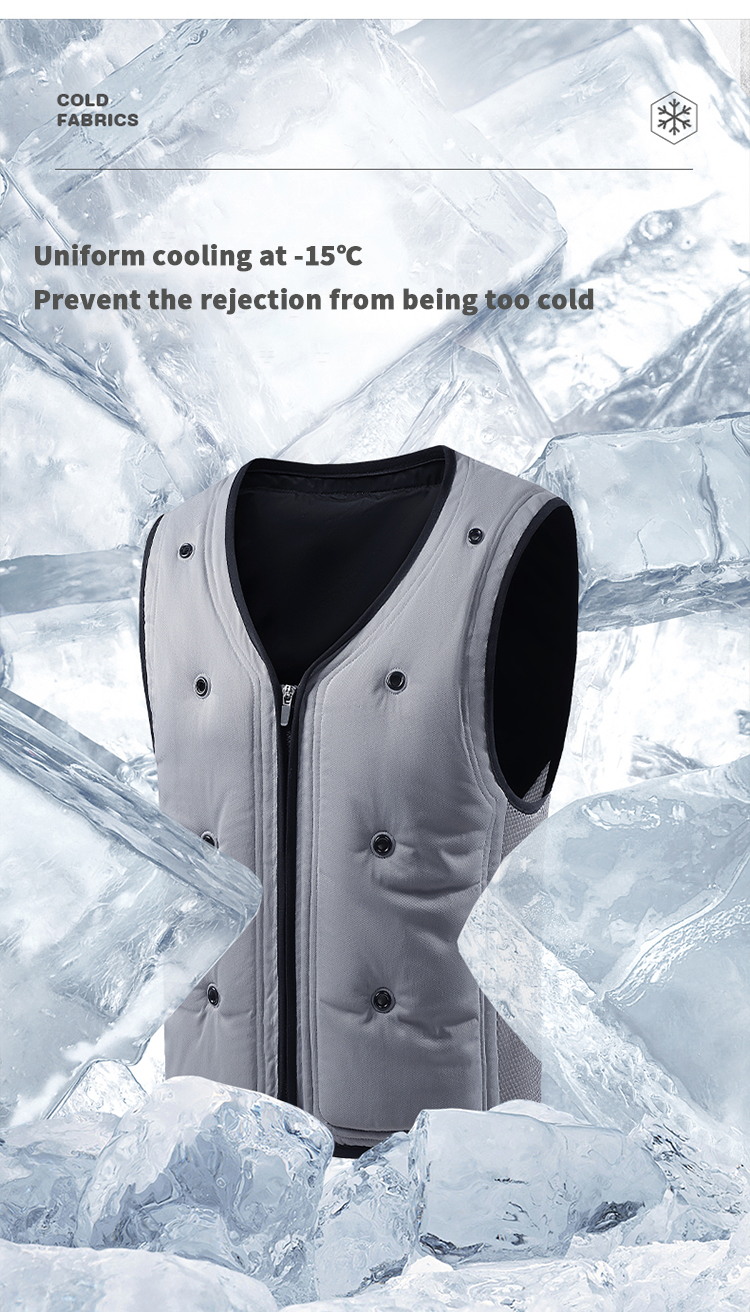
The MOQ depends on how you’re customizing — and the range is wider than most buyers expect.
Here’s a clear breakdown for procurement planning:
By Customization Method:
– Embroidery or DTG digital print: 1 piece minimum — great for samples or small pilot runs
– Screen printing: 12 pieces minimum
– Patches: 25 pieces minimum
– Safety vest imprinting: 20+ pieces (mix-and-match colors and sizes are allowed)
By Vest Type:
– OEM/ODM ice pack cooling vests (full custom logo, specs, packaging): 500 pieces minimum
– Cut-and-sew domestic custom vests: 144 units
– Standard domestic branded vests: 48 units
Running a corporate branded cooling vest program? Or sourcing as a bulk cooling vest supplier? At 500 units, you get full OEM control — custom specs, private labeling, all of it. Smaller teams still have solid branded options starting at 12–48 units.
Know your volume before you reach out. It drives everything from unit cost to lead time.
What Is the MOQ for Custom Logo Cooling Vests? (Direct Answer)
The short honest answer: it depends on the vest type — and the gap between the lowest and highest MOQ is massive.
For Coolheatech’s OEM ice pack cooling vests, the minimum order quantity is 500 pieces. That threshold exists for a reason. These aren’t products sitting on a shelf ready to ship. Each unit is built with industrial-grade materials:
-
Scratch-resistant, leak-proof PEVA gel packs
-
600D Oxford shell fabric
-
3D mesh inner lining
Building each vest takes multi-layer assembly. Add AQL 2.5 quality control across the full run, and that scale demands a real production commitment.
So what do 500 units get you? Full logo customization, structural spec control, and private labeling. You also get access to a factory running 50,000 units per month with a 30-day lead time.
Not ready for 500 yet? Start with 1–3 physical samples first. Lead time for samples is 15–20 days. Each sample goes through real-world cooling and performance testing. Plus, the sample cost credits toward your full MOQ order — so it’s not money wasted.
For phase change cooling vests with logo embroidery, MOQ requirements are more flexible. Send a direct inquiry with your volume, and we’ll give you the exact numbers.
MOQ by Customization Method: Embroidery, Screen Print & Heat Transfer

Your decoration method does more than shape how your logo looks. It controls your minimum order threshold, your unit economics, and your lead time.
Three methods dominate the custom logo cooling vest market: embroidery, screen printing, and heat transfer. Each one runs on a different MOQ logic.
Embroidery starts at just 1–6 pieces. Setup is minimal — digitizing runs $15–25 per design. A left-chest micro logo (3,000–5,000 stitches) costs $1.50–2.50 per unit. Step up to a full center-chest design at 10,000–15,000 stitches, and you’re looking at $3.50–5.50. The trade-off? That raised, textured finish holds up past 100 washes. It’s built to last. For phase change cooling vest logo embroidery orders at 200 units, landed costs drop to around $12.50 per piece — with a retail ceiling of $75+.
Screen printing needs 12–24 pieces per design as a working minimum. Single-color runs can start at 10 garments on a hand press. Push to 7–8 colors on an automatic press, and you’ll need 50+ pieces to cover the $25–40 per-color setup cost. For workwear cooling vest wholesale buyers, the sweet spot sits at 35+ pieces across 1–3 colors. That’s where the per-unit cost starts making real sense. Durability holds at 50–70 washes. At 50 units, your estimated landed cost runs around $14.50.
Heat transfer (DTF/HTV) has no minimum. Setup cost is $0. So a 10-piece heat stress vest custom order is a real option — great for event prototypes, pilot programs, or outdoor event cooling vest promotion runs. The catch is longevity. Expect 25–40 washes, depending on adhesive quality.
Here’s the full comparison at a glance:
|
Metric |
Embroidery |
Screen Print |
Heat Transfer (DTF) |
|---|---|---|---|
|
MOQ |
1–6 pieces |
12–50+ pieces |
1+ pieces |
|
Setup Cost |
$15–25 |
$25–40/color |
$0 |
|
Durability |
100+ washes |
50–70 washes |
25–40 washes |
|
Unit Cost (bulk) |
$1.50–$18 |
Drops with volume |
Higher per unit at scale |
|
Best For |
Premium branded gear |
Bulk cooling vest programs |
Small runs, full-color logos |
Here’s the straight breakdown by volume:
-
Under 50 units — DTF is your lowest-friction starting point. No setup cost, no minimums.
-
50–200 units — Screen printing gives you the best cost-per-impression in this range.
-
200+ units — Embroidery takes over as the premium durability choice. Pair it with evaporative cooling vest custom print on the back panel via screen printing, and you cover both branding and budget.
Match your method to your volume. That one decision can shift your landed cost by $3–5 per unit.
MOQ by Cooling Vest Type: Standard vs Phase-Change vs Ice Pack Vests

Vest type is the single biggest variable that drives your MOQ. The gap between the lowest and highest threshold is close to 150x — that’s a wide range.
Here’s what that looks like in practice.
Standard (Evaporative) Vests have the lowest entry point. You get an 8–12% bulk discount at just 10–24 units. Push to 100+ units, and that discount jumps to 28–35% off retail. Products like the PIP ANSI Type R Class 2 at $34.99 per unit are a good example. For construction sites or corporate gift programs, this is your most flexible starting point. No PCM calibration needed. No complicated assembly either.
Ice Pack Vests sit in the middle range. Small runs are doable, but the economics don’t really work until you hit 500+ units. Below that, gel strip sourcing and fixed adjustment costs eat into your margin fast. Loaded weights run 14.55–20.80 lbs per vest — that adds up quickly in shipping cost calculations at scale. Products like the ICEVEST Class 2 ($148.30 loaded) or the Steele Vest (6 frozen gel strips per unit) show just how layered the cost structure gets.
Phase-Change (PCM) Vests need the highest commitment — the minimum order runs 500–1,500 units. You hit the real efficiency window at 1,000+ units, where OEE reaches 75–85%. Why does it take so many units? Three reasons:
-
PCM formula calibration for 18°C activation
-
Reinforced seam construction built for temperature cycling
-
Multi-layer QC protocols that only make sense at production scale
Coolheatech’s PCM line targets 82% OEE. The hard cap sits at 10,000 units per cycle. A 3-week backlog triggers an overload flag.
Here’s how these thresholds map to real procurement scenarios:
|
Vest Type |
Typical MOQ |
Bulk Discount Threshold |
Key Cost Driver |
Loaded Weight |
|---|---|---|---|---|
|
Standard |
10–100 units |
100+ (28–35% off) |
Basic fabric, no packs |
N/A |
|
Ice Pack |
50–500 units |
500+ for reliability |
Gel strips, fixed adjustment |
14.55–20.80 lbs |
|
Phase-Change |
500–1,500 units |
1,000+ (OEE 75–85%) |
PCM recharge + customization |
6–9 lbs w/packs |
Match your scenario to the right vest type:
-
Building sites — Standard vests at 10–100 units work well for evaporative quick reuse. Ice pack vests at 50–500 units suit short, high-heat shifts.
-
Marathon or outdoor events — Phase-change at 500+ units gives you 4 hours of steady 64°F cooling. Ice pack at 100 units works as a solid backup layer.
-
Corporate branded cooling vests for gifts — Standard at 24 units hits the first discount tier. Stay away from PCM below 500 units. The setup cost destroys your per-unit economics.
One rule of thumb: order below a vest type’s efficiency threshold and you pay more per unit. You also take on higher lead time risk. At Coolheatech, orders below 500 units for PCM or OEM cooling vest factory programs don’t qualify for the 30-day production guarantee. Go above 500, and the system handles it without issue.
5 Key Factors That Affect Your Custom Cooling Vest MOQ
MOQ isn’t a random number a supplier pulls from thin air. It’s a math problem — and five specific variables drive that number.
Know these factors and you gain real leverage. You’ll see why a supplier quotes 500 units instead of 100. You’ll also know which pressure points to hit at the negotiating table.
1. Setup Costs and Break-Even Economics
Every production run carries fixed overhead before a single vest ships. For most OEM cooling vest factory programs, that number sits around $5,000 — covering tooling, digitizing, administrative coordination ($50–$750), and line setup.
Now add variable costs of $12–$15 per vest with a $20 selling price. The break-even formula makes it clear:
Fixed Costs ÷ (Selling Price – Variable Costs) = Minimum Viable Units
Plug in the numbers: $5,000 ÷ ($20 – $15) = 1,000 units just to cover the factory’s exposure. Suppliers don’t guess at MOQ — they calculate it.
2. Factory Capacity and Production Scheduling
A factory running at 85% capacity can take on a mid-sized workwear cooling vest wholesale order within 2–3 weeks. Push that same factory to 95% capacity and your lead time stretches to 5–8 weeks. The MOQ also goes up. At that load, the factory can justify fitting you into the schedule for larger runs only.
Order timing matters more than most buyers expect. Ordering during peak season means higher minimums and longer waits. Off-peak windows give you more room to negotiate smaller initial runs.
3. Shipping and Carton Logic
Freight creates hard minimums that have nothing to do with production. Most suppliers ship in 50-unit cartons — no partial boxes. Your order quantity must align with complete carton multiples. Miss that mark and you’re paying for dead freight.
The economics get sharper at scale. A 30% freight cost increase — say, from $750 to $975 per shipment — can push a supplier’s ideal MOQ from 1,600 to 1,800 units in a single move. That cost lands on you as the buyer.
Free shipping thresholds kick in above certain MOQ levels. For bulk cooling vest supplier programs, run the numbers. Check whether hitting that threshold saves more than placing a smaller order.
4. Raw Material Supplier Minimums
Your vest supplier has their own suppliers. Those suppliers have their own MOQs.
Specialized components — PEVA gel packs for ice pack vests, PCM materials calibrated for 18°C activation, 600D Oxford shell fabric — often carry bulk purchase requirements at the raw material level. The manufacturer absorbs that minimum and passes it down to you as your MOQ.
This matters most for phase change cooling vest logo embroidery programs or any safety cooling vest custom branding order built on non-standard materials. More specialized specs mean a tighter raw material chain — and a higher floor for your order.
5. Volume Discount Tiers and Holding Costs
Price breaks don’t scale in a straight line. They jump at set thresholds:
|
Order Volume |
Per-Unit Reduction |
|---|---|
|
500 units |
$1 less vs. smaller runs |
|
1,000 units |
Additional $1 reduction |
|
2,500 units |
Best available rates |
Here’s what most buyers miss: the 1,000-unit tier can outperform the 2,500-unit tier once you count holding costs. Storage runs $0.50–$2 per unit per year — about 20–30% of inventory value. Order 2,500 units for a 1,000-unit need, and those savings disappear in your warehouse.
One practical formula: Calculate your real rotation needs before chasing the next price tier. A 20-person crew running double shifts (16–18 hours/day) needs at least 3 vests per worker for continuous rotation — that’s 60 units at minimum, before branding or backup stock.
The bottom line: MOQ is negotiable — but you need to understand what’s driving it first. Lock specs early to avoid mid-production resets. Share rolling demand forecasts to support lower initial minimums. Schedule quarterly reviews as your volume grows. Suppliers respond to buyers who show up prepared.
Pricing Per Unit: What Does MOQ Mean for Your Budget?

Unit price isn’t what you pay. Effective unit price is the real number — and MOQ controls it more than anything else.
Here’s the math most suppliers won’t show you upfront.
At 24 units, you pay a baseline rate with zero bulk discount. Stack on one-time setup fees ($50–200), sample costs ($20–50 for 1–3 proofs), and freight ($100–500 flat or $0.50–2 per unit). Your effective cost per vest climbs fast.
Scale to 100 units and the per-unit price drops 20–30%. Fixed costs spread across more pieces. That setup fee that hurt your margins at 24 units becomes a small line item at 100.
The real turning point hits at 500 units. Per-unit cost drops another 30–40% compared to the 100-unit tier. A vest with an effective price of $14.30 at 100 units can land closer to $11.00 at 500.
|
Quantity |
Per-Unit Savings vs. Baseline |
What Changes |
|---|---|---|
|
24 pcs |
Baseline |
No discount; setup costs dominate |
|
100 pcs |
20–30% lower |
Economies of scale kick in |
|
500 pcs |
40–50% lower |
Setup fees shrink to almost nothing |
|
1,000+ pcs |
50–60%+ lower |
Maximum volume pricing |
Chasing the lowest per-unit price isn’t always the right call. At 2,500 units, you tie up serious working capital. Holding costs run $0.50–2 per unit per year. Order more than your rotation needs, and those savings disappear in your warehouse.
The budget formula that works:
-
Calculate your fixed costs (setup + freight) ÷ order quantity = true per-unit impact
-
Stack low-MOQ high-frequency orders against high-MOQ capital commitment — see which model fits your cash flow
-
Set your order at the quantity where margin stays above 20%. The natural break points are 100, 500, or 1,000 units
For most corporate branded cooling vest buyers and workwear cooling vest wholesale programs, the 100–500 unit range hits the sweet spot. You get solid per-unit savings without tying up too much inventory capital.
Sample Policy: Can You Order Below MOQ to Test First?
Yes — and most buyers never ask. That’s money left on the table.
Before locking in 500 units of a custom logo cooling vest, start with 1–3 physical samples. Sample lead time is 15–20 days. Each sample goes through real cooling performance testing — not just a visual mockup.
Here’s what matters for your budget: sample costs credit toward your full MOQ order. It’s not a sunk cost. It’s a deposit.
This is especially important for phase change cooling vest logo embroidery and OEM cooling vest factory programs. Material specs and branding placement need real-world validation. Locking in 500+ units without that step is a risk you don’t need to take.
What to send when requesting samples:
– Your logo file (AI, EPS, or high-res PNG)
– Your preferred customization method — embroidery, screen print, or heat transfer
– Target vest type and size range
– Intended use case — workwear, outdoor event cooling vest promotion, or corporate gifting
Don’t skip the sample step. A $50–150 sample investment shields a $5,000–$15,000 bulk order from a costly spec mistake. The upfront cost is small. The protection it gives you is not.
Lead Time for Custom Logo Cooling Vests: From Order to Delivery
Lead time kills more bulk orders than MOQ ever will.
You’ve confirmed your budget. You’ve locked your vest type. Then someone asks: “When do we get them?” — and the deal stalls.
Here’s the data you need before that question comes up.
Standard lead times by order volume:
|
Order Quantity |
Standard Lead Time |
|---|---|
|
25–50 units |
3–4 weeks |
|
51–100 units |
4–5 weeks |
|
101–250 units |
5–7 weeks |
|
251–500 units |
7–9 weeks |
|
500+ units |
8–12 weeks |
Your customization method adds time on top of that baseline:
-
Screen printing — fastest, minimal delay
-
Heat transfer — adds ~2 weeks
-
Embroidery or DTG — adds 2–3 weeks
Peak season (April–August) adds another 4–6 weeks. A 50-unit order that ships in 4 weeks off-peak can stretch to 8 during busy months. Rush production is available — expect a 15–30% cost premium.
The fix? Order in February or March. Pre-season orders run on standard timelines. No rush fees. Priority scheduling included.
One more lever worth knowing: combine pre-approved artwork, a stock base vest, and off-peak timing. That combination cuts a 30-day production window down to 15 days. Half the wait, same product.
Who Should Order 500+ Custom Cooling Vests? (Ideal Buyer Profiles)
Five hundred units isn’t a random number — it’s where the economics change completely.
At that volume, setup fees disappear. Unit costs drop to ~$76. Full OEM customization opens up. Buyers at this level aren’t guessing at demand. They have a repeatable need, a defined workforce, and a clear ROI case.
Here’s who fits that profile:
-
Industrial Safety Officers (oil/gas, mining, warehouses): A Nevada mining operation ordered 200 vests in February 2024 at $76/unit — saving $3,600 versus the July peak price of $94. A Texas utility won a 340-vest bid at $71/unit in March 2024, coming in under a $94 budget. Smart buyers also build a 110–125% inventory buffer. Take Atlanta as an example: one warehouse ordered 88 vests for 75 workers. That extra stock covered 9 new hires and 4 damaged units — no 4-week reorder delay, no added cost.
-
Large Event Organizers: Qatar’s 2022 World Cup put cooling suits on 30,000 stadium workers. Smaller events see real savings too. One 250-vest order saves $4,500 compared to five separate 50-vest runs over two years. That’s a straightforward case for consolidating purchases.
-
Brand Apparel Distributors: Setup fees run $200–400 below 50 units. At 100+, those fees drop to zero. At 500+, you get the lowest per-unit pricing plus full white-label options. The more you order, the better the margin.
-
Multinational HR Teams: The corporate cooling vest market reached $412M in 2024, growing at 6.5% CAGR. Total two-year vest cost runs ~$142/unit, covering the PCM vest and gel replacement. Order 500+ units from a single source before peak season. You lock in $76/unit and skip the mid-year scramble for stock.
How to Place a Custom Cooling Vest Order: Step-by-Step Process
Seven steps stand between your logo and a finished vest on your worker’s back. Here’s how that process works.
-
Submit your demand — Send vector artwork (AI/EPS/PDF, CMYK, fonts outlined). Include your chosen base model, decoration method, size breakdown, and shipping address.
-
Art proof approval — Use the 2-from-4 rule. Send your PO to four approvers. Two confirmations start production. Set 24-hour reminders so nothing stalls.
-
Sample confirmation — Get your revised delivery date in writing. Confirm three milestones: proof approval, production start, and dispatch.
-
Payment — Need a lower MOQ? A small bump in per-unit price usually covers it. It’s a fair trade.
-
Production begins — First orders take around 4 weeks. Repeat orders with saved assets? 1–2 weeks.
-
QC check — Ask for historical on-time delivery data. Target less than 10% variance.
-
Shipping — Air versus ground shifts your timeline by days, not weeks. Full production to delivery: 15–30 days.
One thing most buyers skip: building a digital asset library after the first order. Save your files once, and every reorder moves at half the lead time.
FAQ: Custom Cooling Vest MOQ — Quick Answers
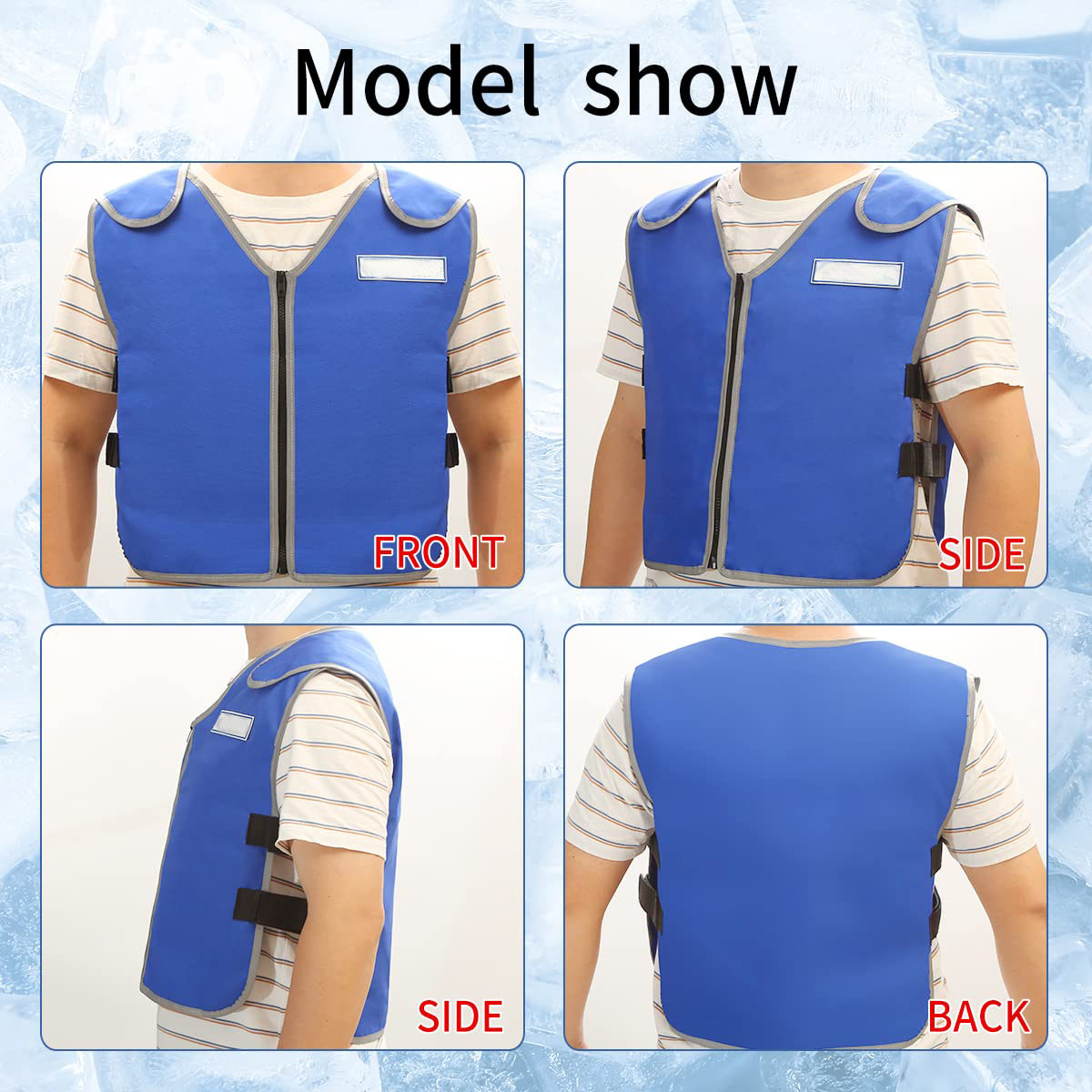
Fast answers for buyers who’ve already done their research.
What’s the standard MOQ?
50 pieces. That’s your baseline for most custom logo cooling vests. The full range runs from 1 piece (samples, DTG prints) up to 500 pieces for full OEM ice pack vest programs.
Can I mix colors and sizes within my MOQ?
Yes. Mix-and-match works fine — your total just needs to hit 50 units. Plan for at least 10 units per color or size. That keeps production running smoothly.
Is private labeling available?
Yes, we support it. OEM and ODM programs cover logo embroidery, multilingual labels, and branded packaging. Sample development takes 15–20 days.
Can you add reflective tape for safety compliance?
Yes. We add Class 2 compatible reflective strips with custom placement. These are built for outdoor and industrial environments.
What are sample lead times and costs?
Standard samples ship in 7–10 days. Custom samples take 15–20 days. Each order comes with 1–3 physical samples plus a cooling performance test report. Free sample options exist — availability depends on your specs.
What’s the production lead time?
Standard: 15–25 days. OEM programs: 30 days at 50,000 units/month capacity. Rush orders: 15–20 days with a 15% premium.
What’s the price range?
At 50+ pieces, unit price runs $46.94–$147.30. The exact price depends on vest type and how much customization you need. No-MOQ options start at $7.99.
What quality standards apply?
We run AQL 2.5 with triple inspection. You can also request third-party SGS/BV certification. Shell fabric is 600D Oxford with 3D mesh lining, rated from -20°C to 60°C.
Still have questions? Send your specs and get a quote within 24 hours.
Conclusion
You now have everything you need. Time to move from “just browsing” to placing a real bulk order.
Here’s the bottom line: most OEM cooling vest factories start at 50–100 units for standard customization. But the right supplier works around your actual needs. They won’t push you into a number that breaks your budget.
Outfitting a construction crew? Staffing an outdoor event? Building a branded safety program from scratch? MOQ is just the starting point — not a wall.
Smart buyers do three things:
-
Request samples first
-
Ask about tiered pricing upfront
-
Lock in lead times before the summer heat window closes
Don’t let MOQ questions stall your order. Request a free quote for your custom logo cooling vest today. Share your quantity, customization method, and deadline. You’ll get a clear proposal back within 24 hours.
The heat won’t wait. Neither should you.