
Field workers collapse from heat exhaustion. Warehouse managers keep filing injury reports. A better solution exists — and it’s built panel by panel on a factory floor.
PCM cooling vests have been around for a while. But customizing one from scratch is a different challenge. You choose the exact phase change temperature, the right fabric weight, and the precise pocket layout for your work environment. That’s where the real engineering work starts.
This guide covers the full custom PCM cooling vest process:
-
How raw phase change material becomes a wearable thermal management system
-
What decisions matter at each production stage
-
What separates a vest that holds up in 45°C heat from one that just looks good on a product page
You’re sourcing, specifying, or scaling an OEM order. Before you sign anything, this is the process knowledge you need.
Custom PCM Cooling Vest Full Process — Content Framework
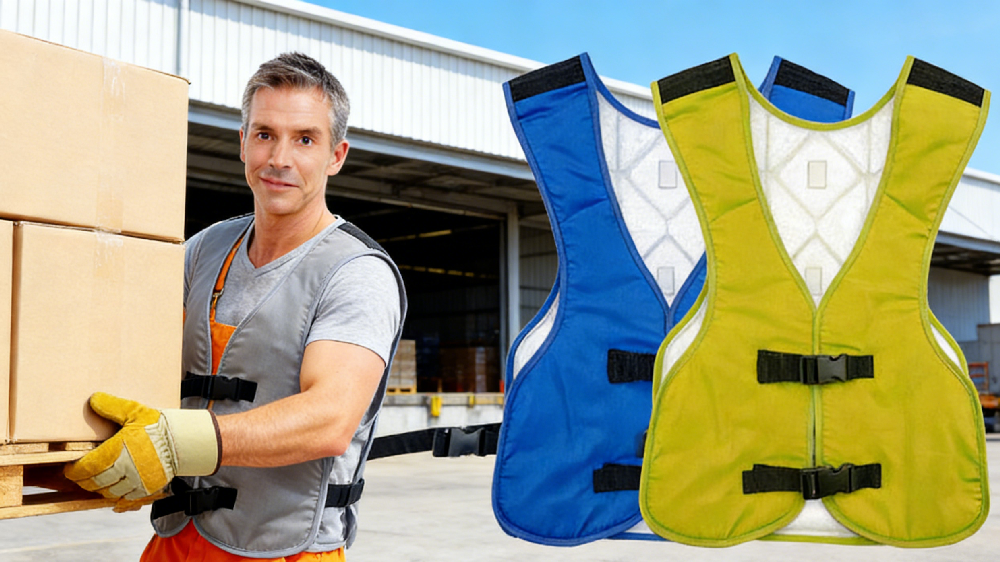
Seven stages. That’s what it takes to turn raw paraffin into a vest that keeps a warehouse worker functional at 45°C.
Each stage has real consequences. Skip DSC analysis on your phase change material, and you won’t know if your paraffin peaks at 30°C or drifts to 34°C under load. Seal the aluminum packs wrong — 0.125 mm foil, 135 g fill per unit — and you get leakage, not cooling.
Here’s the structure this guide follows:
-
PCM formulation — melting point selection, latent heat benchmarks, material variants
-
Pack fabrication — aluminum sealing, fill weight, thermal conductivity standards
-
Vest construction — 17-pack layout, layered architecture, Velcro placement
-
Testing protocol — thermocouple configuration, controlled conditions, performance validation
Every decision builds on the last. The framework below shows where each one fits.
What Is a PCM Cooling Vest and How Does It Work?
The physics here are simple. The application is not.
A PCM cooling vest holds panels of phase change material — a substance built to melt at one exact, preset temperature. That melting process absorbs heat. Your body heat. The material shifts from solid to liquid. It locks onto its set temperature and stays there. Not close. Not around it. Dead on.
Think of ice sitting in water at 0°C. It doesn’t get colder. It doesn’t get warmer. It sits at that line, pulling energy from everything around it, until the last crystal is gone. PCM runs on the same idea — except the melting point is set for human skin. Common options run from 15°C to 29°C, depending on the work environment and heat exposure level.
At the industrial end, 21°C packs are the go-to choice. They pull body heat at 108 kJ/kg of stored energy. That’s enough to keep up steady skin-level cooling for 1.5 to 4 hours in 40°C heat at 40% humidity.
No compressor. No fan. No power source of any kind.
Once the material turns to liquid, you recharge it by cooling it 3°C below the set point — a cooler, a refrigerator, cold water all work. A 21°C pack reactivates at 18°C or lower. Most of the time, that takes under ten minutes.
So what sets this apart from an ice vest? It’s not just comfort. Ice packs start too cold, drip condensation, and drop off fast as they warm up. PCM holds a constant, skin-safe temperature from the first minute to the last — no shock, no mess, no sudden drop in performance.
Step 1: Requirement Confirmation — Defining Your Custom PCM Vest Specifications
Get the specs wrong here, and everything downstream falls apart.
Before a single panel gets cut or a gram of PCM gets measured, you need a confirmed specification sheet. Not a rough idea. Not “something like what our competitor uses.” A locked document with real numbers — every decision in the production chain traces back to this one.
Four spec categories matter most:
-
PCM melting point — 6.5°C, 15°C, 21°C, or 29°C. Steel plants and foundries run hot. They need lower melt points and longer cooling time. Roadwork crews often need 29°C with reflective compliance built in.
-
Size and weight — S through 3XL, loaded weight capped at ≤1.8 lbs, with full shoulder rotation preserved. PPE compatibility is required, not optional.
-
Coverage and pocket layout — Standard torso mass sits at 1.12 kg across four pockets (two front, two back).
-
Cooling duration target — Write it as a minimum: ≥2.5 hours. Give suppliers a floor, not a fixed number.
One Dallas construction company learned this the hard way. They added three pass/fail criteria — ANSI Type R Class 2 reflective compliance, ≥2-hour cooling duration, and ≥100-cycle machine washability. That move filtered out underqualified vendors before sampling even started.
Mark your non-negotiables. State them as hard requirements. Everything else stays open for discussion.
Step 2: PCM Material Selection — Choosing the Right Phase Change Material
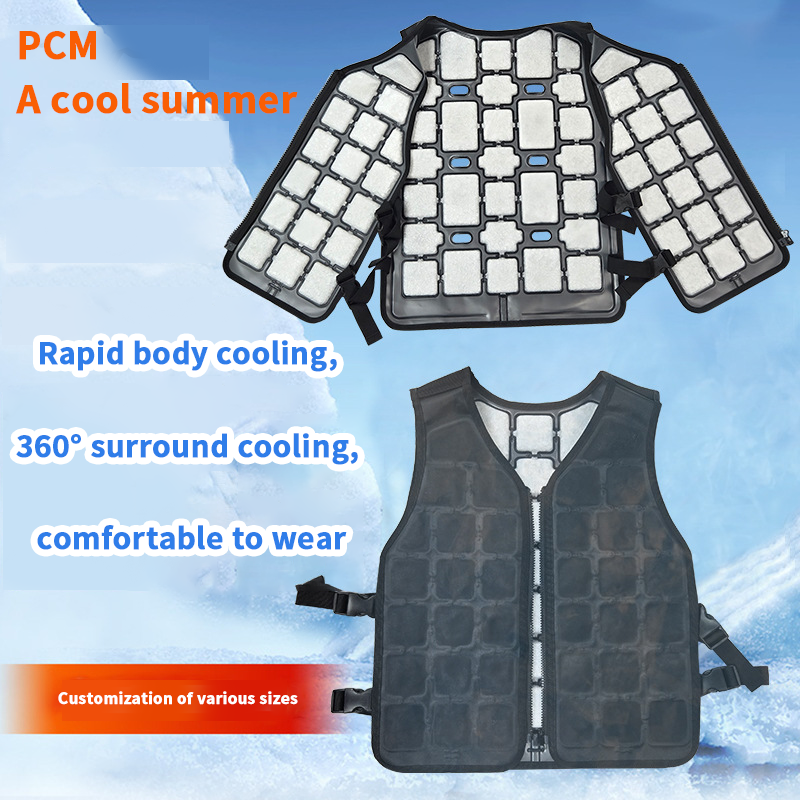
Not all phase change materials are equal. Some supercool. Some corrode aluminum. Some carry hazard classifications that rule them out for skin-contact use — before you even run a thermal test.
Material selection turns vague requirements into hard numbers.
The core selection criteria fall into four categories:
-
Thermal performance — melting point precision, latent heat per unit volume, thermal conductivity in both solid and liquid phases
-
Physical stability — high density, minimal volume change during phase transition, low vapor pressure
-
Chemical durability — no degradation across repeated freeze-melt cycles, confirmed metal compatibility to prevent pack corrosion
-
Handling and compliance — hazard classification from MSDS, hygroscopicity rating, cost per kilogram, and verified cycling stability (industry standard: 100 cycles minimum)
Three PCM families compete for this application:
-
Organic PCMs (paraffins and non-paraffins) — stable under repeated use, low supercooling, safe for direct skin contact. Most industrial vests run on paraffin-based compounds.
-
Inorganic PCMs (salt hydrates like CaCl₂·6H₂O) — higher latent heat density, but supercooling and corrosion risk demand careful encapsulation management.
-
Eutectic blends — engineered mixtures tuned to exact melting points that pure compounds can’t hit. Useful when your target temperature falls between standard grades.
Thickness determines storage capacity. A 2mm PCM slab stores 138 kJ. A 5mm slab stores 345 kJ — 2.5x the thermal reserve, at a proportional cost in vest weight and recharge time. Pick your thickness based on the minimum cooling duration you need. Not the other way around.
Qualified commercial suppliers — Rubitherm, PCM Products, PLUSS — publish DSC-verified datasheets. Check their published melting enthalpy against your target before locking in a formulation.
Step 3: Fabric & Structural Design — Engineering Comfort and Durability
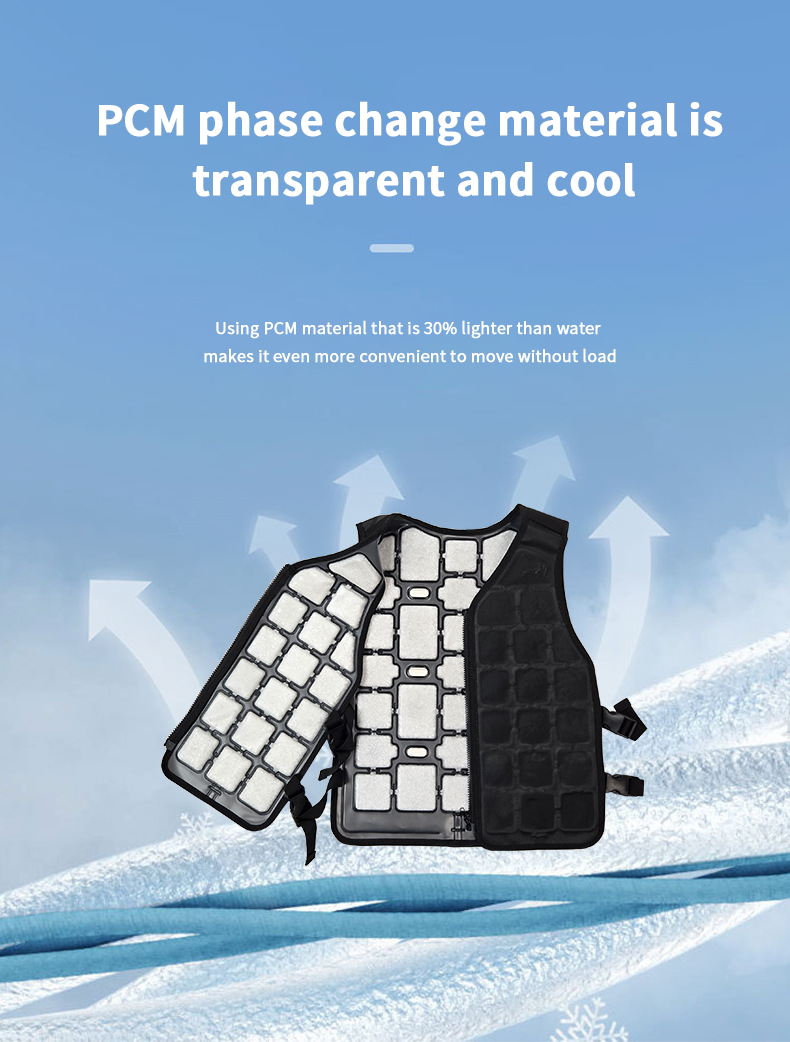
Fabric is where thermal science meets the real world. It’s also where most custom cooling vest projects either hold together — or fall apart.
PCM packs generate moisture. Workers are always on the move. Straps catch on equipment. A vest that performs well in a climate-controlled lab but shreds after six weeks on a steel floor is a failed product. The datasheet doesn’t change that.
Four fabric categories define your structural options:
-
600D Oxford — The industrial workhorse. Abrasion resistance exceeds 100,000 Martindale cycles under GB/T 21295-2014 standards. The S1 structure hits an abrasion index of 116 times/mg — the highest across all tested configurations. Choose this wherever friction and edge wear are constant threats.
-
Nylon — High strength, low stretch under sustained tension. Use it for load-bearing zones like shoulder straps and side adjustment panels. Yarn denier and threads-per-inch determine how much pull it can handle.
-
Polyester — Solid for permanent-use structures. It melts rather than burns at high temperatures. That’s a real safety advantage in foundry or welding environments.
-
Spandex blends — Weft-knitted UHMWPE constructions boost puncture resistance and mobility. Cut resistance ranges from 1,939.9 to 2,822.2 gf across S1–S4 structures. You gain flexibility, but abrasion resistance does drop off.
Structural design follows three rules:
-
17 modular PCM pockets — Standardized pocket positions let you reconfigure the layout without rebuilding the base pattern from scratch.
-
Spinal clearance zones — High-friction convex areas wear down fast. Flat-surface routing spreads pressure more evenly. This extends vest lifespan and keeps workers comfortable during movement.
-
Biaxial-rated adjustment straps — Shear strength and Poisson ratios need validation before you lock in shoulder and side hardware. Skip this step and the straps become a weak point under load.
The CAD review cycle runs 3–5 working days per iteration. Clients confirm 2D pattern specs first — base weight, tensile benchmarks, and tear ratings. Then we move to 3D stress modeling before any cutting begins.
Step 4: Cutting & Sewing — Precision Manufacturing at Scale
Fabric moves through this stage fast. Every millimeter of variance in a pocket edge shows up in a PCM panel that fits — or doesn’t.
Laser cutting replaces guesswork with geometry. Automated systems cut size variance in bulk orders by up to 25%. Manual cutting runs a 5–10% batch error rate. At scale, that gap isn’t small. It’s the difference between a clean production run and a rework pile.
Sewing follows the same logic:
-
Single-needle machines handle small-batch runs — custom sizing, prototype builds, tight specs
-
Multi-needle systems (6–15 needles) keep quality consistent across large OEM orders
-
Reinforcement zones — shoulder straps, pocket edges, adjustment panels — need 200+ stitches per unit. CNC servo-driven sewing heads deliver that
-
Automated thread cutters lower defect rates and cut out the manual rework loop. That loop kills delivery schedules
Branding gets locked in here too. Three methods, three trade-offs:
|
Method |
Durability |
Best For |
|---|---|---|
|
Embroidery |
High |
Premium tactile finish, low MOQ |
|
Heat Transfer |
Medium |
Vibrant colors, fast turnaround |
|
Silicone Printing |
High abrasion resistance |
Bulk orders, raised finish |
Anti-fray processing closes the stage. You get sealed edges, consistent density, and zero loose threads leaving the line.
Step 5: PCM Filling & Hermetic Sealing — The Core Technical Process

Precision here isn’t a selling point. It’s a structural requirement.
Every PCM pack in a finished vest holds 135 grams of phase change material — not 133, not 137. The filling system runs liquid PCM through syringe injection via bottom-entry channels. PCM enters from the bottom port. Air gets pushed out through the top. That setup isn’t random. It clears air pockets that would block thermal transfer right where you need it most.
Dosing nozzles are chosen based on two factors: material rheology and packaging geometry. Together, they keep fill error at ±2 grams per pack — under 1.5% deviation. At batch scale, that consistency is the difference between reliable cooling and unit-to-unit variation that turns into field complaints.
Hermetic Sealing: Where the Process Gets Unforgiving
The aluminum foil envelopes — 75 µm thick — get laser-welded at both inner and outer seams after filling. Temperature and pressure settings are dialed in for each specific foil shape. The weld holds or it doesn’t. No partial credit.
The seal standard is <10⁻¹² std cm³ He/s on a helium leak test. That equals full 24-hour immersion with zero leakage. Every single channel gets verified post-weld. Not sampled. Every one.
Dimple-formed bellows near the ID and OD edges handle what seals alone can’t. PCM melts and expands. The bellows take that volume change without pushing stress onto the weld seam. That’s the reason 8–15% void volume gets built into each sealed module before it reaches the vest.
From Sealed Pack to Vest Integration
Sealed packs sit inside the vest pocket array with bellows and dimple spacers lined up for controlled expansion. The stack compresses to maximize skin-surface contact. This is a direct response to PCM’s low thermal conductivity of 0.2–0.3 W/m·K. Tighter contact means faster heat transfer. The physics stay the same. The engineering works around them.
Latent heat retention across sealed modules runs 85–97%. Hybrid composite approaches push thermal conductivity up by 10–70%. Those aren’t theoretical ceilings — they’re measured results from sealed, integrated packs built to this exact spec.
Step 6: Thermal Performance Testing — Validating Cooling Effectiveness

A sealed pack means nothing until the numbers confirm it works.
Thermal testing turns production claims into documented performance. Two separate protocols run here — one for the PCM material itself, one for the finished vest as a complete system.
DSC Analysis: Material-Level Verification
Differential Scanning Calorimetry runs first, following ASTM D3418-21. The target is simple to state and hard to fake:
-
Melting onset: 28–32°C
-
Peak melt: 29°C
-
Latent heat: 195–210 J/g
-
Batch deviation tolerance: ±2% from the reference sample
Any batch that drifts outside that window gets pulled. No exceptions.
Whole-Garment Chamber Testing
The finished vest goes into a controlled environment — 40°C, 40% RH — for 60 to 120 minutes. A mannequin or human subject first settles at a 35°C baseline. Then the clock starts.
Testers log data every five minutes: skin temperature, core temperature, heart rate, and sweat rate per ASTM F2300. The pass threshold is clear. Skin temperature must drop 3–5°C. Core temperature must stay below 38.5°C for at least 60 minutes. Class A performance clears 90 minutes of safe thermal exposure.
That raw data maps straight to product specs:
|
Raw Result |
Published Spec |
|---|---|
|
Core <38°C for 75 min |
75 min effective cooling at 40°C/40% RH |
|
–4.2°C skin reduction |
4°C cooling effect |
|
5 cycles at >90% latent heat |
Reusable, 50+ wash cycles |
PCM vests built to this protocol last 20–30% longer than evaporative alternatives at the same ambient temperature. That gap isn’t marketing. It’s chamber data.
Third-party certification — SGS, CE marking under EN ISO 13732, ISO 9001 — comes right after this stage. Submit 5–10 units. Plan for 4–6 weeks for SGS thermal cycling and 6–8 weeks for CE. Start this process now, not after mass production. A pre-certification delay costs you months, not days.
Step 7: Quality Control Checkpoints — What Gets Inspected Before Shipping
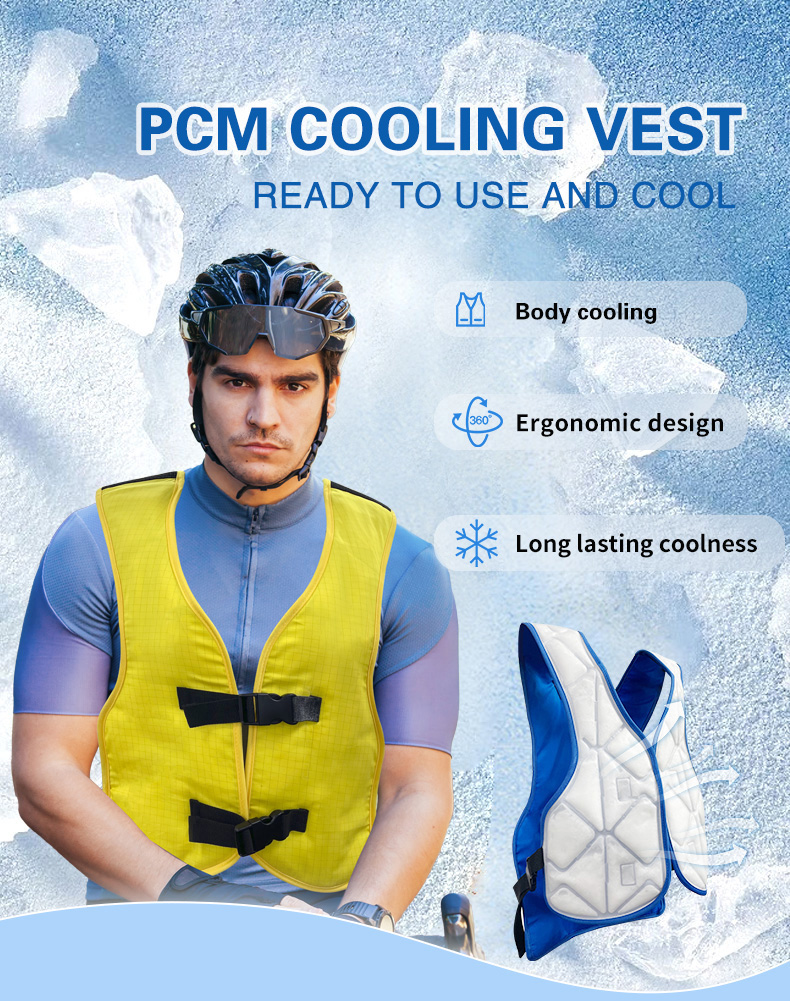
Inspectors walk the floor at 80% completion. Not at 100%. Not after the cartons are taped. Starting this gives the team time to catch and fix problems before anything ships.
Every vest clears seven inspection gates before it leaves the facility:
-
Dimensional verification — weight, pocket placement, strap hardware, and Velcro position all checked against the locked spec sheet
-
Visual and cosmetic review — seam consistency, logo accuracy, Pantone color match, and any build defects flagged under naked-eye inspection
-
PCM pack integrity — each sealed aluminum envelope re-checked against the helium leak standard set in Step 5
-
Functional test — GSM fabric density check, barcode scan, and cooling activation cycle confirmed per unit
-
Quantity audit — finished count, unfinished count, and packed units matched against the purchase order
-
Packaging validation — shipper carton specs, inner carton labeling, shipping marks, and barcode placement all checked
-
Compliance documentation — CE marking, SGS certificates, and ISO 9001 records confirmed present and accurate
Sampling runs on ANSI/ASQ Z1.4 statistical method. Inspectors measure defect rates against AQL thresholds. Any batch that goes over those thresholds stops. It gets reworked or rejected — it does not ship.
Every inspection links to a batch number, an inspector sign-off, and a date. That chain of records is what turns a quality claim into a documented guarantee.
Step 8: Packaging, Lead Time & Export Logistics — From Factory to Global Markets
The vest passed every inspection. Now the harder problem begins.
Moving certified PCM cooling vests from a factory floor to a warehouse in Houston, Rotterdam, or Dubai is not a small detail. In 2026, it’s a strategic decision with real cost consequences.
What the current freight market means for your order:
-
Ocean capacity is growing ~6% this year — an extra 1.5 million TEUs on the water. That’s rate pressure working in your favor, especially on Transpacific eastbound lanes. Lock in contracts between March and May.
-
Arrival reliability sits just above 60%. Build buffer stock into your plan. The 75–80% reliability era is not coming back soon.
-
Ground parcel costs are running 38.9% above 2018 baseline — a 5.4% year-over-year jump. For high-volume B2B shipments, ocean freight is still the go-to option.
Redundancy isn’t optional anymore. Smart buyers build dual-routing models — Mexico plus Asia, dual-port entry — to absorb tariff shocks without stopping shipments.
Standard production lead times:
|
Order Type |
Timeline |
|---|---|
|
Sample / prototype |
7–10 business days |
|
Small batch OEM (≤500 units) |
25–30 days |
|
Large OEM run (500–5,000+) |
35–45 days |
Certification documentation — CE, SGS, ISO 9001 — ships with every carton. No exceptions. You won’t need to chase paperwork after arrival.
Custom PCM Cooling Vest Use Cases — Matching the Right Solution to Your Industry

The global PCM cooling vest market hit $312 million in 2024. By 2033, that number reaches $812 million. That’s an 11.2% CAGR. It’s not driven by one industry. Four very different industries share the same unsolved problem — and each one needs a different fix.
Here’s how the segments break down — and what each one demands from a custom build.
Industrial & Construction — Durability First, Compliance Always
This is the largest segment by revenue. Manufacturing, construction, mining, oil and gas — these environments are brutal. Weak seams fail. Undersized panels don’t cut it. Workers run long shifts in sustained, punishing heat. Your vest needs abrasion-resistant fabric, wide sizing ranges, and regulatory compliance built into the spec from day one. The industrial segment alone is set to hit $351.96M by 2028.
Key requirements:
– Abrasion-resistant outer fabric
– Extended sizing ranges for diverse workforces
– Compliance certifications built in from the start
Medical & Rehabilitation — Where Skin Contact Is Non-Negotiable
Think pediatric patients. Post-surgical recovery. Multiple sclerosis management. These users can’t tolerate harsh materials or incorrect temperatures. This segment requires hypoallergenic materials, lower phase-change temperatures, and antibacterial fabric treatments. Lightweight construction isn’t a comfort preference here — it’s a clinical requirement. Every gram and every material choice carries real consequences.
Key requirements:
– Hypoallergenic, skin-safe fabrics
– Lower phase-change temperature settings
– Antibacterial fabric treatments
Military & Sports — Performance Under Pressure
Defense agencies are pairing PCM vests with real-time sensor systems for combat and training use. The data integration matters as much as the cooling itself. On the sports side — marathon runners, cyclists, endurance athletes — the spec shifts toward elastic, breathable fabrics and targeted cooling zones. Bulky designs don’t work here. The sports segment grows at 9.2% CAGR through 2030.
Key requirements:
– Sensor-compatible design for military use
– Elastic, breathable fabrics for athletes
– Targeted cooling zones for high-output performance
Each industry needs a different vest. The PCM physics stay the same. Everything else — materials, sizing, compliance, structure — gets built around the environment your workers, patients, or athletes are actually in.
How to Start Your OEM/ODM Order — MOQ, Pricing & Inquiry Process
Three numbers tell you where to begin. 500–1,000 units gets you into ODM. 2,000–5,000 is the OEM range. 10,000+ moves you into contract manufacturing. Match your volume to the right tier before reaching out.
ODM vs. OEM — the cost structure is different:
-
ODM: Lower upfront cost. The supplier handles R&D and tooling. You pay for volume, not development.
-
OEM: Custom tooling runs $5,000–$50,000. Sampling takes 2–3 months. Legal and IP costs add another $3,000–$10,000. Budget for all of it before you start.
Your RFQ should include:
-
PCM melt point, fabric spec, pocket layout, and size run
-
Target unit cost and quantity commitment
-
Certification requirements (CE, SGS, ISO 9001)
-
Branding changes — logos, colors, packaging
From there, collect 3–5 quotes. Ask for itemized cost breakdowns on each one. Then negotiate payment terms — 30% deposit, 70% pre-shipment is standard across most suppliers.
Set aside 1–2% of order value for QC. That covers DUPRO at 20–30% production completion and PSI before goods leave the floor.
Ready to spec your order? [Contact our team for a direct inquiry →]
Conclusion
Every degree matters. Your workforce faces relentless heat — and the right vest makes a real difference.
The custom PCM cooling vest full process runs on one core principle: precision at every stage drives performance in the field. That means the right phase change material. The right sealing technique. The right quality checkpoint at the right moment. None of these are small details. They separate a vest that holds up through one shift from one that earns repeat orders and long-term trust.
Sourcing for industrial crews? Building your own branded cooling line? Or just starting to explore a thermal management wearable solution? The manufacturing process you’ve just seen is the standard we apply to every single order — no exceptions.
The next step is straightforward:
-
Tell us your MOQ
-
Share your timeline
-
Send your logo and temperature range
Bring your specs. We’ll build the rest.
[Request a Free Custom Quote →]