
Skin doesn’t lie. A cooling vest that causes redness, itching, or a spreading rash turns heat relief into a new problem. For anyone with sensitive skin, eczema, or contact allergies, that risk is very real. The wrong fabric doesn’t just feel bad — it can put you out of action.
Here’s the good news: finding a skin-friendly cooling technology is not as hard as some brands make it sound. You just need to know what to look for:
-
Clear certifications that back up safety claims
-
Specific materials you can trust — and a few you should skip
-
Simple tests that show whether a product’s hypoallergenic label actually holds up
This guide cuts through the marketing noise. You’ll walk away with practical tools to pick a dermatologically tested cooling vest you can wear with real confidence — all day, every time.
Understanding Hypoallergenic Materials in Cooling Vests
Most cooling vests are built around three core materials: cotton, polyester, and nylon. Each has real performance advantages. Each also carries a distinct allergen profile that most product listings never mention.
That gap is where skin problems start.
What “hypoallergenic” means is more specific than most brands let on. A material isn’t hypoallergenic because it feels soft or looks clean. The fabric must be formulated, processed, and tested to reduce the chance of triggering an immune response — redness, hives, contact dermatitis — in people with reactive skin.
Here’s how the three main cooling vest materials compare:
-
Cotton-based fabrics breathe well and sensitive skin tends to tolerate them easily. Organic cotton goes further — grown without synthetic pesticides or chemical finishes, it’s one of the lowest-risk options you’ll find. For eczema-prone skin, that difference is real.
-
Polyester-based fabrics dominate the market for good reason — durability and moisture-wicking performance. The catch: manufacturers treat polyester with chemical finishes — antimicrobials, wrinkle resistors, dye fixatives — that can irritate sensitive skin during long wear.
-
Nylon-based fabrics are lightweight and shed heat fast. But synthetic dyes and processing chemicals used in nylon production are a known cause of contact reactions.
The construction material is just one part of the picture. Chemical-free cooling fabric is a phrase worth questioning. Fabric goes through dyeing, treating, finishing, and sometimes coating. Each step adds potential irritants.
One example from clinical research: a linen-polyester blend (70/30) used in PPE cooling vest trials showed measurable skin moisture improvements. Median skin moisture scores dropped post-intervention, with an effect size of 0.810 — classified as very large. Linen, a natural fiber, added breathability. Yet the polyester component still brings the same processing-chemical concerns.
The material blend tells you what the vest is made of. The certifications tell you how it was made.
Start your evaluation there.
Cooling Technology Options for Sensitive Skin
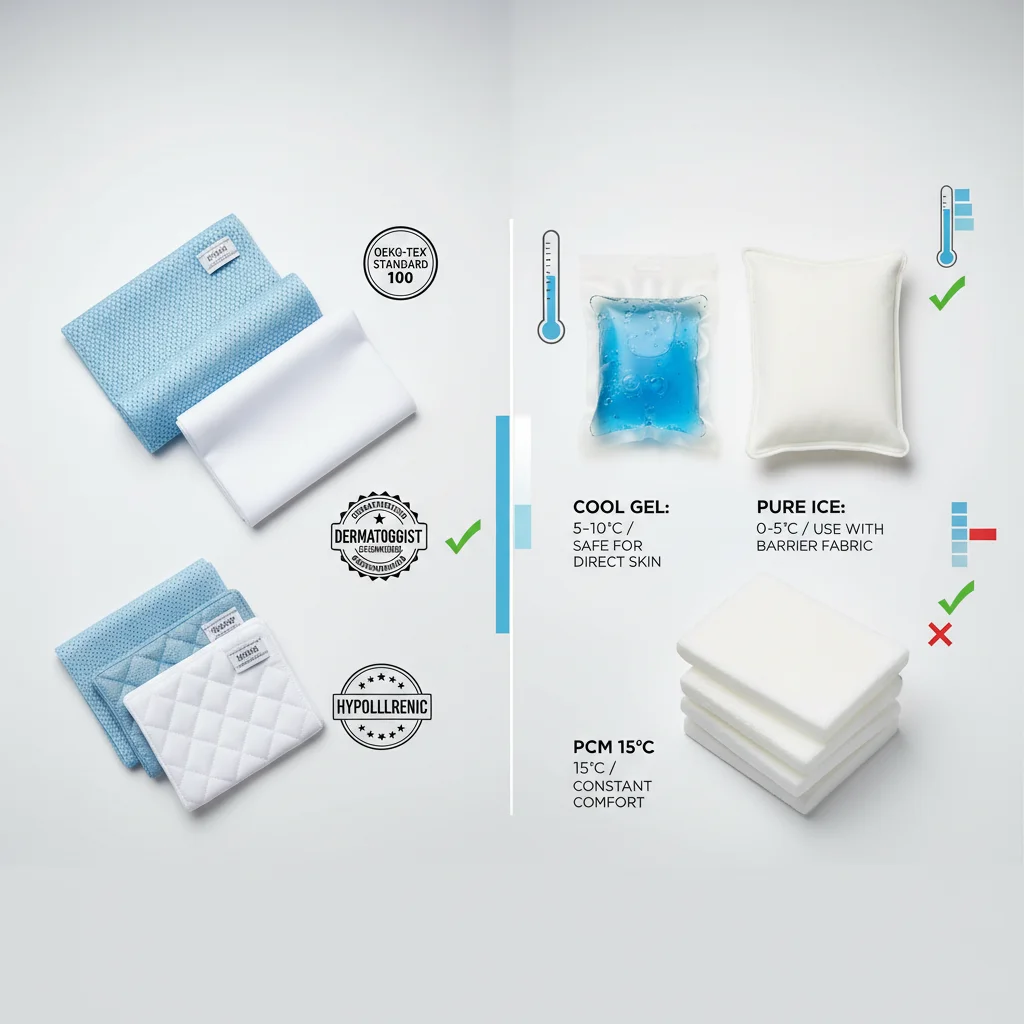
Not all cooling methods work the same way — and for sensitive skin, that gap matters more than most product pages will admit.
The cooling mechanism inside a vest controls two things at once: how well it drops your temperature, and how hard it hits your skin. These two factors push against each other. The most powerful cooling agents tend to carry the highest risk of skin stress. Knowing this trade-off helps you shop smarter.
How Different Cooling Agents Perform — and What That Means for Your Skin
Clinical data on cooling agents gives us something useful here: real temperature numbers, not marketing language.
A controlled 20-minute application study compared four common cooling agents by how much each one reduced skin surface temperature:
|
Cooling Agent |
Temp Reduction |
Minimum Skin Temp |
Skin Risk Profile |
|---|---|---|---|
|
Crushed Ice (CI) |
19.56 ± 3.78°C |
9.2°C |
Sustained cold; risk if applied directly |
|
Wetted Ice (WI) |
16.99 ± 2.76°C |
~10°C |
Holds therapeutic range well |
|
Frozen Peas (FP) |
14.59 ± 4.22°C |
14.61°C |
Moderate; inconsistent sustained effect |
|
Gel Pack (GP) |
13.19 ± 5.07°C |
16.1°C |
Lowest efficiency; highest discomfort risk |
(P<0.001 across all comparisons)
The therapeutic target for meaningful cooling is 10–15°C at the skin surface. That’s the range that triggers about a 50% drop in cellular metabolism. Crushed ice and wetted ice both hit and hold that window. Gel packs don’t.
Here’s the skin-safety problem: gel packs arrive at pre-application temperatures as low as -14°C. That extreme cold pressing against reactive skin — before it even starts working — is the type of contact stress that causes burns, redness, and irritation. High intensity, low efficiency, and high discomfort risk. That’s a bad combination for anyone dealing with eczema or contact sensitivity.
What This Means for Choosing a Cooling Vest
For sensitive skin, here’s the practical breakdown:
-
Phase-change cooling (ice-based) gives you strong, consistent temperature reduction within the therapeutic range — but you need a barrier layer of hypoallergenic, chemical-free fabric between the cooling element and your skin
-
Gel-based vests may seem easier to maintain, but their extreme pre-application temperatures and lower efficiency create a worse risk profile for sensitive users — not a better one
-
Air-based cooling systems work differently. In forearm trials, a cryoflow air device dropped skin temperature from 32.94°C to 16.92°C with no adverse effects and full reversibility — no direct contact material, no chemical finish risk
The cooling technology and the fabric work together — one doesn’t exist without the other. A medical-grade cooling fabric sitting between an ice insert and your skin does real protective work. So if that fabric carries chemical finishes, synthetic dyes, or non-certified processing agents, the cooling mechanism turns into a direct path for potential allergens to reach your skin.
Pick the technology first. Then check every layer that touches your skin.
Material Risk Assessment by Use Case
Pick a cooling vest that fits the conditions you’ll wear it in. This match matters most if your skin is sensitive.
A nurse wearing a vest through a 12-hour hospital shift faces very different skin-contact risks than a construction worker sweating through a two-hour outdoor job. Same product category. Very different exposure profile. The material risk isn’t just about the fabric. It comes from how fabric, duration, sweat volume, and heat load all combine.
Here’s how to read that combination for your own situation.
High-Exertion, Extended Wear (Outdoor Labor, Sports, Military)
Long hours. Heavy sweat. Constant friction against skin. This is the highest-risk category for contact reactions. Not because any single exposure is intense — but because repeated exposure builds up and amplifies everything.
Sweat soaks into fabric treated with chemical finishes — antimicrobial agents, dye fixatives, water repellents. Those compounds don’t stay locked in the fiber. They move outward. Warm, damp skin absorbs more than cool, dry skin. That’s basic physiology. So chemical finishes that feel harmless at first contact can become real irritants by hour three or four of heavy use.
What to look for here:
– OEKO-TEX Standard 100 certification — this covers residual chemicals, dyes, and finishing agents. It’s tested at a level designed for long-term skin contact
– Moisture-wicking fabrics with no antimicrobial treatment — natural wicking is safer than wicking boosted by chemical additives, especially for eczema-prone skin
– Latex-free construction throughout — straps, panels, closures — not just the main fabric panel
Medical and Clinical Settings (Post-Surgical, MS Cooling, Heatstroke Recovery)
Clinical use sets the strictest standard for cooling fabric requirements. Patients in recovery often have weakened skin barriers. Medications like corticosteroids thin the skin even more. Cooling vests in these settings also stay on longer, with less movement — so there’s less natural airflow between fabric and skin.
The allergen risk here isn’t really about sweat. It’s about occlusion. Fabric pressed against skin without airflow for long periods can trigger a localized reaction — even from low-level chemical residues.
For clinical and caregiving use, set a higher bar for verification:
– Request a Material Safety Data Sheet (MSDS) or equivalent documentation from the manufacturer
– Look for vests that carry both OEKO-TEX and GOTS (Global Organic Textile Standard) certification. GOTS covers the full production chain, not just the finished product
– Choose organic cooling vest materials — organic cotton or linen blends — over synthetic options wherever cooling performance allows
Low-Intensity, Intermittent Use (Office, Commuting, Light Activity)
This group carries the lowest overall risk — shorter contact time, less sweat, less friction. But “lower risk” isn’t “no risk.” That gap matters for people with known contact allergies or eczema.
The practical check here is simpler:
-
Verify the vest carries at least one recognized hypoallergenic textile certification
-
Confirm it’s a latex-free cooling garment — latex sensitivity can build up through repeated low-level contact before any clear reaction shows up
-
Look for uncoated, undyed interior panels that touch skin with no coating between them
The honest summary: no single material is safe across every use case. An allergen-free cooling solution for a marathon runner looks different from one built for a hospital patient. Match the material check to the actual wear pattern — that’s where the real risk sits.
Red Flags: Materials and Features to Avoid
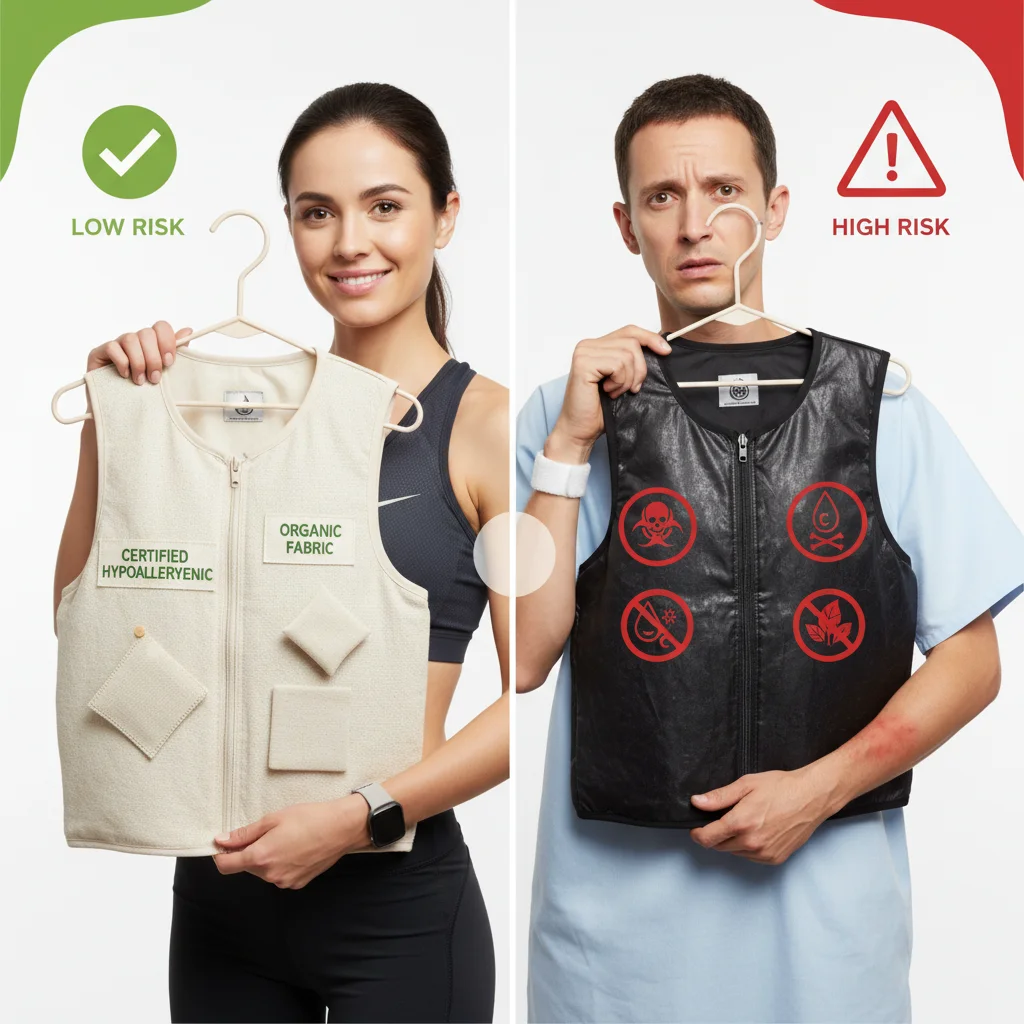
Some cooling vests are built to sell, not to protect. The difference between a vest that soothes and one that triggers a contact-dermatitis flare can come down to a single chemical finish. You’ll never see that finish listed on the product page.
Here’s what to watch for before you hand over your money.
Vague or Missing Material Disclosures
A product listing that says “premium fabric” or “soft inner lining” without naming the actual fiber content — that’s not an oversight. It’s a choice. Reputable hypoallergenic textile manufacturers name their materials clearly — fiber type, blend ratio, and finish treatments. Without that, you can’t evaluate allergen risk at all.
Watch for these specific patterns:
-
No fiber percentage breakdown — “polyester blend” tells you nothing useful
-
“Hypoallergenic” claims with zero certification backing — the word costs nothing to print. An OEKO-TEX or GOTS certification requires real testing and real accountability
-
“Dermatologically tested” without test details — tested how? On whom? At what concentration? An unverifiable claim is not evidence
Chemical Treatments Hidden in Plain Sight
Some treatments are standard in textile manufacturing — and dangerous for sensitive skin. Most manufacturers won’t tell you that upfront.
Avoid vests that use:
-
Formaldehyde-based wrinkle-resistant finishes — a known contact allergen, still common in synthetic blends
-
Antimicrobial chemical coatings (triclosan, silver-based treatments applied through chemical bonding) — marketed as a hygiene feature, but a real irritant risk for eczema-safe cooling vest wearers during extended use
-
Azo dyes on interior panels — certain azo compounds break down into aromatic amines. These are both allergenic and carcinogenic under EU regulations
-
Latex-containing elastic components anywhere in the construction — straps, side panels, closures — not just the main body fabric. A latex-free cooling garment has to be latex-free throughout, full stop
The “Too Soft to Be Dangerous” Assumption
Soft hand-feel is not a safety signal. Some of the most irritating chemical finishes — silicone softeners, optical brighteners — are designed to make fabric feel gentle. That’s the point. It lowers your guard.
A vest that feels extra smooth or looks bright white without a natural-fiber explanation — ask what’s creating that effect. The finish could be the problem, not the solution. For anyone building a true allergen-free cooling solution, that answer matters a lot.
Expert Selection Guide for Hypoallergenic Cooling Vests
One rule applies to every hypoallergenic cooling vest: every material that touches your skin must be verified safe. That includes what’s inside the cooling pack, not just the outer fabric.
Most buyers check the outer fabric and stop there. That’s not enough.
Match the Cooling Insert to Your Skin Safety Standard
The cooling insert affects your allergen exposure just as much as the fabric does. Here’s how the main options break down:
Phase Change Material (PCM) vests are the best starting point for sensitive skin. Inorganic PCM — hydrated salt solutions — melts between 55°F and 65°F. That range stays within the therapeutic cooling window. It won’t push your skin into cold-stress territory. These salts are non-toxic and non-flammable. No chemical barrier between the insert and skin is needed to prevent damage.
Bio-based PCM (derived from vegetable oils) carries the same non-toxic profile. It also has a near-unlimited lifecycle. Two things worth noting: the cost runs higher, and it can ignite at elevated temperatures. Organic petroleum-based PCM is a hard no. It’s toxic, flammable, and flat-out wrong for any direct skin-contact use.
|
PCM Type |
Skin Safety |
Flammability |
Cost |
|---|---|---|---|
|
Inorganic (salts + water) |
Non-toxic |
Non-flammable |
Economical |
|
Bio-based (vegetable oil) |
Non-toxic |
Flammable (high temp) |
Higher |
|
Organic (petroleum) |
Toxic — avoid |
Flammable |
Higher |
Skip ice vests if your skin reacts easily. Direct ice contact creates real frostbite risk. Temperatures drop well below the safe therapeutic range. That cold-stress pattern is what triggers skin damage in sensitive users.
A Practical Four-Point Selection Checklist
Before you commit to any vest, run through these four checks:
-
Confirm non-toxic insert chemistry — inorganic or bio-based PCM are your two safe options. Ask for documentation if the product doesn’t list it.
-
Match cooling duration to your use case — most quality PCM inserts last 2–4 hours. Check that this covers your actual shift or activity window.
-
Check full vest weight — under 5 lbs keeps it practical for long wear. Heavier vests add pressure-point friction over time.
-
Verify climate compatibility — PCM holds up in humidity and extreme heat. Evaporative systems don’t.
Products tested against OSHA and CDC heat illness standards — like ThermApparel’s UnderCool line — give you a third-party benchmark. That goes beyond what a brand says about itself. For sensitive skin, that outside verification matters.
Common Allergy Concerns: Questions Answered

31.7% of American adults live with at least one diagnosed allergy condition — that’s the 2024 CDC number. So this isn’t a niche issue. It’s the reality for most people searching for a safe, skin-friendly cooling technology.
Here are the most common questions.
Can I wear a cooling vest if I have eczema?
Yes — but the material matters. Look for organic cooling vest materials with an OEKO-TEX or GOTS certification. Skip synthetic finishes. Eczema affects 12.7% of children and 7.7% of adults in the US. Women report it at close to double the rate of men. So the bar for your vest goes beyond “softer fabric.” It needs to clear a much higher standard.
Does latex matter if it’s just a strap?
It matters. A lot. Latex sensitivity grows through repeated low-level contact — even small exposures add up. A true latex-free cooling garment covers every single component: straps, closures, side panels. Not just the main body. Partial coverage doesn’t count.
Are “dermatologically tested” claims trustworthy?
Sometimes — but only with specifics behind them. Ask these questions:
– Tested how?
– Tested by whom?
– For how long?
A dermatologically tested cooling vest label with no documented methodology is a marketing claim, not proof. Ask for the actual test data before you trust it.
What if I’ve never had a reaction before?
That can change. Skin sensitization builds over time. Extended wear and heavy sweating speed up that process. That’s the environment a chemical-free cooling fabric is built to handle — protecting skin before a reaction ever starts.
Conclusion
Your skin doesn’t negotiate — and neither should your standards for a cooling vest.
The right hypoallergenic cooling vest isn’t a luxury. It’s a basic requirement for anyone with sensitive skin, eczema, or allergy concerns. Look for cooling vests that passed skin safety testing and carry certifications like Oeko-Tex Standard 100. Avoid latex, synthetic dyes, and chemical-heavy PCM treatments. Ask manufacturers for clear material data. These steps don’t just get you a product — they protect you from avoidable reactions.
The good news? Safe options exist. You now know what to look for, what to question, and what to walk away from.
Put this knowledge to work before your next purchase:
-
Run through the material checklist
-
Verify certifications on the Oeko-Tex database
-
Request fabric specifications from sellers if they aren’t listed
Cool, comfortable, and reaction-free — that combination is within reach.